Parsing Archi Models in TypeScript
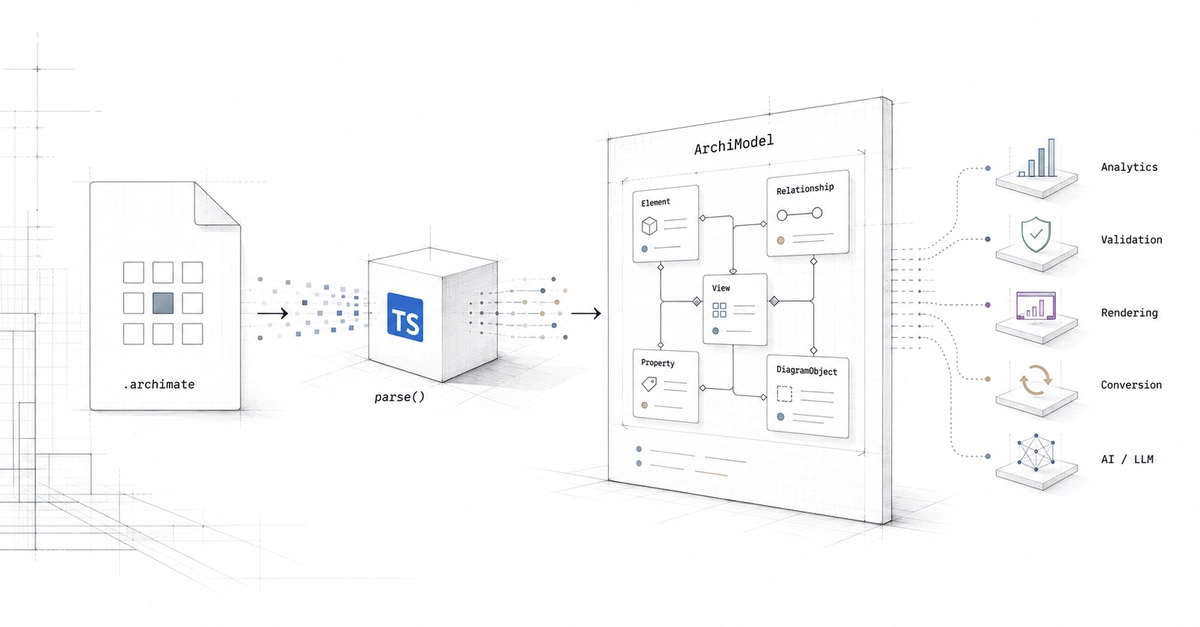
Archi, a popular open-source tool for creating ArchiMate models, stores its project data in .archimate files. These files, while human-readable as XML, contain the full spectrum of model information: elements, relationships, views, diagram objects, properties, and geometric data. Until now, accessing and manipulating this data programmatically from applications, particularly those built with TypeScript, has been a significant hurdle.
Enter archi-semantic-core, a new library developed by the Continuous Driven Architecture (CDA) team. This package provides a direct bridge, enabling developers to read and interact with ArchiMate models from their TypeScript projects without needing to decipher the underlying XML structure. It abstracts away the complexities of Archi's internal representation, offering a clean API to the semantic content of the models.
The primary function for interacting with these models is parseArchiModel. This function takes the path to an .archimate file as input and returns a structured representation of the model. This representation includes all the core components that define an ArchiMate model, making it accessible for analysis, transformation, or integration into other systems.
Installation and Basic Usage
Getting started with archi-semantic-core is straightforward. The package is available on npm, and installation is as simple as running:
npm install @cda/archi-semantic-core
Once installed, developers can import the necessary functions and begin parsing their ArchiMate models. The core operation, parseArchiModel, is the entry point. It processes the .archimate file and returns a comprehensive JavaScript object representing the model's semantic core.
Consider a scenario where you have an ArchiMate model representing your enterprise architecture. You might want to generate documentation, perform impact analysis on proposed changes, or integrate architectural data into a dashboard. Previously, this would involve manual export and processing, or complex custom XML parsing. With archi-semantic-core, this process becomes programmatic. You can load the model, iterate through its elements (like Business Actors, Applications, or Technology components), examine their relationships (e.g., Assignment, Realization), and even access custom properties defined within Archi.
The library aims to provide a developer-friendly way to leverage the rich information contained within ArchiMate models. This opens up possibilities for automated architectural governance, dynamic visualization tools, and custom reporting that goes beyond the standard capabilities of the Archi editor itself.
Working with Model Components
The output of parseArchiModel is a structured object that mirrors the semantic relationships and entities within an ArchiMate model. This object typically contains collections of elements, relationships, and views. Developers can then traverse these collections to extract specific information.
For instance, to find all Business Actors in a model, a developer could access the elements collection and filter by type. Similarly, to understand how an Application Component is realized by a specific Technology Service, one would query the relationships collection, looking for the appropriate relationship type and connecting elements.
The library's design prioritizes ease of use. It abstracts the XML parsing, providing a clean, object-oriented interface to the model's content. This means developers can focus on the architectural logic and insights they want to derive, rather than the mechanics of file parsing and data extraction. This is particularly valuable for teams that use ArchiMate for enterprise architecture management and need to integrate this data into broader software development workflows or CI/CD pipelines.
The potential applications are vast. Imagine a system that automatically checks for compliance with architectural standards by analyzing the relationships and properties within an Archi model. Or a tool that generates a simplified, domain-specific view of a complex architecture for different stakeholder groups. archi-semantic-core provides the foundation for building such custom solutions.
Future Implications and Use Cases
The introduction of archi-semantic-core addresses a long-standing need for programmatic access to ArchiMate models. Its availability in TypeScript makes it particularly relevant for the modern web development ecosystem, where TypeScript is prevalent.
This library can serve as a crucial component in developing custom enterprise architecture tooling. It bridges the gap between visual modeling tools and the automated systems that can benefit from architectural data. For example:
- Automated Documentation Generation: Extracting model details to create up-to-date architectural documentation.
- Impact Analysis: Programmatically assessing the ripple effects of changes to specific architectural elements.
- Compliance Checking: Verifying adherence to architectural principles and standards by analyzing model structure and properties.
- Integration with DevOps Toolchains: Feeding architectural insights into CI/CD pipelines or configuration management systems.
- Custom Visualization Tools: Building bespoke dashboards or viewers that present architectural information in tailored ways.
The library effectively transforms ArchiMate models from static diagrams into dynamic data sources that can be queried, analyzed, and manipulated by software. This unlocks new possibilities for how organizations manage and leverage their enterprise architecture, making it a more integrated and actionable part of their digital strategy.
While the library currently focuses on parsing, future developments might include capabilities for modifying models programmatically, further enhancing its utility for automated architecture management. The ability to read and understand the semantic core of ArchiMate models from TypeScript is a significant step forward for developers and architects alike.