Understanding Agent Context and Tooling
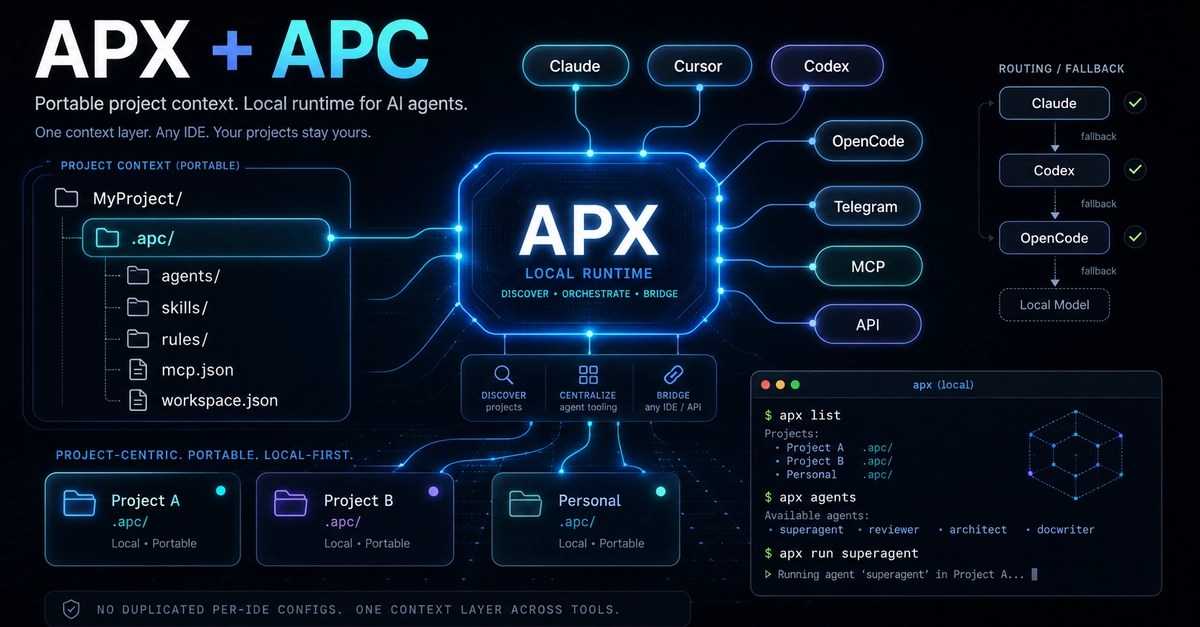
When defining agents within the Agent Project Context (APC) framework, a critical distinction exists in how the tools field is handled. APX, the runtime and tooling layer, interprets the presence or absence of the tools field in an agent definition to determine its operational scope. The core principle is to ensure agent definitions describe a durable, consistent role rather than a temporary snapshot of the available runtime tools. This approach promotes portability and predictability in agent behavior across different environments.
The rule is straightforward: omit the tools field when the agent should leverage APX's broad project-agent default capabilities. Conversely, declare a non-empty list for tools only when you intentionally intend to restrict the agent to a specific, narrower set of callable functions. This deliberate choice creates a clear separation between the portable context layer (APC, stored in files like .apc/agents/\[slug\].md) and the dynamic runtime layer (APX, which resolves these definitions against the tools available on the current machine).
Omission Preserves Capability and Flexibility
Consider the implications of creating an agent without explicitly declaring its tools. When the tools field is omitted from an agent definition, APX assumes the agent should inherit the system's default toolset. This default is typically comprehensive, encompassing all callable tools available within the project's context. This broad access allows the agent to be more versatile and adaptable, as it can draw upon a wider range of functionalities without explicit configuration. This is particularly beneficial for general-purpose agents or those designed to handle a variety of tasks that might not be known in advance.
The absence of a declared tools list effectively signals to APX that the agent's role is defined by its purpose and context, not by a specific, pre-selected toolkit. This makes the agent definition more robust and less prone to breaking when the underlying environment or tool availability changes. If a tool that was previously declared becomes unavailable, an agent relying on an explicit list might fail. An agent that omits the tools field, however, can seamlessly adapt to new tool availability, provided those tools align with the agent's broader purpose and the project's default context. This design philosophy prioritizes agent longevity and adaptability over rigid, environment-specific configurations.
For instance, imagine an agent tasked with general code analysis. If its definition omits the tools field, it can utilize any code analysis tools available in the project, whether that’s a static analyzer, a linter, or a code formatter. If a new, more advanced code analysis tool is added to the project later, the agent can immediately leverage it without any modification to its definition. This contrasts sharply with an agent that explicitly lists only the old tools; such an agent would require an update to its definition to benefit from the new tool.
Declaring Tools for Specificity and Control
Conversely, declaring a non-empty tools list is a deliberate act of restriction. When you provide a specific list of tools, you are instructing APX to limit the agent's capabilities exclusively to those enumerated functions. This is crucial when you need an agent to perform a very specific, well-defined task and want to prevent it from accessing or attempting to use other available tools. This approach enhances security, predictability, and maintainability for specialized agents.
Think of this like hiring a specialist versus a general practitioner. If you need a heart surgeon, you don't want them to also be performing appendectomies unless that's part of their explicit, declared skillset for a particular procedure. Declaring the tools field is akin to specifying that the surgeon's role in this instance is strictly cardiac-related. This ensures the agent operates within its intended boundaries, reducing the risk of unintended side effects or errors that could arise from accessing extraneous functionalities.
A practical example would be an agent designed solely for automated testing. If the project has multiple testing frameworks installed, but this specific agent is only intended to run unit tests using a particular framework, its definition should explicitly list only the tools associated with that unit testing framework. This prevents the agent from accidentally triggering integration tests, end-to-end tests, or other types of test suites, which might have different requirements or side effects. This precise control is invaluable for ensuring that automated processes execute exactly as intended, without deviation.
Bridging APC and APX
The distinction between omitting and declaring the tools field serves as a critical bridge between the portable context layer (APC) and the runtime layer (APX). APC agent definitions, often stored in Markdown files within the .apc/agents/ directory, are designed to be environment-agnostic. They define the agent's role, purpose, and potentially its desired capabilities in a abstract manner.
APX then takes these abstract definitions and grounds them in the reality of the current execution environment. When APX encounters an agent definition, it inspects the tools field. If the field is absent, APX resolves the agent against the full spectrum of available tools. If the field is present and populated, APX filters the available tools, allowing the agent to interact only with the specified subset. This mechanism allows developers to create agent definitions that can be shared and reused across different projects and environments, while still maintaining fine-grained control over their execution when necessary.
This layered approach ensures that agent definitions remain stable and portable. A developer can define an agent's core function in APC once. Then, in APX, they can choose whether to let that agent operate with maximum flexibility by omitting tools, or to constrain it to a specific set of operations by declaring tools. This separation of concerns makes agent development more modular and less brittle.
Best Practices for Agent Definition
Adhering to the principle of declaring tools only when narrowing an agent's scope leads to more robust and maintainable AI systems. For general-purpose agents or agents intended to adapt to evolving project needs, omitting the tools field is the recommended approach. This preserves flexibility and ensures the agent can take advantage of new tools as they become available.
For agents that perform highly specific, critical functions where deviation could be detrimental, explicitly declaring the allowed tools is essential. This provides a clear contract for the agent's behavior and enhances system reliability and security. Developers should consider the intended lifespan and operational context of each agent when making this decision. A temporary agent for a one-off task might benefit from explicit tool declaration, while a long-term, evolving agent should likely omit it to maintain adaptability.
Ultimately, the judicious use of the tools field in APX agent definitions allows for a powerful combination of portability and precise control, enabling developers to build more sophisticated and reliable AI-powered applications.