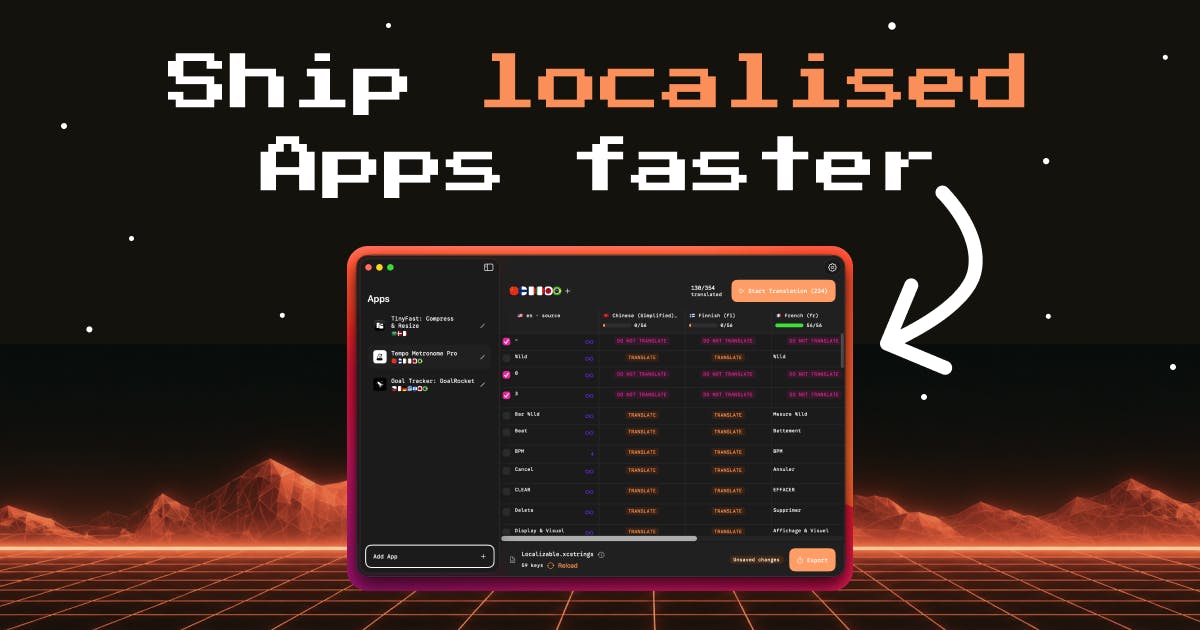
Streamlining Global App Deployment with AppUFO
AppUFO has officially launched, introducing a new AI-powered platform designed to significantly speed up the process of localizing mobile applications. The service targets developers and product teams seeking to expand their reach into international markets without the traditional bottlenecks of manual translation and quality assurance. The core promise is to ship localized apps faster, leveraging artificial intelligence to handle the complexities of linguistic and cultural adaptation.
Localization is no longer a nice-to-have; it's a critical component of global product strategy. Apps that speak the user's native language and understand cultural nuances see higher engagement, retention, and ultimately, better monetization. However, the process can be resource-intensive, involving teams of translators, project managers, and QA testers. AppUFO positions itself as a solution to this challenge, aiming to make localization more accessible and efficient.

How AppUFO Leverages AI for Localization
At its heart, AppUFO employs advanced AI models to automate key aspects of the localization workflow. The platform integrates with app development pipelines to extract text strings and other translatable content. These strings are then processed by AI translation engines, which have been trained on vast datasets to provide contextually relevant and accurate translations across a wide array of languages. This initial AI-driven translation serves as a foundational layer, drastically reducing the time and cost associated with human-only translation.
Beyond raw translation, AppUFO focuses on maintaining consistency and quality. AI algorithms are used to identify and manage repetitive phrases, ensuring that terminology remains uniform throughout the application. This is crucial for brand consistency and user experience. The platform also offers features for managing glossaries and style guides, allowing teams to define specific terminology and tone of voice that the AI should adhere to.
A significant hurdle in localization is ensuring that translations are not only linguistically correct but also culturally appropriate. AppUFO aims to address this by incorporating AI models that can detect potential cultural missteps or awkward phrasing. While human review remains an essential part of the process, the AI's ability to flag sensitive content or identify idiomatic expressions that may not translate directly helps human reviewers focus their efforts on the most critical aspects, rather than sifting through every single translated string.
Integrating with Development Workflows
AppUFO is designed with developers in mind, emphasizing seamless integration into existing workflows. The platform supports common localization file formats, such as `.strings` (iOS), `.xml` (Android), and JSON, enabling easy import and export of translation data. Furthermore, it offers integrations with popular version control systems like Git, allowing for automated updates and synchronization of localized content as the app evolves.
This integration is key to AppUFO's value proposition. By connecting directly to code repositories or CI/CD pipelines, the platform can trigger localization updates automatically whenever new text is added or modified in the source code. This eliminates the manual effort of extracting, translating, and re-integrating strings, which is often a major bottleneck in agile development environments. Teams can push updates to their app's localization in parallel with feature development, rather than treating it as a separate, time-consuming phase.
The platform also provides a collaborative interface for human translators and reviewers. This dashboard allows teams to oversee the entire localization process, track progress for each language, and assign tasks. Human reviewers can edit AI-generated translations, provide feedback, and approve final versions. This hybrid approach, combining AI efficiency with human oversight, is intended to strike a balance between speed, cost, and quality.
The Future of App Localization?
AppUFO enters a market that is increasingly recognizing the importance of global reach. While many tools exist for managing translation files, the explicit focus on AI-driven automation from extraction to review for mobile apps is a notable differentiator. The challenge for AppUFO will be to prove that its AI can consistently deliver high-quality translations that meet the nuanced demands of diverse markets, without requiring excessive human intervention.
What remains to be seen is how effectively AppUFO's AI can handle highly technical jargon or creative marketing copy, which often require deep domain expertise or a flair for language that AI still struggles to replicate. The success of the platform will likely hinge on its ability to strike the right balance between AI automation and the indispensable human touch, making it a valuable tool for rapid global expansion rather than a complete replacement for human localization professionals.