The Testing Blind Spot
Engineering teams often report confidence in their API testing. They cite automated pipelines running on every pull request and seemingly solid coverage metrics. Yet, critical bugs still slip into production, bugs that the automated pipeline should have caught. When teams investigate these failures, the root cause is rarely that tests didn't run. Instead, it's that the tests simply didn't cover the specific scenarios that failed. This gap, often invisible to teams unless they actively look for it, is precisely what API testing maturity models aim to define.
The core issue lies in how teams conceptualize and implement API testing. They often conflate different aspects of testing, leading to an incomplete picture of their application's robustness. This is akin to a chef meticulously measuring ingredients but neglecting to taste the dish before serving. The components are there, but the final product might be fundamentally flawed.
The Two Axes Teams Don't Separate
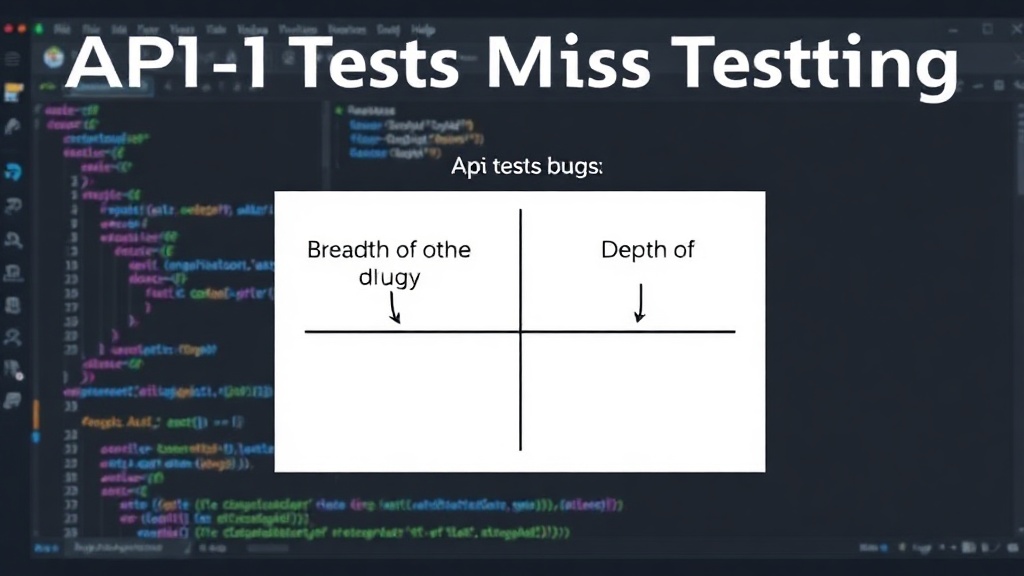
When discussing API testing improvements, people typically mean one of two things but rarely clarify which: the scope of what is tested, or the depth of how it's tested. These are the two critical axes that most teams fail to separate, leading to blind spots.
The first axis concerns what behaviors your tests actually exercise. This includes everything from basic happy paths and field validation to more complex scenarios like schema conformance, error handling, and business logic validation. A team might have extensive tests for basic CRUD operations but lack tests for edge cases, concurrency issues, or specific business rule violations. This is the breadth of the testing surface.
The second axis is how deeply each behavior is tested. This relates to the rigor and comprehensiveness of the test cases themselves. Are tests checking for expected outcomes only? Or are they also probing for unexpected side effects, security vulnerabilities, performance degradation under load, or compliance with specific standards? This is the depth of the testing fidelity.
The Impact of Separating the Axes
Consider a team that believes they have excellent API test coverage because they've written tests for every endpoint. They might have tests verifying that a POST request to `/users` with valid data returns a 201 Created status. This covers the 'what' at a basic level. However, if this team doesn't also test how that creation affects other parts of the system – for instance, if it correctly triggers downstream notifications or updates related user profiles without race conditions – then their testing is superficial.
This is where the maturity model comes into play. It provides a framework to systematically evaluate testing practices across both axes. A low maturity level might indicate tests that only cover happy paths (narrow 'what') and only check for basic success responses (shallow 'how'). A high maturity level would involve tests that cover a wide range of behaviors, including edge cases and error conditions (broad 'what'), and employ deep, rigorous checks for each behavior, potentially including fuzzing, performance testing, and security validation (deep 'how').
Identifying Your Blind Spots
To find the gap, teams must consciously separate these two dimensions. Ask yourselves:
- For 'What' (Breadth): What are all the potential behaviors and outcomes of this API? Have we tested:
- Happy paths?
- All expected error conditions (e.g., invalid input, unauthorized access)?
- Schema conformance?
- Business logic rules?
- State changes and side effects on other parts of the system?
- Concurrency and race conditions?
- Interactions with external dependencies?
- For 'How' (Depth): For each behavior tested, how thoroughly are we checking the outcome? Are we just checking:
- A 2xx status code?
- Basic schema validation?
- Or are we also checking:
- The exact structure and content of the response body?
- The absence of sensitive information in error messages?
- The state of the system *after* the operation (e.g., database changes, cache updates)?
- Performance under load?
- Security implications (e.g., injection vulnerabilities, broken access control)?
A team might have 100% schema conformance tests, which is good breadth for that specific aspect. But if they have zero tests for business logic validation or error handling, their overall 'what' coverage is incomplete. Similarly, a team might have tests for all error conditions ('what'), but if those tests only check for a generic 400 error without verifying the specific error message or code, the 'how' is shallow.
Moving Towards Higher Maturity
The goal is to achieve high coverage across both axes. This means not only testing a wide array of API behaviors but also testing each behavior with increasing depth and rigor. This doesn't necessarily mean writing exponentially more tests. It means writing more effective tests that probe deeper into the system's behavior and resilience.
For instance, instead of just testing that a user can be created, a more mature test suite would also verify:
- The user creation event triggers an asynchronous email confirmation.
- The user's default profile settings are correctly initialized.
- Attempting to create a user with a duplicate email address returns a specific, informative error (e.g., 409 Conflict with `{