
The Hidden Cost of Lingering APIs
Internal APIs often carry a sunset date, a deadline for their eventual retirement. However, the reality rarely aligns with these plans. Key challenges emerge: identifying every consumer becomes impossible, traffic persists past the deadline, and exceptions lack clear ownership. This situation creates what is known as migration debt. It’s the silent accumulation of costs and risks associated with maintaining outdated API versions long after they should have been decommissioned.
This debt manifests in several ways. Engineering teams spend valuable time on-call for legacy services that should be retired. Security teams struggle to patch vulnerabilities in systems that are no longer actively managed or understood. Business units might rely on undocumented integrations, creating business continuity risks if the API suddenly fails. The longer an API lingers past its intended lifespan, the greater the complexity and the higher the cost of eventual migration, if it ever happens.
The core problem is a lack of visibility. Without a clear understanding of who is using the API and how, it's impossible to accurately plan for its deprecation. This leads to reactive decision-making, missed deadlines, and a continuous cycle of technical debt. The sunset date becomes a suggestion, not a firm commitment, as the effort to truly retire the service feels insurmountable.
Establishing an API Deprecation Ledger
To combat this, a structured approach is necessary. The first step is to establish a single, authoritative ledger for tracking API deprecation. This ledger should serve as the central source of truth for all information related to an API's lifecycle, particularly its sunsetting process. It needs to capture essential details about each API consumer and the associated costs of maintaining the old service.
A well-structured ledger typically includes columns for the consumer's name, their monthly call volume, the assigned owner (team or individual), estimated migration hours required, an exception end date (if applicable), and the last seen date for traffic. This data provides a granular view of API usage and dependencies.
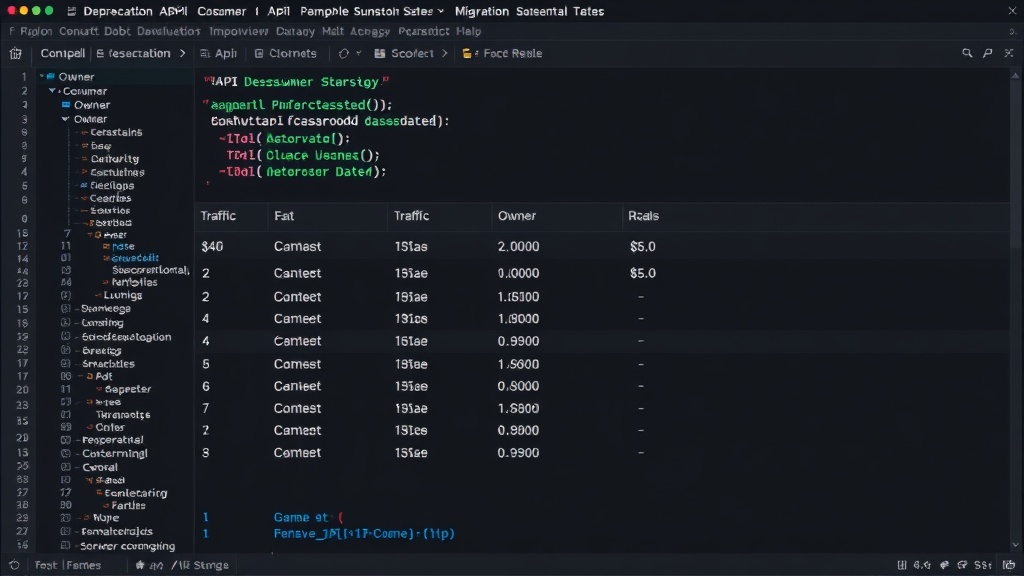
Consider this sample ledger entry:
consumer,monthly_calls,owner,migration_hours,exception_until,last_seen
billing-ui,120000,team-a,24,,2026-07-18
legacy-export,80,team-b,40,2026-08-15,2026-07-17
unknown,9300,,unknown,,2026-07-18
The 'unknown' entry highlights a common and critical issue: traffic from sources that cannot be identified. This requires proactive investigation to determine the source and impact, often involving network traffic analysis or application logging.
Quantifying the Costs of Migration Debt
Simply tracking usage isn't enough. To make a compelling case for deprecation and secure resources, the financial implications must be quantified. Migration debt can be broken down into three primary cost categories:
- Migration Cost: This is the direct cost of re-platforming or updating the consuming applications. It's typically calculated as
estimated_hours * loaded_hourly_rate. This captures the engineering effort required to move off the old API. - Run Cost: This encompasses the ongoing operational expenses of keeping the old API alive. It includes infrastructure costs (servers, databases, networking), on-call support rotations, and any security maintenance or patching required.
- Delay Cost: This is the cost incurred due to the continued existence of the old API. It's a combination of the monthly run cost and a risk reserve. The risk reserve accounts for potential issues like security breaches, unexpected outages, or the increased complexity and cost of a delayed migration.
Calculating these costs provides a clear financial picture. For instance, a high monthly run cost on an API with significant 'unknown' traffic indicates a substantial risk that is not being adequately addressed. The delay cost then represents the compounding penalty for not addressing the migration promptly.
Strategic Scenarios and Risk Management
When dealing with APIs, especially those with unknown consumers or uncertain migration paths, a single cost estimate is insufficient. It's crucial to model different scenarios to understand the potential range of outcomes. This involves running downside, expected, and upside scenarios for the migration effort and associated costs.
The 'unknown' traffic category is particularly sensitive. For these cases, it's vital to conduct thorough investigations. This might involve deep packet inspection, analyzing application logs for originating services, or even temporarily throttling traffic to identify callers. The goal is to reduce the 'unknown' as much as possible before the sunset date. If some traffic remains unassigned, a higher risk reserve within the delay cost calculation is prudent.
By actively maintaining this ledger and quantifying the associated costs, organizations can move from a reactive, debt-laden state to a proactive, managed deprecation strategy. This ensures that sunset dates are met, migration debt is controlled, and valuable engineering resources are focused on innovation rather than maintaining the past.