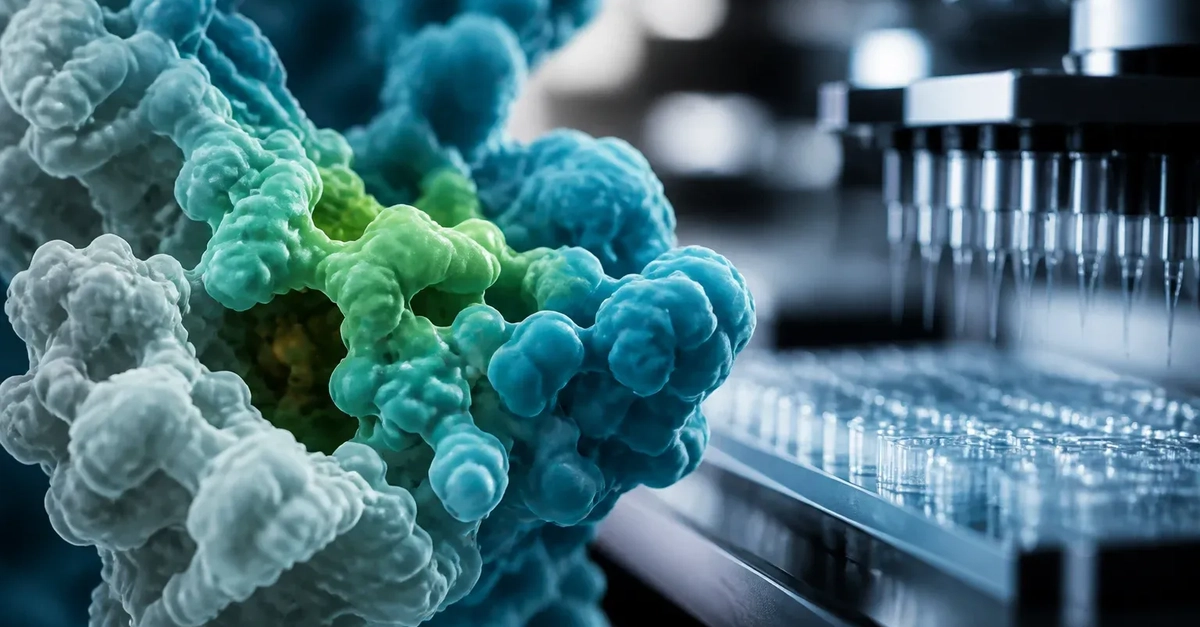
AI Enters the Lab: A Novel Approach to Protein Design
Anthropic and Adaptyv Bio have launched a groundbreaking protein design competition that moves beyond theoretical generation to experimental validation. This initiative uniquely integrates Claude-enabled biology models with automated wet-lab testing, cloud computing support, and significant funding. The goal is to create a comprehensive, end-to-end program for teams tackling complex protein-design challenges.
The competition focuses on five specific protein-design challenges. Participants can earn substantial rewards, including up to $1 million in Claude credits, additional funding for experimental validation through Adaptyv Bio, and up to $250,000 in Modal compute credits. Twist Bioscience is providing the necessary DNA synthesis for the project.
What sets this competition apart is its direct pathway from AI-generated design to physical testing. Historically, AI models have excelled at generating novel sequences, but the bottleneck has always been the slow, expensive process of synthesizing and testing these designs in the real world. This program aims to dismantle that barrier by embedding wet-lab validation directly into the AI development cycle.
Leveraging Claude for Biomolecular Modeling
Anthropic's Claude, a large language model, is being adapted for sophisticated biomolecular modeling. This isn't just about predicting protein structures; it's about designing proteins with specific, desired functions. The competition leverages Claude's advanced reasoning and generative capabilities to propose novel protein sequences tailored to solve predefined biological problems.
According to Anthropic's research, Claude has demonstrated significant uplifts in biomolecular modeling tasks. This suggests that large language models, when fine-tuned or prompted with specialized biological knowledge, can act as powerful co-pilots for synthetic biologists. The competition provides a real-world proving ground for these capabilities, pushing the boundaries of what AI can achieve in drug discovery, enzyme engineering, and materials science.
The competition structure encourages collaboration between AI expertise and biological understanding. Teams will likely need to combine prompt engineering skills for Claude with deep knowledge of protein folding, function, and experimental biochemistry to succeed. This holistic approach is crucial because protein design is not merely a sequence generation problem; it requires an understanding of complex biophysical interactions.
The Experimental Validation Pipeline
Adaptyv Bio is central to the competition's experimental validation component. They are providing the infrastructure and expertise to synthesize and test the AI-generated protein designs. This automated wet-lab testing is what elevates the competition beyond a typical AI challenge.
The process will likely involve:
- AI Design Generation: Teams use Claude and their biological insights to design protein sequences for specific challenges.
- Sequence Synthesis: Twist Bioscience synthesizes the DNA encoding these designed proteins.
- Cloning and Expression: Adaptyv Bio's automated systems clone the DNA and express the proteins in suitable host organisms (e.g., bacteria, yeast).
- Experimental Testing: The expressed proteins undergo rigorous experimental assays to evaluate their function, stability, and other desired properties.
- Feedback Loop: Results from experimental validation are fed back to the teams, informing future design iterations.
This end-to-end pipeline, supported by Modal's cloud infrastructure, significantly accelerates the discovery cycle. It allows for the rapid iteration and optimization of AI-generated designs, something that has been a major hurdle in computational protein engineering.
Competition Details and Incentives
The competition is structured around five distinct protein-design challenges. These challenges are designed to be difficult and impactful, requiring innovative solutions that push the state of the art in protein engineering.
The incentives are substantial, designed to attract top talent and ambitious projects:
- Claude Credits: Up to $1 million in credits for using Anthropic's Claude models. This allows teams to explore extensive design spaces and run complex simulations or generative tasks.
- Experimental Validation Funding: Additional funding from Adaptyv Bio to cover the costs associated with synthesizing and experimentally testing their designs. This removes a major financial barrier for many research groups.
- Compute Credits: Up to $250,000 in Modal compute credits. This supports the computational heavy lifting required for AI model training, fine-tuning, and large-scale inference.
- DNA Synthesis: Provided by Twist Bioscience, ensuring that the foundational building blocks for experimental validation are readily available.
The scale of experimental validation is impressive: the competition aims to experimentally validate more than 5,000 AI-generated designs. This volume is unprecedented and will generate a rich dataset for future AI model training and biological understanding.
The Future of AI in Biology
This competition represents a significant step forward in the application of AI to biological design. By bridging the gap between AI generation and experimental validation, Anthropic and Adaptyv Bio are accelerating the pace of innovation in synthetic biology.
The success of this initiative could pave the way for similar programs in other areas of biological engineering, such as drug discovery, enzyme development for industrial processes, and the creation of novel biomaterials. It demonstrates a viable model for how AI language models can be directly integrated into laboratory workflows, transforming scientific research and development.
What remains to be seen is how effectively the AI models can generalize across different types of protein design challenges and how the data generated from this large-scale experimental validation will be used to further train and improve future generations of biomolecular AI models.