The Problem with Traditional Admin Panels
Spinning up internal tools or admin dashboards often involves a familiar, frustrating process. Developers typically start by hunting for a pre-built template. Once installed, the node_modules folder balloons to hundreds of megabytes. This is often accompanied by a tangled mess of BehaviorSubject chains, legacy RxJS logic, and a heavy-duty component library that actively resists custom styling. The result is a project that feels bloated, difficult to maintain, and slow to iterate on.
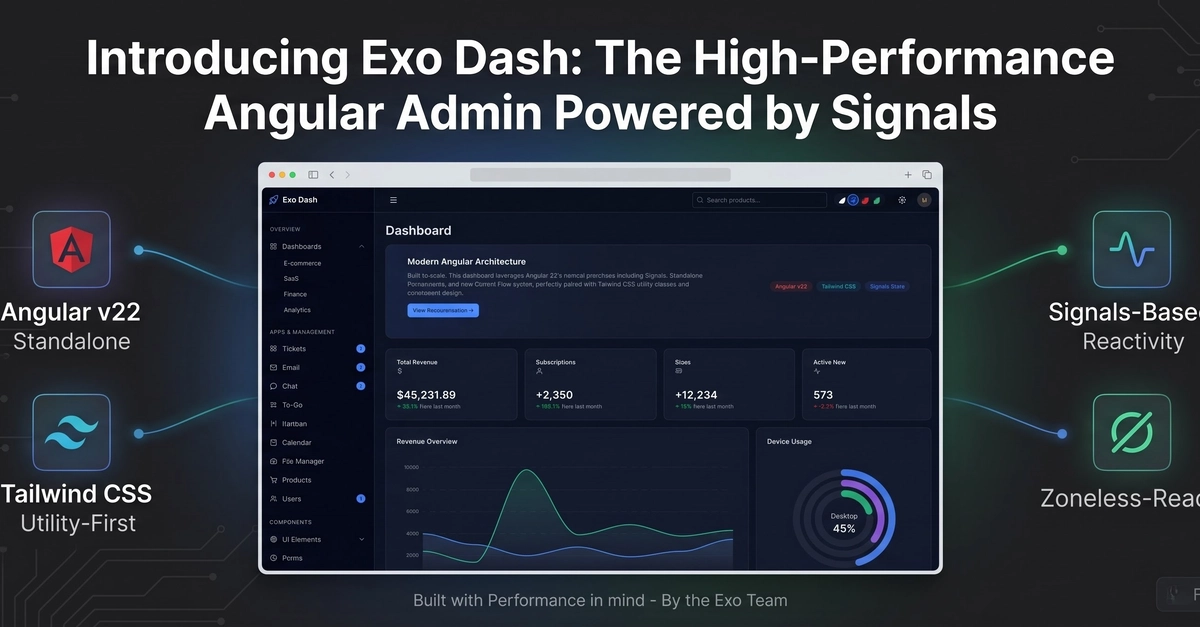
This was the exact problem [Developer Name] set out to solve with Exo-Dash. The goal was to create a dashboard starter kit that eschewed these common pitfalls. It needed to be lightweight, embrace modern Angular architecture—specifically Standalone Components and Signals—and offer a clean, sharp aesthetic out-of-the-box without the typical UI library impedance mismatch.
Shifting UI State Management with Signals
Angular Signals represent a fundamental shift in how UI state is managed within Angular applications. While RxJS remains a powerful tool for handling complex asynchronous data streams and intricate event sequences, using it for simple UI state toggles—like managing a sidebar's visibility or tracking a dark-mode preference—is often unnecessary overhead. Signals provide a more direct, efficient, and performant way to handle these granular state changes.
The core idea behind Signals is reactivity at a fine-grained level. Instead of relying on observable streams that can introduce complexity and potential performance bottlenecks for simple state, Signals offer a simpler primitive. A signal is a function that, when called, returns its current value. When that value changes, Angular can intelligently re-render only the parts of the UI that depend on that specific signal. This granular reactivity drastically reduces unnecessary computations and change detection cycles, leading to a snappier user experience and improved performance, especially in large or complex applications.
For Exo-Dash, this meant re-evaluating how common UI states were managed. Instead of reaching for BehaviorSubject to track whether a modal was open or a dropdown was active, a simple signal variable suffices. This approach simplifies component logic, reduces dependencies on RxJS operators for non-stream-based data, and makes the codebase easier to reason about. The developer's experience is enhanced as they can focus on the application's core logic rather than wrestling with reactive plumbing for simple state.
Leveraging Standalone Components
The adoption of Standalone Components in Angular has further streamlined the architecture of applications like Exo-Dash. Previously, Angular applications relied heavily on NgModules to organize and declare components, directives, and pipes. While NgModules provided a structured way to manage dependencies, they could also lead to boilerplate and a more complex mental model, especially for smaller, self-contained features.
Standalone Components, introduced in Angular v14 and progressively enhanced, allow developers to create components, directives, and pipes without the need for a corresponding NgModule. Each standalone piece of UI can declare its own dependencies directly, making it more self-contained and easier to understand. This approach aligns perfectly with building modular and performant applications.
For Exo-Dash, this meant that each component—whether it's a chart, a data table, a navigation item, or a form input—could be defined and imported directly where needed. This eliminates the NgModule overhead, reduces the bundle size by only including necessary code, and simplifies the bootstrapping process of the application. It allows for a cleaner separation of concerns and makes it easier to manage dependencies at the component level. Developers building on Exo-Dash can easily adopt or replace individual components without needing to navigate complex NgModule hierarchies.
Styling with Tailwind CSS
The choice of Tailwind CSS as the styling foundation for Exo-Dash addresses the common pain point of fighting with UI libraries. Tailwind is a utility-first CSS framework. Instead of writing custom CSS rules for every element, developers compose interfaces by applying pre-defined utility classes directly in the HTML markup. This approach offers several key advantages for a dashboard starter kit:
- Rapid Prototyping and Development: Quickly assemble interfaces by combining utility classes. This significantly speeds up the initial development and iteration cycles.
- Consistent Design System: Tailwind's configuration file allows for defining a consistent design system (colors, spacing, typography). This ensures a cohesive look and feel across the entire application without manual enforcement.
- No CSS-in-JS or Selector Conflicts: Unlike some component libraries or CSS-in-JS solutions, Tailwind generates highly optimized, atomic CSS. There are no naming collisions or specificity wars, and it avoids the performance overhead associated with dynamic style generation at runtime.
- Customization without Fighting: While providing a robust set of utilities, Tailwind is highly customizable. Developers can extend or modify the default configuration to match their specific brand or design requirements. Crucially, it doesn't impose a rigid component structure that fights custom styling efforts.
By integrating Tailwind CSS, Exo-Dash provides a clean slate for styling. Developers can leverage the utility classes for rapid development or extend the configuration to build custom components that integrate seamlessly. This avoids the common scenario where a heavy component library dictates styling and requires significant effort to override or adapt.
Architectural Benefits and Performance
The combination of Angular Signals, Standalone Components, and Tailwind CSS yields significant architectural benefits. The application becomes inherently more modular and easier to scale. State management is simplified and more performant due to Signals. Component management is cleaner with Standalone Components, reducing boilerplate and improving maintainability.
From a performance perspective, the benefits are substantial. Signals minimize unnecessary re-renders. Standalone Components ensure only necessary code is included in the final bundle. Tailwind CSS generates minimal, optimized CSS. This contrasts sharply with traditional approaches that often lead to bloated JavaScript bundles, excessive change detection, and large CSS stylesheets.
Exo-Dash is positioned not just as a visual template, but as a foundational architecture for modern Angular applications. It provides a blueprint for building internal tools and dashboards that are performant, maintainable, and developer-friendly, moving away from the common pain points of legacy architectures.