A New Approach to Real-Time Ray Tracing Complexity
Rendering massive amounts of animated geometry with ray tracing has long been a significant computational hurdle. Traditional methods often struggle to keep pace with the dynamic nature of scenes, where objects constantly move, deform, and intersect. This limitation has restricted the fidelity and complexity of real-time ray-traced applications, particularly in fields like gaming, simulation, and virtual production. AMD's recent technical paper introduces a novel technique leveraging tetrahedral cages to efficiently manage and trace rays through these highly dynamic environments, promising a substantial leap in performance and visual quality.
The core innovation lies in how the system represents and queries animated geometry. Instead of directly tracing rays against the potentially millions of triangles that constitute complex animated meshes, AMD's approach uses a hierarchical structure of tetrahedral cages. These cages act as bounding volumes, but with a crucial difference: they are designed to adapt and deform alongside the underlying geometry in a predictable and efficient manner. This allows the ray tracing hardware to perform initial intersection tests against these simpler, deformable cages, significantly reducing the number of expensive ray-triangle intersection tests required.
The Tetrahedral Cage: A Dynamic Bounding Volume
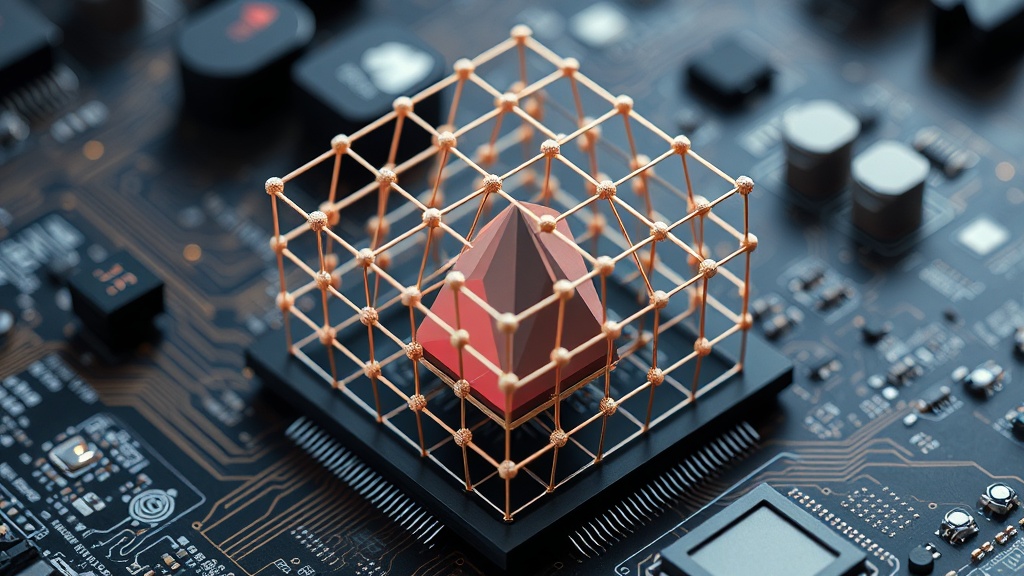
At the heart of the technique is the concept of a tetrahedral cage. Imagine a simplified, low-polygon mesh that loosely encloses a more complex animated object. This cage is not static; it's designed to deform in lockstep with the animated mesh. Each vertex of the tetrahedral cage is associated with a corresponding vertex or region of the animated geometry. As the animated geometry deforms, the cage deforms with it. This deformation is carefully controlled to ensure that the cage always tightly encloses the geometry, maintaining its bounding property.
The advantage of this approach becomes apparent when considering ray tracing. When a ray enters the scene, it first intersects with the highest level of the tetrahedral cage hierarchy. If an intersection occurs with a cage, the ray is then recursively tested against the sub-cages within. Only when a ray potentially intersects with a cage that directly encloses a piece of the actual geometry does the system perform the final, more expensive ray-triangle intersection test against the detailed mesh. This hierarchical culling, powered by the adaptive tetrahedral cages, dramatically prunes the search space for ray intersections.
Efficient Deformation and Hierarchical Structure
A key challenge in this method is efficiently deforming the tetrahedral cages to match the animated geometry. The paper details how this is achieved by associating cage vertices with the deformation data of the underlying mesh. For skeletal animation, this might involve interpolating transformations based on bone weights. For more complex mesh deformations, techniques like blend shapes or other procedural methods can be employed. The critical aspect is that the cage deformation is computationally cheaper than re-calculating complex bounding volume hierarchies for every frame or every deformation step.
Furthermore, the technique employs a multi-level hierarchy. Coarse-grained tetrahedral cages encompass large sections of the scene or large animated objects. These then contain finer-grained cages, which in turn enclose smaller parts of the geometry. This pyramid of cages allows for efficient traversal. Rays that miss a broad cage at a high level are immediately discarded, saving immense computation. Only rays that hit lower-level cages get passed down for more detailed intersection tests.
Performance Gains and Application Potential
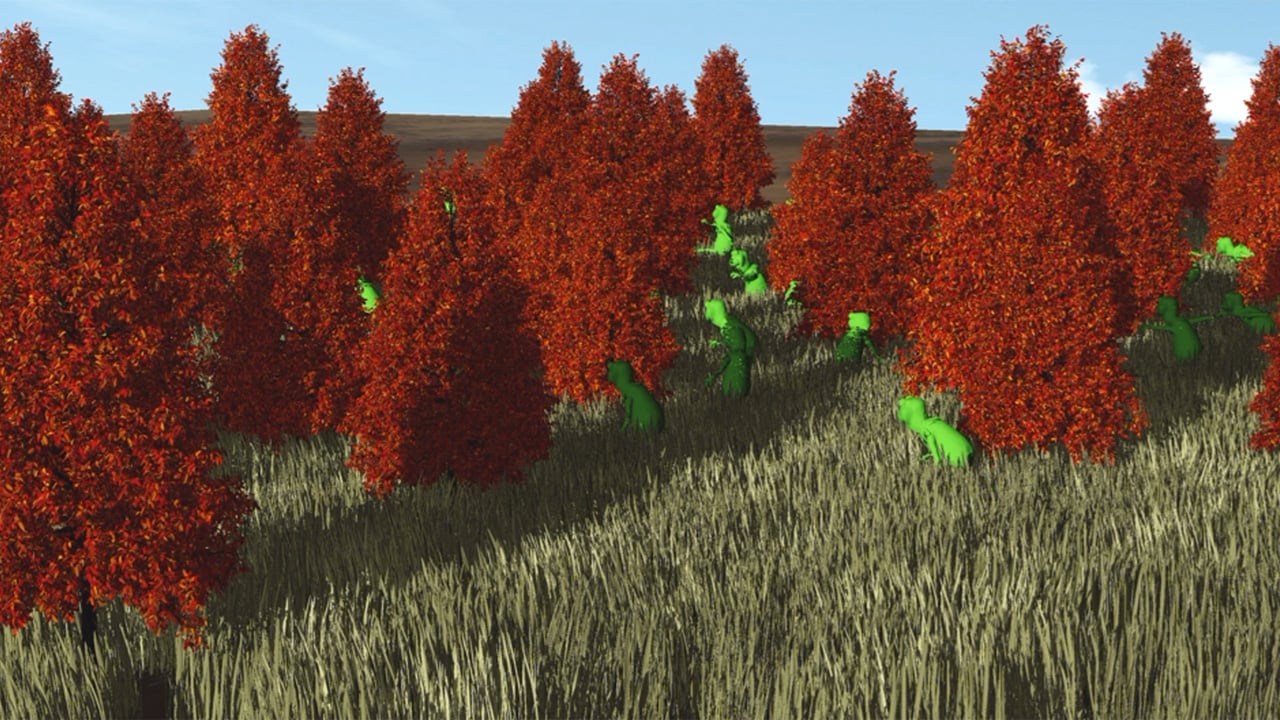
The performance benefits of this method are substantial. By offloading a significant portion of the ray intersection workload to the simpler, deformable tetrahedral cages, the GPU's ray tracing cores are freed up to handle other tasks or to process more rays per unit of time. This is particularly impactful for scenes with a high density of animated elements, such as crowds of characters in a game, flocks of birds in a simulation, or complex character animations with intricate facial movements.
The authors demonstrate that this technique can lead to orders-of-magnitude improvements in performance compared to naive ray tracing of dense, animated meshes. This opens up new possibilities for real-time rendering. Games can feature more detailed and dynamic environments without sacrificing frame rates. Architectural visualizations can incorporate more lifelike animated elements. Virtual reality experiences can achieve higher levels of immersion with more complex, interactive scenes. The ability to efficiently ray trace animated geometry is a fundamental step towards photorealistic real-time rendering across a wide spectrum of applications.
Challenges and Future Directions
While promising, the technique is not without its challenges. Ensuring that the tetrahedral cages perfectly and efficiently bound the animated geometry under all deformation conditions requires careful implementation. The overhead associated with deforming the cages themselves, although less than direct mesh tracing, still needs to be managed. Moreover, the integration with existing ray tracing pipelines and hardware acceleration features requires further development.
The paper hints at potential future work, including adaptive refinement of the tetrahedral cages based on ray hit density, and exploring different cage structures beyond tetrahedrons for specific types of geometry. The ultimate goal is to make ray tracing of dynamic, complex scenes as efficient as rasterization, a long-sought objective in real-time graphics. This work by AMD represents a significant stride towards that future, offering a concrete and effective solution to a long-standing problem in computer graphics.