Beyond Smoke Tests: A Cross-Cloud Agent Benchmark
Most demonstrations of Agent-to-Agent (A2A) protocols showcase a simple success: an HTTP 200 OK response. This proves connectivity but fails to establish genuine interoperability or provide performance metrics. A new project detailed on Dev.to moves beyond these basic smoke tests, demonstrating a robust cross-cloud currency agent that measures real-world performance characteristics like latency and reliability.
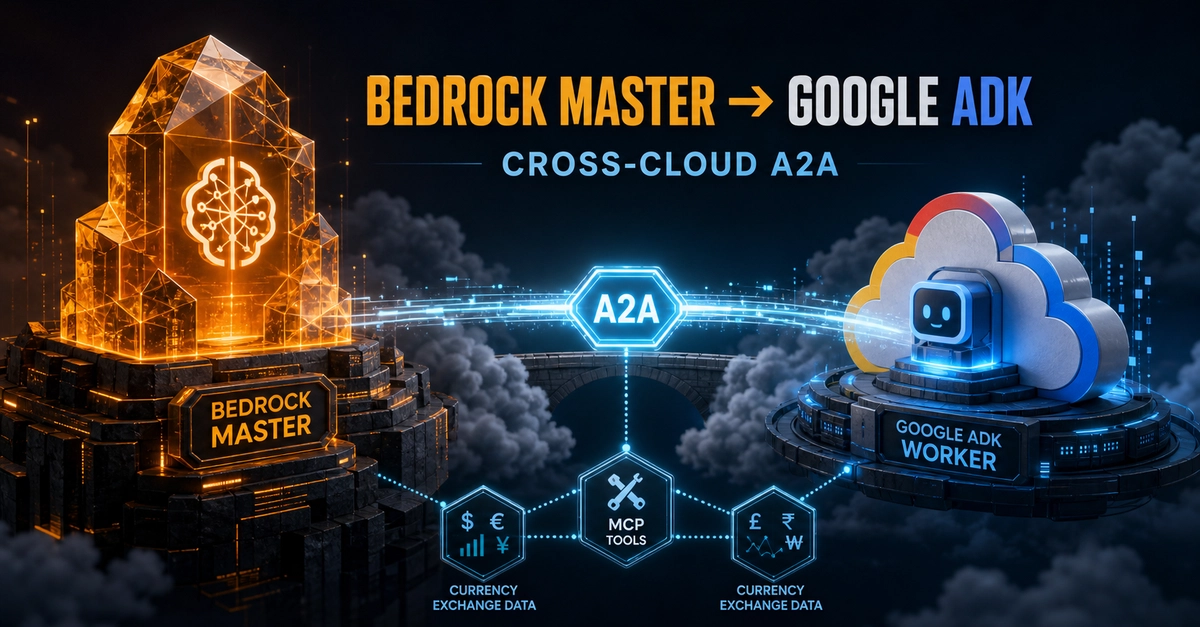
The core of this initiative involves an Amazon Bedrock master agent, built using Strands Agents and hosted on Amazon Bedrock AgentCore Runtime in AWS's us-east-1 region. This master agent is designed to delegate tasks to a Google ADK worker agent. This worker agent operates on Google Cloud Platform (GCP) via Cloud Run in the us-central1 region. The communication between these two agents occurs over A2A v1.0, a protocol facilitating inter-agent communication.
What sets this project apart is its sophisticated approach to verification and benchmarking. The Bedrock master agent doesn't just forward requests; it actively manages the user interaction and enforces a benchmark policy. This policy dictates how the worker agent's responses are evaluated. Crucially, the master agent cross-checks the results provided by the Google ADK worker against a local MCP (likely a placeholder for a specific internal tool or standard) exchange-rate tool. This local tool serves as a ground truth, allowing for direct comparison and validation of the cross-cloud agent's output.
Measuring Performance and Reliability
The project rigorously measures several key performance indicators. Latency is a primary focus, quantifying the time taken for the entire transaction, from the master agent receiving a request to returning a verified response. This includes the network transit time between AWS and GCP, the processing time within the Google ADK worker, and the time taken for the master agent to perform its cross-check against the local MCP tool.
Reliability is assessed by examining the success rate of these cross-cloud interactions over a sustained period and under various conditions. This involves understanding how often the A2A v1.0 communication succeeds without errors and how consistently the Google ADK worker returns accurate results. The project also delves into the failure behavior of the cross-cloud verification process. This means analyzing what happens when either the A2A communication fails, the GCP worker returns an error, or the worker's response deviates from the local MCP tool's expected output.
The master agent's role in this failure analysis is critical. It's responsible for detecting, logging, and potentially attempting to recover from these failures. This comprehensive approach provides valuable insights into the practical challenges and performance characteristics of orchestrating agents across disparate cloud environments. It moves the conversation from theoretical possibilities to empirical data, offering a benchmark for future A2A implementations.
Technical Architecture and Implementation Details
The architecture leverages specific cloud services to enable this cross-cloud orchestration. On the AWS side, Amazon Bedrock AgentCore Runtime provides the foundational service for hosting and running the master agent. Strands Agents, a framework likely used for defining the agent's logic and state management, is employed to build the master agent's capabilities. The choice of us-east-1 for the AWS hosting region is significant, potentially chosen for its availability, performance, or proximity to other AWS services used in the broader ecosystem.
On the GCP side, the worker agent is deployed using Cloud Run. This serverless container platform allows the Google ADK worker to scale automatically based on demand and execute without the need for managing underlying infrastructure. The worker is situated in the us-central1 region. The A2A v1.0 protocol serves as the communication layer, enabling the two agents to exchange messages securely and efficiently despite residing in different cloud providers.
The local MCP exchange-rate tool, running perhaps as a simple command-line interface (stdio) application, acts as a crucial component for validation. Its proximity to the master agent (presumably within the same AWS environment) ensures that its responses are fast and reliable, providing a stable baseline against which the cross-cloud worker's performance can be measured. This setup allows the project to isolate and quantify the overhead and potential unreliability introduced by cross-cloud communication.
Implications for Multi-Cloud Agent Development
This project tackles a fundamental challenge in modern distributed systems: effective and measurable agent interaction across different cloud providers. As organizations increasingly adopt multi-cloud strategies, the ability for AI agents to seamlessly collaborate and perform tasks across these environments becomes paramount. This work demonstrates a practical approach to building such systems, moving beyond simple API calls to establish a framework for performance benchmarking and reliability testing.
The insights gained from measuring latency, reliability, and failure modes are invaluable for developers and architects designing distributed AI systems. They highlight potential bottlenecks, areas prone to failure, and the overhead associated with inter-cloud communication. This data can inform decisions about agent placement, communication protocols, and error handling strategies.
What remains to be seen is how A2A protocols will evolve to natively support more sophisticated benchmarking and verification mechanisms. Currently, the responsibility falls on the master agent to implement these checks. Future iterations of A2A might include built-in features for performance monitoring or standardized methods for cross-cloud result validation, further simplifying the development of robust multi-cloud agent applications.