
The Illusion of Static Truth
Imagine reviewing your meeting notes from three months ago. You find a definitive statement: "Users don't need a search function. Recommendations are enough." This conclusion, born from a specific user feedback session and deemed valuable enough to record, is later cited in a new discussion. The person quoting it, however, may not question whether this judgment, made in a particular context, still holds true today. This is the core of a phenomenon termed 'Ghost Memory,' a subtle yet significant challenge in how information systems, including advanced AI, retain and present data.
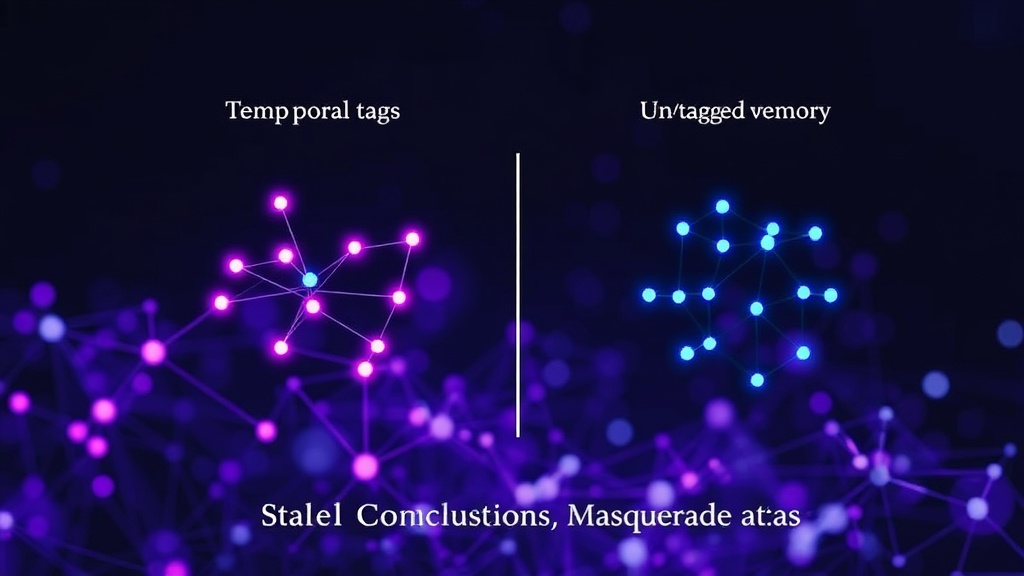
Ghost Memory describes the tendency for AI systems, and indeed any record-keeping mechanism, to store information without inherently distinguishing between what was true at a specific moment and what remains perpetually valid. When this data is retrieved, the original context or the temporal nature of its truthfulness is lost. The retrieved piece of information appears identical, regardless of whether it represents a fleeting observation or a timeless fact. This lack of contextual metadata means users might retrieve a conclusion they believe is current and validated, only to find it's an outdated judgment that no longer reflects reality. The problem isn't necessarily with the information itself, but with its presentation and the absence of temporal markers.
The Temporal Blind Spot in AI
This issue extends beyond simple note-taking. Large language models (LLMs) and other sophisticated AI systems often operate on vast datasets that are snapshots of the world at a particular time. While these models are trained on data up to a certain cutoff date, they don't inherently possess a mechanism to flag information that has since become obsolete. When an AI generates a response based on this information, it presents it as fact without indicating its temporal origin or potential for staleness. This can be particularly problematic in rapidly evolving fields like technology, finance, or scientific research, where information can become outdated within weeks or months.
Consider an AI assistant tasked with providing market analysis. It might access historical data and present trends that were accurate a year ago but are now misleading due to recent market shifts. The AI, functioning on its stored 'memory,' has no built-in way to signal that its information is a historical artifact rather than a current assessment. This is akin to a historian presenting a diary entry from 1945 as a live news report from today; the information is factually accurate for its time, but its utility and truthfulness in the present are nonexistent.
Beyond AI: Human Systems and Cognitive Biases
The phenomenon of Ghost Memory isn't exclusive to artificial intelligence. It mirrors human cognitive biases, particularly confirmation bias and the persistence of belief. Once an idea or conclusion is formed and accepted, it can be difficult to dislodge, even when new evidence emerges. In human communication and documentation, we often fail to timestamp our insights or explicitly note the conditions under which they were formed. This leads to a collective 'memory' that can be riddled with outdated assumptions, presented as enduring truths.
In a business context, this can manifest as clinging to strategies that once worked but are now ineffective. A decision made during a period of economic boom might be rigidly adhered to during a recession, because the original rationale, stored without temporal context, still feels compelling. The lack of explicit temporal tagging means that the decision-making process is constantly at risk of being influenced by historical data that no longer accurately represents the current environment. This 'stale conclusion' problem can hinder innovation and adaptation, as teams operate under the illusion that past successes guarantee future ones.
The Challenge of Contextual Retrieval
The fundamental challenge lies in designing systems that can not only store information but also its context, including its temporal validity. This requires moving beyond simple data storage to a more nuanced understanding of information as dynamic and context-dependent. For AI, this could involve developing mechanisms for continuous learning and updating, or explicitly tagging data with timestamps and sources that indicate when the information was current.
For human systems, it means fostering a culture of critical evaluation and demanding explicit context when information is presented. When a conclusion is cited, the natural follow-up question should be: "When was this determined, and under what conditions?" This shift in inquiry is crucial for preventing outdated information from dictating present actions. The goal is to ensure that when we retrieve information, we know not just what was concluded, but also whether that conclusion is still relevant.
Addressing Ghost Memory
Tackling Ghost Memory requires a multi-pronged approach. For AI developers, it means exploring architectures that can better track data provenance and temporal relevance. This could involve incorporating metadata pipelines that automatically tag information with timestamps, confidence scores based on recency, and even the specific query that led to its storage. Techniques like time-series analysis in data handling and models that explicitly reason about time could also play a role.
For users of AI and information systems, the onus is on developing a critical mindset. Always question the source and recency of information, especially when it seems definitive or counter to current understanding. Treat AI-generated information with the same skepticism you would a second-hand report – verify and seek corroboration, particularly for critical decisions. The ability to differentiate between a snapshot in time and a continuous truth is paramount in navigating an increasingly complex information landscape.
Ultimately, the 'Ghost Memory' phenomenon highlights a universal challenge: information is not static. Our systems, both artificial and human, must evolve to reflect this reality. Without explicit mechanisms for tracking context and temporal validity, we risk making decisions based on echoes of the past, rather than the realities of the present.