
The Challenge of AI Explainability
Artificial intelligence, particularly in complex decision-making systems, often operates as a black box. While models can achieve high accuracy, understanding the precise reasoning behind a specific output remains a significant hurdle. This lack of transparency is a critical issue across many domains, from finance and healthcare to autonomous systems, where trust and auditability are paramount. Developers and users alike need to understand not just *what* an AI decided, but *why*. This is where the concept of explainable AI (XAI) becomes crucial.
Traditional rule-based systems, like those built on the Rete algorithm, offer inherent explainability. Every decision can be traced back to a specific rule firing. However, these systems often struggle with the nuanced, probabilistic, and vast knowledge domains that modern AI, especially Large Language Models (LLMs), excel at. The challenge lies in marrying the deterministic, verifiable logic of rule engines with the fluid, knowledge-rich capabilities of LLMs.
Introducing AI·rete·RAG
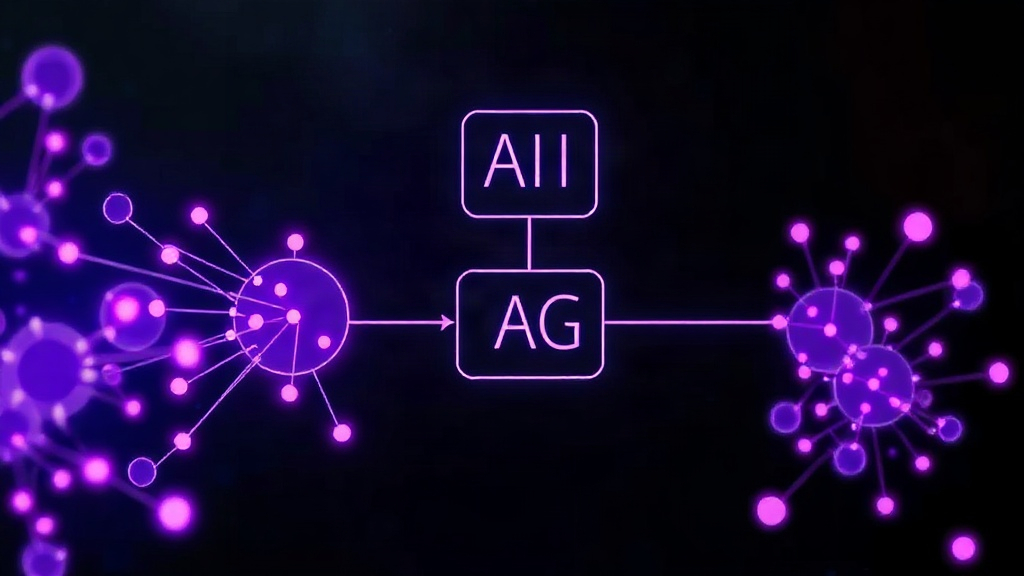
A recent Hacker News submission, titled "Show HN: AI·rete·RAG – a Rete rule engine decides, RAG explains why," presents an intriguing solution to this challenge. The project, aptly named AI·rete·RAG, proposes a hybrid architecture that leverages the strengths of both a Rete rule engine and Retrieval-Augmented Generation (RAG) to achieve explainable AI decisions. The core idea is to use the Rete engine for structured, logical decision-making and then employ RAG to generate human-readable explanations for those decisions.
The Rete algorithm, developed by Charles Forgy in 1979, is a highly optimized pattern-matching algorithm for implementing artificial intelligence rule-based systems. It excels at efficiently evaluating a large number of rules against a large number of facts. When facts change, Rete efficiently updates the set of satisfied rules without re-evaluating everything from scratch. This makes it incredibly performant for complex, dynamic rule sets. In the context of AI·rete·RAG, the Rete engine acts as the primary decision-maker. It processes input facts and applies predefined rules to arrive at a conclusion or action.
The RAG Layer: Generating Explanations
Where AI·rete·RAG distinguishes itself is in its use of RAG to translate these logical decisions into understandable language. After the Rete engine has determined an outcome, the system queries an LLM, augmented with relevant contextual information (retrieved through a RAG process), to generate an explanation. This explanation isn't just a restatement of the rule; it's a contextualized narrative that clarifies how the specific facts, processed by the rules, led to the final decision. This approach aims to provide the best of both worlds: the certainty and auditability of rule-based logic, combined with the natural language fluency and contextual understanding of LLMs.
The RAG component is critical here. It ensures that the LLM doesn't just hallucinate an explanation but grounds its response in the actual rules and facts that governed the decision. By retrieving relevant rule definitions, fact states, and perhaps even past decision rationales, the RAG system can provide the LLM with the necessary grounding to generate an accurate and faithful explanation. This is akin to providing a student with the textbook and lecture notes (retrieved facts and rules) before asking them to explain a concept (generate an explanation).
Potential Applications and Implications
The implications of this hybrid approach are broad. For developers building complex AI systems, AI·rete·RAG offers a pathway to create more transparent and trustworthy applications. Imagine a loan application system where the Rete engine assesses eligibility based on a strict set of financial rules, and RAG then explains to the applicant precisely why their loan was approved or denied, referencing specific criteria like credit score, debt-to-income ratio, and employment history, all tied back to the rules. In healthcare, a diagnostic support system could use the Rete engine to flag potential conditions based on patient data and symptoms, with RAG providing doctors with a clear, rule-based rationale for the suggested diagnoses.
This architecture could also be valuable in regulatory compliance. Industries with stringent audit requirements can use the deterministic nature of the Rete engine to ensure adherence to complex regulations. The RAG layer then provides an easily digestible explanation for auditors, demonstrating compliance and the reasoning behind specific system actions. This bridges the gap between the technical implementation of compliance and the human need for understanding.
The Unanswered Question: Scalability and Complexity
While the concept is compelling, a key question remains: how well does this architecture scale when the number of rules and facts becomes extremely large, or when the rules themselves are highly complex and interdependent? The efficiency of the Rete algorithm is well-established for rule evaluation, but the overhead of generating an RAG-based explanation for every decision might introduce latency. Furthermore, crafting prompts for the RAG system that accurately capture the nuances of complex rule interactions without overwhelming the LLM is a non-trivial engineering task. The surprising detail here is not the integration itself, but the potential performance bottleneck at the intersection of deterministic logic and generative explanation at scale.
The project's success will likely hinge on the careful design of the Rete rule set and the sophistication of the RAG retrieval and prompt engineering. If developers can effectively manage the complexity of the rule engine and ensure the RAG system consistently retrieves the most pertinent information, AI·rete·RAG could represent a significant step forward in building AI systems that are not only intelligent but also understandable and trustworthy.