aimock Achieves 2.5 Million Weekly Installs Amidst AI Development Surge
The landscape of AI application development is rapidly evolving, bringing with it a unique set of testing challenges. Developers building with Large Language Models (LLMs), multimodal models, and agentic protocols often face a critical bottleneck: their test suites rely on live API calls to external AI services. This reliance leads to several persistent issues: escalating token costs with every continuous integration (CI) run, brittle test pipelines susceptible to provider outages, and the logistical hurdle of distributing API keys to every developer on a team simply to run local tests.
aimock, an open-source mock server designed to address these pain points, has seen remarkable adoption, crossing the 2.5 million weekly install mark. Its growing popularity signals a strong demand for robust, deterministic testing infrastructure within the AI developer community.
The core problem aimock solves is the inherent unpredictability and cost associated with testing AI applications that interface with external services. Traditional testing methodologies often fall short when dependencies are third-party APIs that are rate-limited, expensive, or intermittently unavailable. For AI development, where interactions with LLMs and other specialized models are central, this translates directly into slower development cycles, higher operational costs, and increased developer friction.
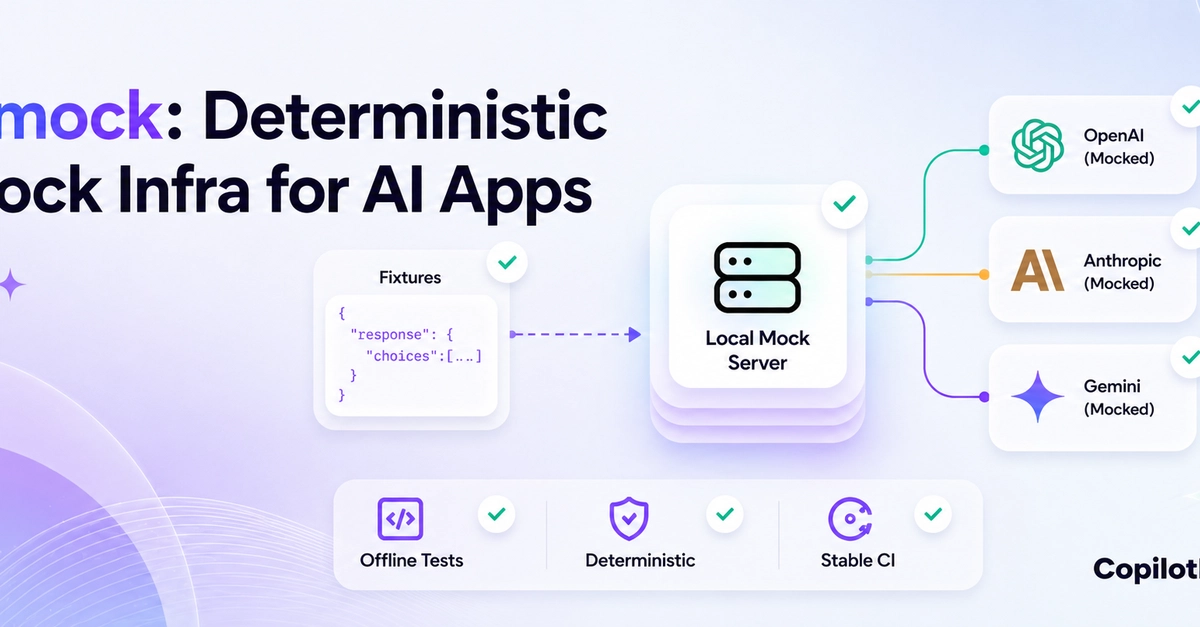
aimock acts as a local substitute for these external AI services. Developers configure it to mimic the behavior of LLMs, model configuration tools (MCP), agentic protocols, vector databases, and text-to-speech (TTS) or image generation models. Instead of sending requests to actual production endpoints, applications are pointed to a local `localhost` instance running aimock. The mock server then responds based on pre-defined JSON fixtures, which are essentially recorded or manually crafted examples of expected API interactions and responses.

How aimock Delivers Deterministic Testing
The primary benefit of this approach is determinism. Each test run, whether in a developer's local environment or within a CI/CD pipeline, will yield the exact same results. This eliminates the “flakiness” that often plagues tests dependent on external, variable systems. When a test fails, developers can be confident that the failure is due to a change in their application's logic or its integration with the mocked service, not an external factor like an API rate limit or a transient network error.
This deterministic behavior directly translates into significant cost savings. By mocking AI services, aimock ensures that no actual tokens are consumed during testing. For applications that make numerous calls to LLMs or other paid AI APIs, this can represent a substantial reduction in development and operational expenses. Imagine running hundreds or thousands of tests daily without incurring any per-call charges. This allows teams to test more frequently and more thoroughly without budget constraints.
Furthermore, aimock simplifies the developer onboarding process and environment setup. Developers no longer require individual API keys for the various AI services their application uses just to run the test suite. All they need is aimock configured with the appropriate fixtures. This streamlines the setup process, reduces security risks associated with key management, and ensures that every team member is testing against a consistent, predictable environment.
Adoption and Use Cases
The adoption of aimock, evidenced by its 2.5 million weekly installs and over 900 GitHub stars, highlights its utility in the burgeoning AI development ecosystem. Several prominent projects and companies are leveraging aimock to enhance their testing strategies. These include OpenClaw, TanStack, Mastra, Composio, and the AG-UI protocol. This diverse range of users, from framework developers to application builders and protocol implementers, underscores the broad applicability of aimock across different facets of AI development.
For developers working with LLM-powered applications, aimock can simulate responses from models like GPT-3.5, GPT-4, Claude, or Llama. This is invaluable for testing prompt engineering, response parsing, and fallback mechanisms. For agentic applications that orchestrate multiple AI calls and tools, aimock can mock the outcomes of each step, allowing developers to verify the agent’s decision-making logic and state management.
Vector databases, crucial for RAG (Retrieval Augmented Generation) and semantic search, can also be mocked. This allows testing of similarity search queries and document retrieval logic without needing a live database instance, which can be complex to set up and manage for testing purposes. Similarly, image generation models (like DALL-E or Stable Diffusion) and TTS models can have their outputs mocked, enabling testing of workflows that incorporate these modalities.
The Future of AI Testing with aimock
The rapid growth of aimock suggests a clear trend: as AI capabilities become more integrated into mainstream applications, robust and cost-effective testing solutions are paramount. The current approach of testing against live, often expensive, and variable APIs is unsustainable for scalable development. aimock provides a concrete solution by offering a deterministic, zero-token-cost alternative.
What remains to be seen is how aimock will evolve to support the next generation of AI services. As new types of AI models and interaction patterns emerge, the flexibility and extensibility of the mock server will be critical. The team behind aimock has built a strong foundation, but continuous adaptation to the fast-paced AI landscape will be key to its long-term success. The community's engagement, as indicated by the GitHub stars and install numbers, suggests a strong appetite for such developments.
For any developer building applications that rely on AI services, integrating aimock into their testing workflow is a pragmatic step. It directly addresses common development pain points, reduces costs, and increases the reliability of test suites. The success of aimock is not just a testament to its technical merits but also a reflection of the evolving needs of the modern AI developer.