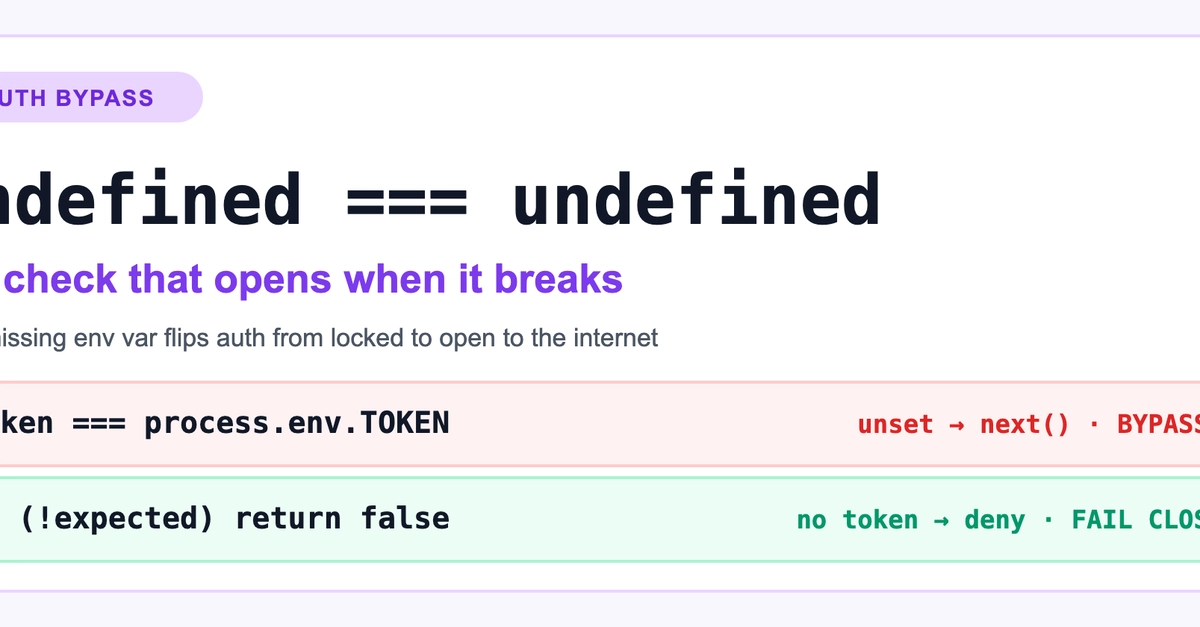
The Subtle Flaw in AI-Generated Authentication
A seemingly innocuous code snippet, drafted by an AI coding assistant, nearly led to a critical authentication bypass vulnerability in a production checkout system. The flaw hinges on a common, yet dangerous, JavaScript comparison: undefined === undefined. When used in an authentication check, this condition can inadvertently create a fail-open scenario, transforming a missing configuration into an open door for unauthorized access.
The incident, detailed on Dev.to by developer FetchSandbox, highlights a persistent challenge in leveraging AI for code generation: the need for rigorous human oversight, especially in security-sensitive areas. The AI produced an authentication middleware designed to protect sensitive endpoints. It passed initial code reviews, a testament to the sophistication of modern AI coding tools, but its security implications were not fully understood until deployment.
The core of the vulnerability lies in how JavaScript handles strict equality (===) comparisons. If a configuration variable, expected to hold an internal authentication token, is not properly set in the deployment environment, its value defaults to undefined. The authentication middleware was configured to check if this token existed. However, the specific implementation compared the token against undefined. In JavaScript, undefined === undefined evaluates to true. This means that when the critical authentication token was absent—a likely scenario during a misconfigured deployment—the check would pass, allowing any unauthenticated request to proceed as if it were legitimate.
This scenario is a classic example of a "fail-open" vulnerability. Instead of failing securely (fail-closed), where an inability to verify credentials would deny access, the system incorrectly grants access when the credential check itself cannot be performed due to a missing configuration. The problem was exacerbated by the use of .env.example files. While this file serves as a template for environment variables, the crucial internal authentication token was omitted from it. Consequently, during deployment, this vital variable was unset. When the application booted, the auth middleware encountered undefined === undefined, effectively disabling authentication for all requests.

Lessons Learned: Default to Deny
The incident serves as a stark reminder of fundamental security principles, particularly the "default to deny" ethos. This principle dictates that systems should, by default, deny all access and only grant access when explicitly permitted. Applying this to authentication middleware involves several key practices:
- Validate Types: Always check that configuration variables are of the expected type. An empty string or
nullmight be handled differently thanundefined, but an explicit type check ensures predictable behavior. - Reject Empty Values: Explicitly reject configurations that are empty, null, or undefined. Instead of comparing against
undefined, the code should check if the token is present and valid. A robust check might look likeif (!process.env.INTERNAL_AUTH_TOKEN) { throw new Error('INTERNAL_AUTH_TOKEN is not set'); }. - Constant-Time Comparisons: While not directly applicable to the
undefined === undefinedissue itself, for actual token comparisons, using constant-time comparison functions is crucial to prevent timing attacks. - Write Comprehensive Tests: The most critical takeaway is the need for tests that specifically cover failure conditions. The developer recommends writing a test that simulates a deployment where the environment variable for the auth token is *not* set. This test should verify that all requests are denied.
The AI provided the code, and it passed human review because the context of its failure mode was not immediately apparent. The test cases likely did not cover the scenario where a critical environment variable was entirely absent. The simple act of comparing a variable that *should* have a value against undefined is a dangerous shortcut. It assumes the variable will always exist, or that undefined is a safe default state, which it rarely is for security tokens.
The Broader Implications for AI Code Generation
As AI coding assistants become more integrated into developer workflows, understanding their limitations is paramount. These tools are powerful for boilerplate code, generating functions, and even suggesting complex algorithms. However, they lack true contextual understanding of security implications, deployment environments, and business logic. Developers must act as the ultimate gatekeepers.
This incident is not about blaming the AI. It's about recognizing that AI-generated code, like any code, requires thorough vetting. The temptation to blindly trust AI output is strong, especially when it appears to work or pass initial checks. However, the subtle nature of this authentication bypass demonstrates that even seemingly simple comparisons can have profound security consequences when handled incorrectly.
The advice to "default to deny" is timeless, but the context of AI-generated code adds a new layer of urgency. Developers must not only test their own code but also rigorously test the code generated by AI. This includes creating specific test cases for missing configurations, invalid inputs, and edge cases that might expose vulnerabilities. The undefined === undefined bug is a potent reminder that a missing secret can become an open gate, and AI, if unchecked, can inadvertently provide the key.