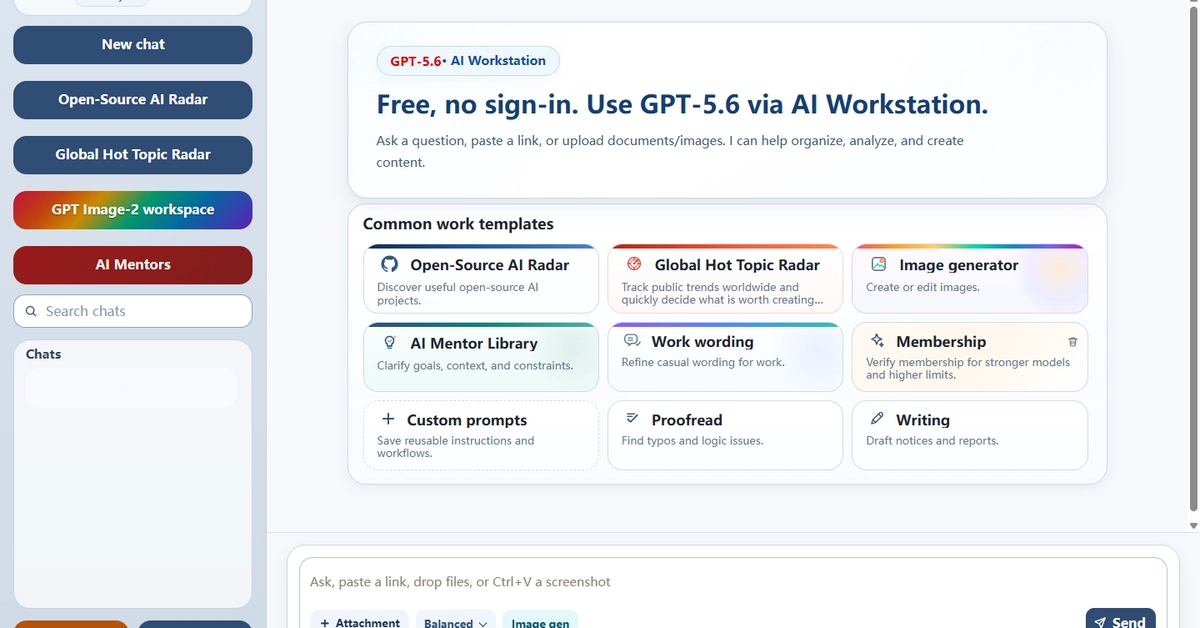
The Limits of the General Chat Interface for AI Discovery
Most AI tools begin with a chat box. It’s an intuitive and efficient interface for many tasks, including research and drafting. AI Workstation, the product developed by Zxh Wolfe, retains this core functionality. However, as Wolfe found through daily use, certain critical questions fall outside the scope of a general chat flow. These questions demand real-time, live evidence and have unique failure modes that standard chat models struggle to address.
Specifically, two questions emerged as problematic for a unified chat interface:
- What current topic is worth researching today?
- Which open-source AI project is worth evaluating now?
The inherent challenge with these queries lies in their reliance on dynamic, up-to-the-minute information. A traditional AI model, trained on a static dataset, can easily provide outdated answers. It might cite a project that has since been superseded, misrepresent its licensing, or conflate popularity with actual quality. The risk of generating fluent but factually inaccurate or irrelevant responses is high. This disconnect between the need for live data and the capabilities of a general chat interface is what prompted a structural change.
Introducing Layers: Workspace, Discovery Radars, and Agent Skills
To address these limitations, AI Workstation was re-architected into three distinct layers. This segmentation aims to provide specialized environments for different types of AI interaction, ensuring that each task is handled by the most appropriate interface and underlying mechanism. The three layers are:
- The Workspace: This is the primary interface for general-purpose AI tasks. It functions as the familiar chat box where users can engage in drafting, summarizing, brainstorming, and other common AI-driven activities. It prioritizes speed and accessibility for routine operations.
- Public Discovery Radars: This layer is dedicated to answering the questions that require live, up-to-date information. Radars are designed to continuously scan and assess the current landscape of AI research and development, providing users with timely insights into trending topics and promising open-source projects.
- Installable Agent Skills: These are specialized tools or modules that can be added to the AI Workstation to extend its capabilities. They are designed for specific, often complex, tasks that benefit from dedicated logic and potentially custom data sources.
This layered approach ensures that users can pivot between broad generative tasks and focused, evidence-based discovery without compromise. The separation acknowledges that not all AI interactions are created equal, and specialized tools yield superior results for specialized needs.
The Workspace: The Foundation for General AI Tasks
The main AI Workstation interface serves as the user's primary hub for interacting with AI. It retains the chat box paradigm because it remains the most efficient method for a wide array of tasks. When a user needs to draft an email, brainstorm ideas, summarize a document, or generate creative text, the general workspace excels. Its strength lies in its speed and directness, allowing for rapid iteration and fluid conversation with the AI.
However, the workspace is not equipped to handle the complexities of identifying emerging trends or evaluating the current viability of open-source projects. Its knowledge base, while extensive, is inherently tied to its training data, which has a cutoff point. Relying on this static data for questions about what is *currently* valuable or *now* worth evaluating would inevitably lead to outdated or misleading information. The workspace is therefore best viewed as the command center for generative and analytical tasks that do not depend on real-time market or project status.
Public Discovery Radars: Navigating the Live AI Landscape
The introduction of Public Discovery Radars is the most significant departure from traditional AI chat interfaces. These Radars are specifically engineered to tackle the challenge of live discovery. Unlike the general workspace, Radars are designed to actively monitor and analyze the ever-changing AI ecosystem.
Consider the question, “What current topic is worth researching today?” A standard chat model might pull from its training data, listing popular or historically significant topics. A Radar, however, would analyze real-time signals such as recent publications, trending discussions on developer forums, emerging GitHub repositories, and news cycles. It would then synthesize this live data to identify topics gaining traction and demonstrating current relevance and potential impact.
Similarly, when evaluating open-source AI projects, a Radar goes beyond simple popularity metrics. It would examine factors like recent commit activity, community engagement, license clarity, and the project's alignment with current research frontiers. This allows users to make informed decisions based on the project's present-day health and trajectory, not just its historical reputation or initial buzz.
The failure modes that Wolfe identified – stale memory, mixed identities, overlooked licenses, and mistaking popularity for quality – are precisely what Radars are built to mitigate. By grounding their assessments in live data and employing more sophisticated evaluation criteria, Radars provide a level of trust and timeliness that a general chat interface cannot match.
Agent Skills: Extending Specialized Functionality
The third layer, Agent Skills, complements the Workspace and Radars by offering modular, extendable functionality. These are essentially specialized tools or plugins that users can install to enhance the AI Workstation's capabilities for specific, often complex, workflows. While Radars focus on discovery and the Workspace on general generation, Agent Skills are for performing deep dives into particular domains or executing intricate processes.
For instance, a developer might install an Agent Skill designed for code analysis, another for scientific literature review, or a third for legal document summarization. Each Skill would be optimized for its domain, potentially incorporating specific datasets, fine-tuned models, or tailored evaluation algorithms. This modularity allows users to customize their AI Workstation to their exact needs, treating it less like a monolithic chatbot and more like a personalized AI operating system.
The separation of these layers is not merely an organizational choice; it reflects a deeper understanding of how AI is used in practice. By segmenting the interface and the underlying logic, AI Workstation offers a more robust, reliable, and efficient platform for a wider range of AI-powered tasks. Users can leverage the speed of the chat box for drafting, the currency of Radars for discovery, and the specialization of Agent Skills for complex operations, all within a cohesive environment.
Why This Separation Matters
The decision to separate live discovery from the general AI chat box acknowledges a critical bottleneck in current AI tools. Chat interfaces are excellent for generative tasks but fall short when real-time, evidence-based assessment is required. By creating dedicated Discovery Radars, AI Workstation provides a mechanism for users to reliably answer questions about current trends and emerging projects.
This architectural choice reflects a maturing understanding of AI application. It recognizes that different AI tasks have different requirements, particularly concerning data freshness and evaluation rigor. For developers, founders, and researchers, this means having a tool that not only generates content but also provides trustworthy, up-to-date insights into the rapidly evolving AI landscape. It’s about building an AI workspace that doesn’t just talk, but also intelligently observes and reports on the world as it is, right now.