The Myth of AI Replacing Developers
The prevailing narrative on AI's impact on software development often paints a picture of mass displacement. This view, fueled by breathless headlines and speculative Twitter threads, suggests that generative AI will soon be capable of understanding complex requirements and churning out production-ready code, rendering human developers obsolete. It's a compelling, if alarmist, vision. However, it fundamentally misunderstands both the current capabilities of AI and the nature of software development itself.
I recently encountered a developer at a tech meetup in Shenzhen who articulated this common sentiment. He stated he was adopting a wait-and-see approach to learning AI tools, a stance he had maintained for two years. In that same timeframe, I've witnessed individuals with no prior coding experience successfully launch functional Software-as-a-Service (SaaS) products by leveraging AI-powered development environments like Cursor and intelligent assistants like Claude. This stark contrast in outcomes highlights the true dynamic at play.
Let's be unequivocal: AI is not going to replace software developers wholesale. The CEO typing "build me Facebook but for dogs" into a prompt and expecting a fully functional, scalable, and secure application is a far-fetched scenario. The technology, while advancing rapidly, is not yet at a level where it can independently manage the nuanced complexities of software architecture, security, user experience design, and long-term maintenance without significant human oversight and intervention. The real challenge is far more subtle and, frankly, more intriguing.
The threat isn't AI itself, but rather the individuals who master its application. Someone proficient in wielding AI tools will undoubtedly outpace and outperform those who do not. This isn't about AI writing code; it's about AI augmenting human capability, transforming workflows, and accelerating the development lifecycle.

The Rise of the AI-Augmented Builder
My own journey in corporate tech for six years before transitioning to focus on AI-driven development has illuminated this shift. The core of software development is not just writing lines of code; it involves problem-solving, critical thinking, architectural design, debugging, testing, and continuous iteration. AI tools are becoming exceptionally good at automating repetitive tasks, generating boilerplate code, assisting with debugging, and even suggesting architectural patterns. They act as powerful co-pilots, dramatically increasing the productivity of a developer who knows how to direct them.
Consider the process of building a new feature. A traditional developer might spend hours writing unit tests, setting up API endpoints, and structuring data models. An AI-augmented builder, however, can instruct an AI assistant to generate these components in minutes. This doesn't eliminate the need for the developer; it frees them from the mundane and allows them to focus on higher-level strategic decisions, intricate logic, and the unique business requirements that AI cannot comprehend. They can spend more time refining the user experience, optimizing performance, and ensuring the overall robustness of the application.
This augmentation is akin to the difference between a carpenter using hand tools versus one using advanced power tools. The carpenter with power tools can cut more wood, shape it faster, and complete projects in a fraction of the time, while maintaining precision and quality. They are not replaced by the tools; they are empowered by them. Similarly, developers who integrate AI into their workflow become exponentially more effective. They can iterate on ideas faster, experiment with more approaches, and deliver value at a pace previously unimaginable.
What This Means for the Developer Career Path
The implication for developers is clear: continuous learning is no longer optional, it's imperative. The skills that will define successful developers in the coming years are not just proficiency in a specific programming language or framework, but also the ability to effectively prompt, guide, and integrate AI tools into their development process. This includes understanding the strengths and limitations of various AI models, knowing how to break down complex problems into AI-solvable chunks, and developing a critical eye to vet and refine AI-generated output.
The developer who waits to see where AI goes is, in essence, choosing to remain with hand tools while the rest of the industry adopts power tools. They risk being left behind not because AI is smarter, but because others are faster and more efficient with AI's assistance. This isn't a prediction of widespread unemployment, but a call to adapt. The demand for developers who can deliver high-quality software rapidly will only increase. Those who can meet this demand through AI augmentation will be highly sought after.
The skills gap will widen between those who embrace AI as a productivity multiplier and those who view it with skepticism or fear. The latter group will find themselves increasingly unable to compete on speed, cost, and output. The former will be able to tackle more ambitious projects, innovate more rapidly, and command higher value in the market. This shift necessitates a proactive approach to skill development, focusing on AI literacy and prompt engineering alongside traditional software engineering principles.
Beyond Code Generation: AI in the Development Lifecycle
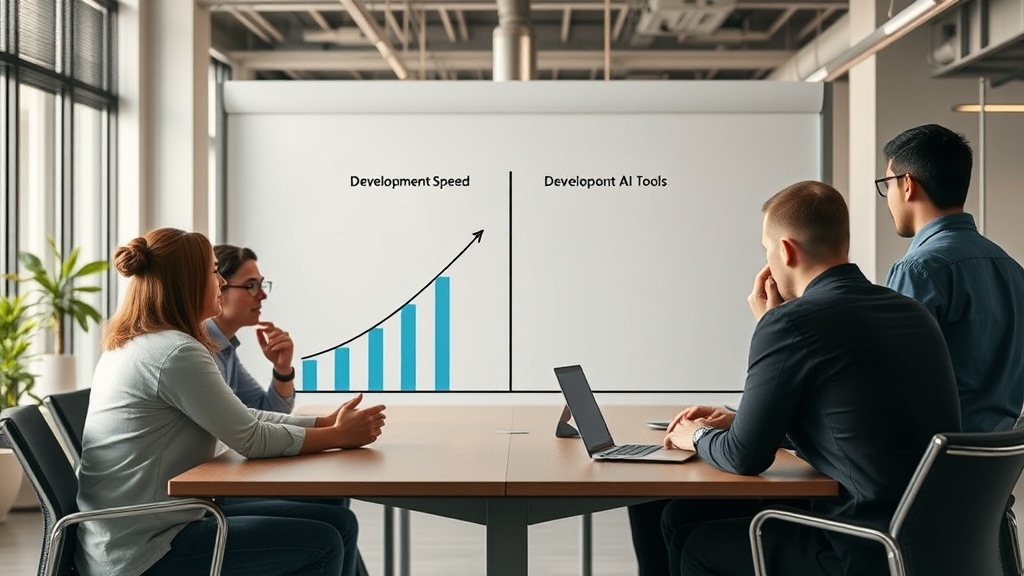
The impact of AI extends far beyond simple code generation. AI tools are beginning to play significant roles across the entire software development lifecycle. In the design phase, AI can assist with generating user interface mockups and prototypes based on textual descriptions. During development, AI code assistants can offer real-time suggestions, identify potential bugs, and even refactor code for better performance or readability. For testing, AI can generate comprehensive test cases, identify edge cases that human testers might miss, and automate aspects of quality assurance.
Furthermore, AI is proving invaluable in areas like project management and documentation. AI can help summarize lengthy technical documents, generate release notes, and even assist in identifying dependencies and potential blockers in complex project plans. This holistic integration means that AI isn't just a coding tool; it's an overarching enhancement to the entire development workflow. Developers who understand how to leverage these diverse AI capabilities will be able to streamline processes, reduce time-to-market, and improve the overall quality of their software products.
The challenge for developers is to view AI not as a competitor, but as a sophisticated collaborator. It's a tool that, when wielded correctly, can amplify human creativity and problem-solving abilities. The individuals who will succeed are those who actively seek to understand and integrate these tools into their daily work, transforming their productivity and expanding their capacity for innovation. The future of software development belongs to the builders who learn to build *with* AI.