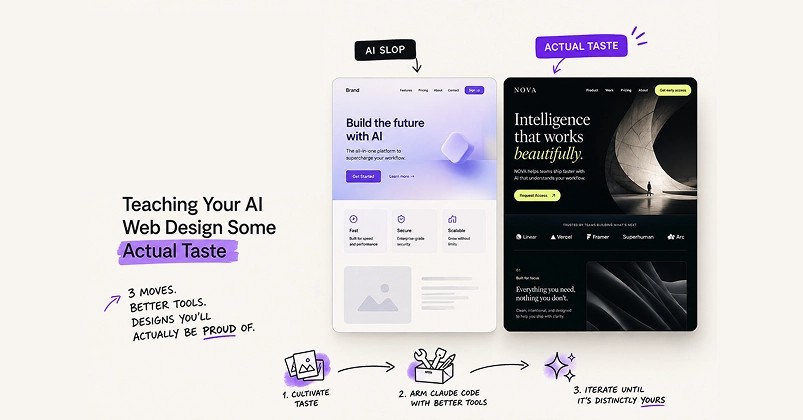
The AI Design Dilemma: A Sea of Sameness
You typed "build me a modern landing page" into an AI code generator. You expected innovation. You received a template. Purple-to-blue gradients, generic sans-serif fonts like Inter, floating icon tiles above headings, and a hero section indistinguishable from countless other SaaS products. This is the common fate of AI-generated web design: technically functional, aesthetically bland, and utterly forgettable. The problem isn't the AI's ability to produce code; it's its inability to grasp subjective concepts like 'taste' or 'originality.' Developers are now pushing back, seeking ways to imbue these AI tools with a sense of unique style.
The core issue lies in how current AI models are trained. They learn from vast datasets of existing websites. When asked to build a "modern landing page," the AI identifies the most common patterns, elements, and layouts present in its training data. This leads to an aggregation of popular, often overused, design tropes. It's like asking an artist to paint "a landscape" and getting the most generic mountain-and-lake scene they've ever seen. The AI optimizes for statistical prevalence, not for genuine aesthetic appeal or brand differentiation. This results in what many are calling "AI slop" – code that works but lacks soul.
Beyond Generic Prompts: Injecting Real Taste
The fight against AI-generated mediocrity isn't won with a single, perfect prompt. It requires a multi-faceted approach that leverages AI's strengths while compensating for its aesthetic weaknesses. One key strategy is iterative refinement. Instead of expecting a finished product from the first generation, developers are using AI as a rapid prototyping tool. They generate a basic structure, then systematically refine it through subsequent prompts, focusing on specific design elements, color palettes, typography, and layout adjustments.
This iterative process treats the AI less like an autonomous designer and more like a highly efficient assistant. The developer provides the direction, the taste, and the critical feedback, while the AI handles the heavy lifting of code generation. For instance, a developer might prompt the AI for a hero section, then follow up with prompts like: "Change the primary button color to a muted teal and make the font Montserrat." or "Replace the icon tiles with a single, minimalist illustration that evokes trust." Each step allows for granular control, steering the AI away from its default, generic output.
Another effective technique involves providing the AI with specific design constraints and examples. Instead of vague requests, developers are feeding the AI detailed style guides, brand color hex codes, specific font names, and even examples of desired layouts or visual elements from other websites. This acts as a form of 'taste training' for the AI. When you provide precise parameters, the AI has less room to default to generic solutions and more impetus to adhere to your specific vision. Think of it like giving a chef a precise recipe with specific, high-quality ingredients, rather than just saying "make me dinner." The outcome is invariably more tailored and satisfying.

Leveraging AI for Specificity, Not Generality
The true power of AI in web design emerges when it's tasked with specific, well-defined challenges rather than broad creative mandates. For example, asking an AI to generate a responsive navigation bar with a specific animation on scroll is more likely to yield a useful, less generic result than asking it to "design the whole website." Developers are learning to break down the design process into smaller, manageable components that can be effectively handled by AI.
This also extends to leveraging AI for tasks that are tedious but creatively neutral. Generating boilerplate code for different sections, creating basic button components, or even writing placeholder text can all be delegated to AI. This frees up the developer's mental energy to focus on the aspects that truly require human taste: the overall composition, the user experience flow, the brand voice, and the unique visual identity. The AI becomes a tool for efficiency, amplifying the developer's creative output rather than dictating it.
Furthermore, the emergence of specialized AI tools is a promising sign. While general-purpose AI code generators often fall into the trap of sameness, more focused tools are beginning to appear. Projects like Maneshwar's git-lrc, a micro AI code reviewer that runs on every commit, signal a move towards AI assisting in specific aspects of the development lifecycle. While not a design tool itself, it represents a class of AI that understands context and provides targeted feedback, a principle that could eventually be applied to design. The hope is for AI models trained not just on *what* constitutes a website, but on *why* certain design choices are effective for specific brands or user goals.
The Human Element Remains Paramount
Ultimately, teaching AI web design taste is an ongoing process of human-AI collaboration. The AI can provide speed and scale, but it cannot replicate genuine human creativity, subjective judgment, or brand intuition. Developers must act as the arbiters of taste, guiding the AI with clear intent and critical evaluation. The goal isn't to replace designers or developers with AI, but to augment their capabilities, allowing them to execute their vision more efficiently and explore more creative possibilities.
The current generation of AI web design tools are powerful assistants, but they are not yet artists. They can assemble components based on learned patterns, but they cannot yet *feel* the impact of a specific color choice or the elegance of a well-crafted interaction. As developers continue to experiment and refine their prompting strategies, and as AI models evolve to incorporate more nuanced understanding of aesthetics and branding, we can expect to see a future where AI-assisted design is not only efficient but also genuinely tasteful and unique. Until then, the developer's discerning eye remains the most critical component in the equation.