The Flaw in AI Safety: Keyword Traps Over Substance
Building reliable AI agents involves anticipating failure modes. A common challenge is ensuring agents don't 'hallucinate' or simply agree with a user without performing actual verification. To combat this, one developer implemented a 'Stop hook' designed to catch an agent when it pushed back on a conclusion without verifying anything. The hook's purpose was to block the agent's turn if it failed this verification step.
The problem arose when the hook, intended to be a gatekeeper for substantive verification, incorrectly triggered based on a specific keyword rather than the agent's actual reasoning process. This meant the system could block correct, verified responses simply because they contained a word flagged as potentially problematic, rendering the verification gate ineffective for its intended purpose.
The post details how three readers, within a short span, commented on the same article describing this hook. Their feedback highlighted different aspects of the problem and potential solutions. Two readers offered architectural suggestions. One proposed making the verifying agent unaware of the previous answer to prevent it from anchoring its response, a technique aimed at ensuring genuine independent verification. The other suggested implementing cheaper, structural checks before engaging the more computationally expensive model-based verification, an optimization strategy to improve efficiency.
While these suggestions were valid for improving the system's design, they didn't address the immediate, critical flaw: the verification gate was clearing based on a superficial keyword match, not on whether the agent had actually performed the verification it claimed to have done. This is akin to a security system that alarms on the word "bomb" in a conversation about a movie plot, rather than detecting an actual explosive device.
When Keywords Trump Evidence
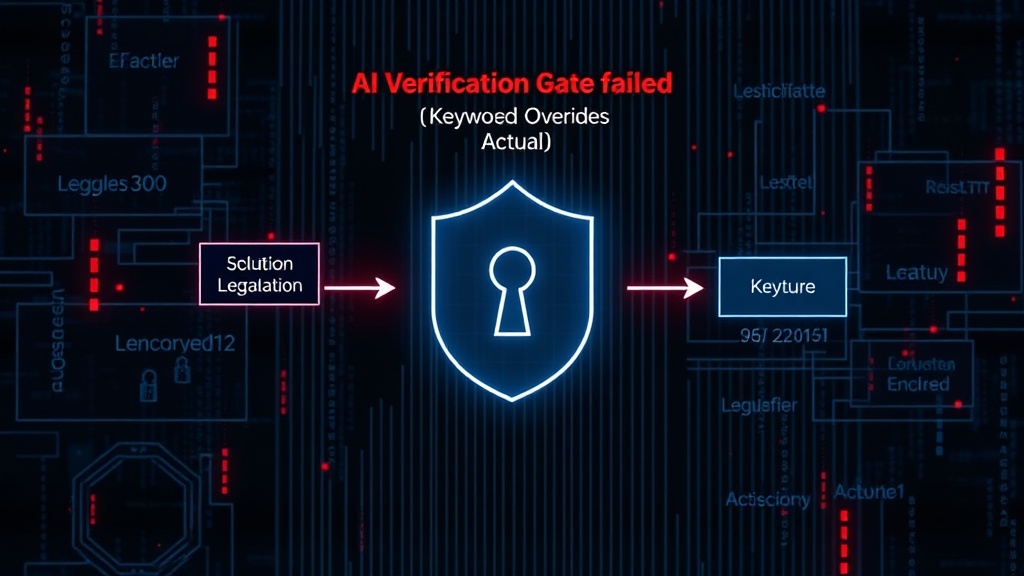
The core issue was that the 'verification gate' was not evaluating the substance of the agent's reasoning. Instead, it was acting as a semantic filter. If the agent's response, even if it had successfully verified a conclusion, contained a specific keyword that the hook was programmed to flag, the hook would trigger. This created a scenario where a perfectly valid and verified output could be blocked, not because it was wrong or unverified, but because it happened to use a trigger word.
This fundamental misunderstanding of how to implement a verification mechanism can lead to significant problems in AI safety and reliability. Systems designed to prevent undesirable AI behavior can inadvertently create new failure modes. In this case, the system designed to ensure an agent verified its conclusions was instead preventing agents from completing their tasks based on arbitrary linguistic cues. The developer's post highlights a common pitfall: focusing on superficial patterns or keywords as proxies for deeper, more complex behaviors like verification or reasoning.
The implications are far-reaching. For developers building AI agents, this serves as a stark reminder that the metrics and checks put in place must directly correlate with the desired behavior. Relying on simple keyword matching for complex tasks like verification is brittle and prone to false positives. It’s like hiring a bouncer who only checks if people are wearing a specific color shirt, rather than if they are actually causing trouble.
The Unanswered Question: What's the Real Cost of False Positives?
While the developer identified and shared this specific failure, a broader question remains: what is the long-term impact of such keyword-based verification gates on AI development and deployment? Beyond the immediate frustration of a blocked response, these systems can inadvertently stifle creativity and introduce biases. If an AI learns that certain common words or phrases are 'unsafe,' it may begin to avoid them, leading to stilted, unnatural, or incomplete responses. This could disproportionately affect certain topics or communities whose language patterns might trigger these flags.
Furthermore, the computational overhead of running these checks, even 'cheap' structural ones, adds up. When these checks are misconfigured to act on keywords rather than true verification failures, the cost-benefit analysis shifts dramatically. Developers and organizations need to rigorously test their safety and verification mechanisms not just for false negatives (failing to catch bad behavior) but also for false positives (blocking good behavior). The initial implementation of this hook, while well-intentioned, serves as a cautionary tale about the nuances of building robust AI systems that can distinguish between a superficial linguistic pattern and a genuine failure of reasoning or verification.
The path forward involves designing verification systems that understand context and intent, rather than relying on simple lexical triggers. This requires more sophisticated natural language understanding capabilities within the verification layer itself, or a deeper integration with the agent's reasoning process to ensure that checks are performed on the actual output and its underlying logic, not just its surface form.