The Grind of Manual Lead Generation
Lead generation is a critical but often manual and time-consuming task for many businesses. The typical weekly workflow involves searching LinkedIn for companies, visiting multiple websites, identifying key decision-makers like CTOs or VPs, hunting down their contact information, and finally, writing personalized outreach emails. This repetitive process can consume half a day each week, diverting valuable resources from core business activities.
Imagine waking up to a fully prepared outreach campaign: a list of companies matching your Ideal Customer Profile (ICP), identified decision-makers, completed company research, calculated lead qualification scores, and ready-to-send personalized email drafts. This is the reality achieved by a custom-built AI system designed to automate these exact steps.

The Goal: A Fully Automated Campaign Brief
The objective was to create a system that could take a simple campaign brief and execute the entire lead generation and outreach process autonomously. This involves several distinct AI-powered agents working in concert.
The AI Team Composition
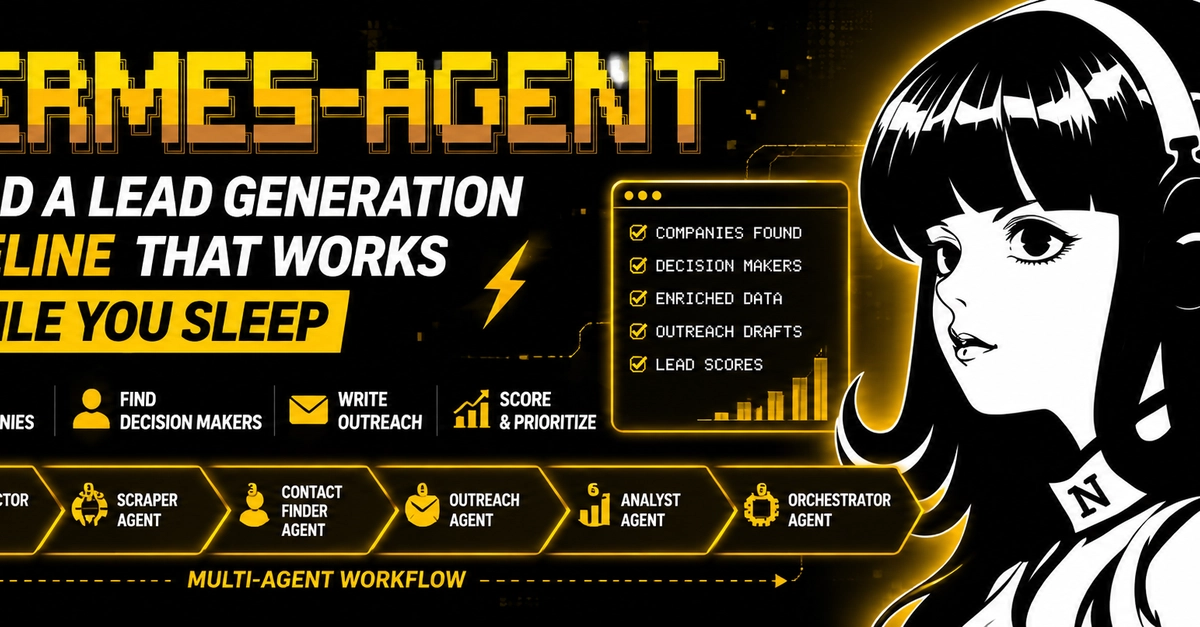
The system, built using the Hermes Agent framework, orchestrates a team of specialized AI agents to accomplish the lead generation and outreach tasks:
- Company Researcher: This agent identifies companies that fit the defined Ideal Customer Profile (ICP). It scours various data sources to build a list of potential target organizations.
- Decision Maker Identifier: Once target companies are identified, this agent's role is to pinpoint the relevant decision-makers within those organizations, such as CTOs, VPs of Engineering, or Directors of Product.
- Contact Information Hunter: This agent focuses on finding accurate contact details for the identified decision-makers, including email addresses and potentially other relevant communication channels.
- Research Assistant: Before drafting outreach, this agent gathers essential information about the target company and the identified decision-maker, providing context for personalization.
- Email Writer: Leveraging the research and decision-maker information, this agent crafts personalized outreach email drafts. The goal is to make the communication relevant and engaging to the recipient.
Workflow and Output
The process begins with a campaign brief that specifies the ICP. The AI team then executes the following steps:
- The Company Researcher identifies target companies.
- The Decision Maker Identifier finds key contacts within those companies.
- The Contact Information Hunter retrieves their contact details.
- The Research Assistant gathers company and contact-specific information.
- The Email Writer drafts personalized outreach emails.
The output is a comprehensive package ready for review and sending. This includes a list of qualified leads, identified decision-makers with contact information, completed company research summaries, and personalized email drafts. This effectively transforms a half-day manual task into an automated process that can be initiated and completed with minimal human intervention.
The Power of Autonomous Agents
This system demonstrates a powerful application of autonomous AI agents for a common business challenge. By breaking down the complex lead generation process into discrete, automatable tasks handled by specialized agents, the entire workflow becomes significantly more efficient. The ability to provide a simple brief and receive ready-to-send outreach materials means sales and marketing teams can focus on higher-value activities like closing deals and strategic planning, rather than spending hours on repetitive data gathering and writing.
The underlying technology, likely leveraging large language models and sophisticated agent orchestration frameworks, offers a glimpse into the future of sales and marketing automation. It moves beyond simple templating to true personalization driven by AI analysis of company and individual data.
What remains to be seen is how effectively these AI-generated outreach messages will perform in terms of conversion rates compared to human-crafted emails, and the scalability of such systems across diverse industries and target markets.