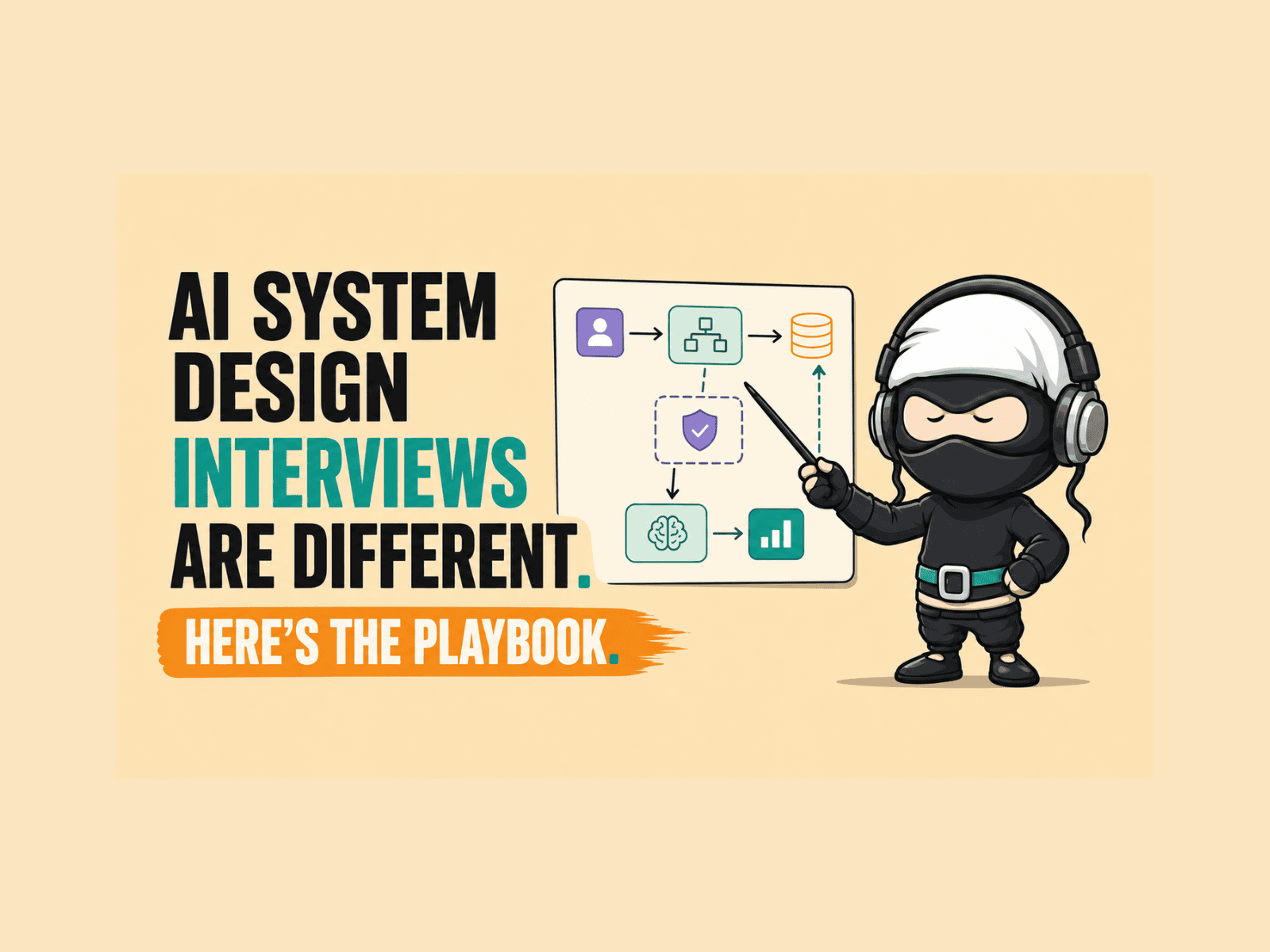
The Core Framework for AI System Design Interviews
AI system design interviews test your ability to architect scalable, efficient, and robust AI-powered products. The key is a structured approach that demonstrates your understanding of trade-offs, data flow, model selection, and deployment considerations. Think of it less like a coding interview and more like designing a complex distributed system, but with a heavy emphasis on machine learning components.
A common pattern emerges: start with requirements, estimate scale, design high-level components, deep dive into specific ML components, and finally, consider operational aspects like monitoring, deployment, and iteration. This framework adapts whether you're asked to design something as seemingly simple as a "recommendation system" or as complex as a "large language model deployment." The transition from designing a system like YouTube's recommendation engine to a system like ChatGPT highlights this adaptability.
Deconstructing the Requirements
Every design problem begins with understanding the user needs and business goals. For a YouTube-like system, this means recommending videos to users to maximize engagement (watch time, likes, shares). For ChatGPT, it's about generating coherent, relevant, and safe text responses to user prompts. You must clarify functional requirements (what it *does*) and non-functional requirements (how well it *does* it: latency, throughput, accuracy, cost, safety, fairness).
For YouTube, non-functional requirements might include serving recommendations within milliseconds, handling billions of daily requests, and continuously updating recommendations based on new user activity and video uploads. For ChatGPT, it could involve generating responses within seconds, handling millions of concurrent users, and ensuring responses are factually accurate (where applicable), non-toxic, and aligned with user intent. Always ask clarifying questions. What are the key metrics for success? What are the expected user loads? What are the latency constraints?
Estimating Scale and Throughput
Once requirements are clear, estimate the scale. This is crucial for designing a system that can handle the load. For YouTube, consider daily active users, videos watched per user, and the size of the video catalog. For ChatGPT, think about daily active users, prompts per user, and the complexity of generated responses.
A back-of-the-envelope calculation is expected. For YouTube recommendations, you might estimate: 1 billion users * 10 videos watched/day * 1000 recommendations generated/video = 10^11 recommendations/day. This translates to roughly 10^7 requests per second during peak hours. For ChatGPT, if 100 million users send 5 prompts/day, that's 5 * 10^8 prompts/day, or about 6,000 prompts per second. These numbers inform decisions about caching, database sharding, and model serving infrastructure.
High-Level Design: Components and Data Flow
Sketch out the main components. For a recommendation system like YouTube's, this typically involves:
- Data Ingestion: Collecting user interactions (views, likes, searches) and video metadata.
- Feature Store: Storing user and item features for quick retrieval.
- Candidate Generation: Retrieving a large set of potentially relevant videos (e.g., using embeddings, collaborative filtering).
- Ranking: Scoring the candidate videos using a more complex model to predict engagement.
- Re-ranking/Filtering: Applying business rules, diversity constraints, or safety filters.
- Serving Layer: Delivering the final ranked list to the user.
For ChatGPT, the high-level design looks different but follows similar principles:
- API Gateway/Load Balancer: Manages incoming requests and distributes them.
- Prompt Processing: Pre-processing user prompts, potentially including safety checks or context retrieval.
- Model Serving Infrastructure: Hosting the large language model (LLM) for inference. This is the most critical and resource-intensive part.
- Response Generation: The LLM generates text token by token.
- Post-processing: Applying safety filters, formatting, and potentially retrieving supporting information.
- User Feedback Loop: Collecting feedback on generated responses.
The surprising detail here is how similar the high-level architectural *patterns* are, even for vastly different AI tasks. Both require robust data pipelines, efficient feature management, scalable inference, and careful consideration of user experience.
Deep Dive: Machine Learning Models and Data
This is where you demonstrate your ML expertise. For YouTube recommendations, you might discuss:
- Model Choice: Two-tower models (for candidate generation), deep neural networks (for ranking), factorization machines, or even simpler models for cold-start users.
- Training Data: User watch history, explicit feedback (likes/dislikes), implicit feedback (watch duration), video metadata, user demographics.
- Training Strategy: Offline training on historical data, online learning for rapid adaptation, A/B testing for model evaluation.
- Embeddings: How user and item embeddings are learned and used.
For ChatGPT, the focus shifts to generative models:
- Model Architecture: Transformer-based LLMs (e.g., GPT variants). Discuss attention mechanisms, tokenization, and sequence generation.
- Training Data: Massive text corpora from the web, books, code. Discuss data cleaning, deduplication, and ethical considerations (bias, toxicity).
- Fine-tuning: Techniques like Reinforcement Learning from Human Feedback (RLHF) to align model behavior with human preferences and safety guidelines.
- Inference Optimization: Techniques like quantization, pruning, efficient attention mechanisms (e.g., FlashAttention), and batching to reduce latency and cost.
What nobody has addressed yet is the long-term sustainability of training and serving these massive LLMs, particularly concerning energy consumption and the potential for creating an ever-widening gap between organizations that can afford such compute and those that cannot.
Operational Considerations: Deployment, Monitoring, and Iteration
A deployed AI system is never static. You need to discuss:
- Deployment: Canary releases, blue-green deployments, A/B testing frameworks for models.
- Monitoring: Tracking model performance (accuracy, drift), system health (latency, error rates), and business metrics (engagement, user satisfaction). Setting up alerts for anomalies.
- Feedback Loops: Mechanisms for collecting user feedback (explicit ratings, implicit signals) and retraining models.
- Scalability and Cost: Auto-scaling infrastructure, optimizing model inference for cost-efficiency, tiered service levels.
- Security and Ethics: Protecting user data, preventing model misuse, mitigating bias, ensuring fairness, and handling adversarial attacks.
For if you run a team building AI products, you must prioritize building robust monitoring and feedback systems from day one. Without them, your models will degrade silently, and your product will fall behind competitors.
Trade-offs and Decisions
Throughout the design process, you must articulate the trade-offs. For example:
- Latency vs. Accuracy: A more complex ranking model might be more accurate but slower. How do you balance this?
- Model Size vs. Cost: Larger models are often more capable but exponentially more expensive to train and serve.
- Personalization vs. Diversity: Over-personalization can lead to filter bubbles; too much diversity might reduce engagement.
- Real-time vs. Batch Processing: Real-time updates offer freshness but are more complex than batch processing.
By systematically addressing requirements, scale, architecture, ML specifics, and operational concerns, you can tackle any AI system design interview question with confidence. It's about demonstrating a holistic understanding of building and maintaining AI products in the real world.