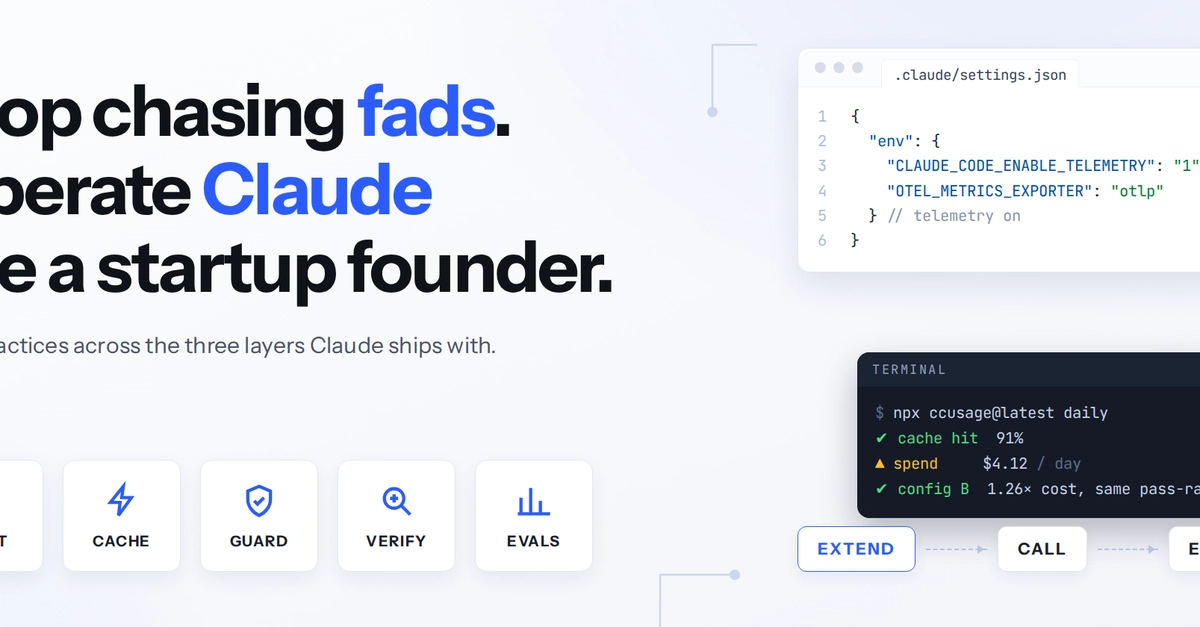
Beyond the Hype: Operating AI Like a Startup
The allure of the next big AI model or technique is powerful, especially for startups operating at the bleeding edge. Early on, the temptation to master every new AI development can be overwhelming. This often leads to a diffusion of focus, where developers and founders spend more time experimenting with fleeting trends than solving core business problems. The result? A sprawling skillset, bloated infrastructure, and API bills that skyrocket without delivering tangible business value. This isn't about needing a hundred skills or complex server farms; it's about getting clear answers to fundamental questions: What is this AI costing us? Is the output actually usable and reliable? Is this new technique genuinely improving our product, or is it just making us feel productive?
These are operational questions. While using a model like Claude to generate code or text might seem straightforward—prompt, generate, ship—true value emerges from the system built around the model. Operationalizing AI is what transforms raw output into a trusted, scalable component of a business. It's not solely about the inherent quality of the AI model itself, but about the robust framework supporting its integration and deployment.
The surprising realization for many is that the necessary tools for effective AI operation are often already built into the platforms they use. Claude, for instance, offers layers of functionality designed to support this operational rigor, catering to different needs:
- Extend Claude Code: This layer allows for the integration of custom configurations and logic directly with Claude's output. Think of it as adding guardrails and bespoke workflows to the AI's capabilities. This isn't about reinventing the wheel, but about tailoring the AI's output to specific business requirements, ensuring consistency and adherence to standards.
- Call the API Directly: For more granular control or integration into existing systems, direct API calls provide flexibility. This is where developers can embed Claude's capabilities into their applications, triggering specific tasks or data processing pipelines. It enables programmatic interaction, allowing the AI to become a seamless part of larger workflows.
- Build on Claude: The highest level of integration involves building entire applications or services powered by Claude. This requires a deeper understanding of prompt engineering, output parsing, and error handling, but unlocks the potential for truly AI-native products. It means designing user experiences and business processes that are fundamentally enhanced by AI.
The Core Operational Questions
Instead of chasing the latest LLM release or a novel prompting technique, founders and developers should anchor their AI strategy in a few critical operational questions. These questions cut through the noise and focus on what truly matters for business viability and growth:
Cost Management
Understanding the financial implications of AI usage is paramount. This involves tracking API calls, token consumption, and the overall cost per task or per user. Without this visibility, a startup can quickly find itself with an unsustainable AI infrastructure bill. It’s crucial to implement monitoring and potentially set budget alerts to prevent runaway expenses. This is akin to managing cloud infrastructure costs; if you don't watch it, it will grow exponentially.
Output Reliability and Usability
The quality of AI-generated content is a primary concern. Is the code generated by Claude bug-free and idiomatic? Does the generated text meet brand voice and factual accuracy standards? Implementing validation steps, such as automated code testing, human review workflows, or fact-checking mechanisms, is essential. The goal is to ensure that the AI's output is not just produced quickly, but that it is also trustworthy and directly usable, minimizing the need for extensive post-generation editing or correction.
Performance and Impact Measurement
It's vital to assess whether adopting a new AI tool or technique actually yields a positive return on investment. This means moving beyond subjective feelings of busyness and defining clear metrics for success. For example, if using Claude for code generation is intended to speed up development cycles, measure the actual reduction in time-to-market for new features. If it's for customer support, track improvements in response times or customer satisfaction scores. Without measurable outcomes, it’s impossible to discern genuine progress from the illusion of activity.
Structuring Your AI Operations
An AI-native startup's operational framework should be built on principles that prioritize focus and efficiency. This means adopting a startup founder's mindset towards AI integration:
- Start with the Problem, Not the Tool: Identify the specific business problem you are trying to solve. Then, evaluate which AI tools, including Claude's various layers of functionality, are best suited to address that problem effectively and efficiently. Avoid adopting AI for AI's sake.
- Iterate on Operational Workflows: Treat your AI integration as a product feature that requires continuous improvement. Regularly review your prompts, your surrounding logic, and your output validation processes. Gather feedback from users and stakeholders to refine the system over time.
- Prioritize Visibility and Control: Implement robust logging, monitoring, and analytics for your AI usage. Understand what's happening under the hood, how much it's costing, and what impact it's having. This visibility is critical for making informed decisions about scaling, optimization, and future AI investments.
- Focus on Integration, Not Just Generation: The real power of AI for startups lies in its seamless integration into existing business processes and products. This requires careful consideration of how AI output is consumed, validated, and acted upon. Building a reliable operational layer around the AI model is more critical than simply having access to the most advanced generation capabilities.
By shifting the focus from chasing AI fads to diligently addressing core operational questions and building robust integration frameworks, startups can harness the true power of AI models like Claude. This disciplined approach ensures that AI investments translate into measurable business outcomes, sustainable growth, and a competitive edge, rather than becoming an expensive distraction.