AI Adoption Faces a Reality Check
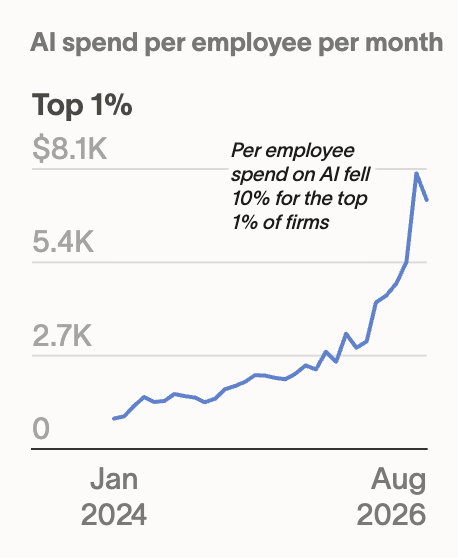
The initial frenzy surrounding AI adoption, particularly among hyperscalers, appears to be cooling. August data reveals a notable slump in AI spend per employee across top firms, a trend that deviates from the exponential growth many had anticipated. This decline is not just a minor fluctuation; it suggests a broader recalibration of AI investment strategies as companies move past the initial excitement and into a phase of more pragmatic evaluation.
Several factors are contributing to this shift. Firstly, the cost of AI, particularly the "token costs" associated with large language models (LLMs), has been steadily decreasing. As the underlying infrastructure becomes more efficient and competition among AI providers intensifies, the per-unit cost of AI inference and training is falling. This naturally leads to a reduction in overall spend, even if usage remains constant or grows modestly. Cheaper models are becoming more accessible, allowing companies to achieve similar or even better results with less expenditure.
The narrative of unchecked AI expansion, where every employee is equipped with the latest AI tools regardless of immediate ROI, is being replaced by a more discerning approach. Companies are beginning to ask harder questions about the tangible benefits and return on investment for their AI initiatives. This is a critical juncture, moving from a land-grab mentality to one focused on sustainable, value-driven integration.

Beyond the Hype: Reasons for the Slump
The decrease in AI spend per employee isn't a singular event but a confluence of market dynamics and strategic adjustments. One of the most significant drivers is the maturation of AI models and the surrounding ecosystem. As more companies develop and deploy AI, the market has responded with greater efficiency and competition. This has led to a reduction in the cost of essential components, such as compute power and specialized AI hardware. Furthermore, the development of more optimized AI algorithms and techniques means that businesses can achieve comparable outcomes with fewer resources.
Think of it less like a gold rush where everyone is digging for the same precious metal, and more like the early days of cloud computing. Initially, adoption was driven by the promise of innovation and a 'get in early' mentality. Over time, as the technology matured, businesses became more focused on cost optimization, scalability, and demonstrable ROI. The current AI landscape appears to be entering a similar phase. Companies are no longer just buying AI; they are buying specific AI solutions that solve particular problems and deliver measurable business value.
The initial wave of AI adoption often involved broad deployments across entire workforces. This included providing access to generative AI tools for content creation, coding assistance, and general productivity enhancements. However, as companies analyze their usage data, they are likely discovering that the actual utilization and impact of these tools vary significantly by role and department. This realization prompts a strategic shift towards more targeted AI deployments, focusing on areas with the highest potential for efficiency gains or revenue generation.
Is This a Summer Doldrum or a Systemic Shift?
The question remains whether this August slump is merely a seasonal dip, characteristic of summer slowdowns in many industries, or a more profound indicator of a fundamental change in AI investment strategy. Historically, August can see reduced activity as employees take vacations and decision-making processes slow down. However, the sustained nature of cost reductions in AI infrastructure and models suggests that this trend might have longer-term implications.
If the cost of AI continues to decline and companies become more discerning about their investments, we could see a more balanced growth trajectory. Instead of a hockey-stick growth in spend, we might witness a more gradual adoption curve, driven by proven use cases and clear business cases. This would be a healthier, more sustainable path for the AI industry, leading to more robust and impactful applications rather than speculative ventures.
The surprising detail here is not just that spending is down, but that it's happening at the top firms. These are the companies with the deepest pockets, the most aggressive innovation agendas, and the talent pools to effectively leverage advanced AI. Their re-evaluation of spending suggests that even the most technologically forward-thinking organizations are hitting a point where they need to justify AI investments beyond mere technological adoption. This implies that the market is maturing, and the focus is shifting from 'can we do this?' to 'should we do this, and how can we do it most effectively?'
Future Implications for AI Investment
The implications of this trend are far-reaching. For AI vendors, it means a greater emphasis on demonstrating clear ROI and value propositions. Generic AI solutions may struggle, while those that offer specific, measurable benefits and cost efficiencies are likely to thrive. Companies will demand more transparency in pricing and a clearer understanding of how AI investments translate into business outcomes.
For enterprises, this shift encourages a more strategic approach to AI. Instead of widespread, undifferentiated deployments, organizations will likely focus on identifying high-impact use cases, optimizing their existing AI infrastructure, and potentially consolidating AI toolsets. The pressure to justify every dollar spent on AI will intensify, leading to more rigorous performance metrics and accountability frameworks.
What nobody has addressed yet is what happens to the thousands of developers who have been tasked with integrating these AI tools across their organizations. Will their roles pivot from rapid implementation to deep optimization and cost-benefit analysis? The ongoing evolution of AI investment will undoubtedly reshape internal development teams and their strategic priorities.
Ultimately, this period of re-evaluation could lead to more sustainable and impactful AI adoption. By moving beyond the initial hype and focusing on pragmatic, value-driven integration, businesses can ensure that their AI investments contribute meaningfully to long-term growth and competitive advantage. The path forward is not about spending more, but about spending smarter.