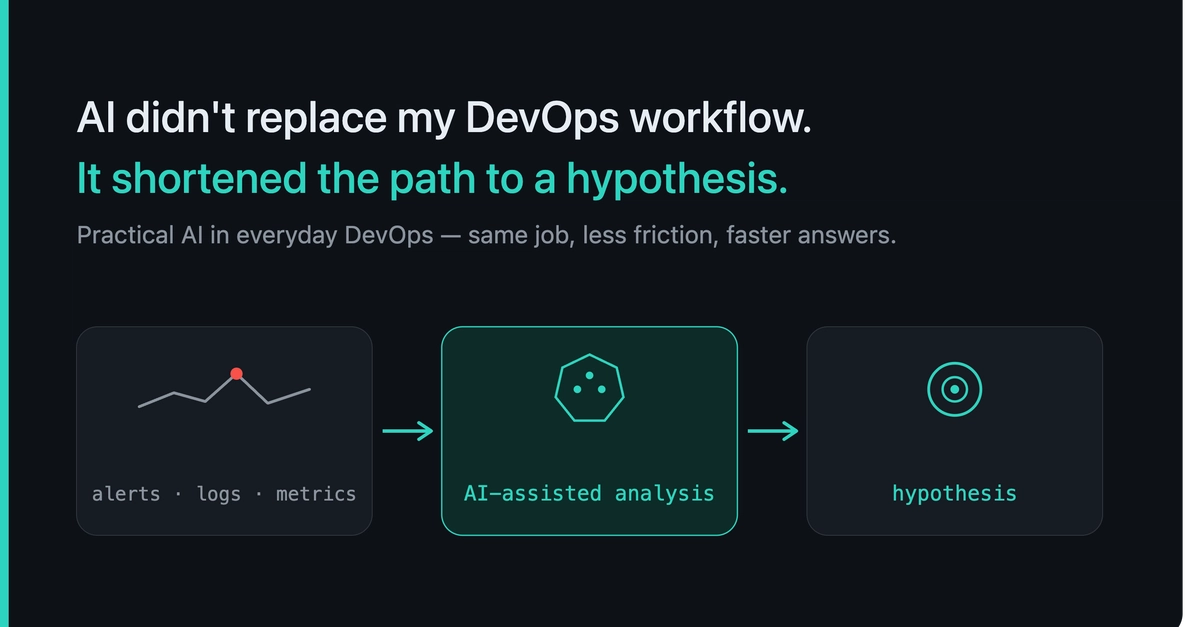
AI as a Catalyst, Not a Replacement, in DevOps Troubleshooting
The siren song of AI in technology often promises automation and efficiency. For DevOps engineers, this typically conjures images of AI autonomously resolving incidents, flagging misconfigurations, or even writing code. However, the reality, as experienced by many practitioners, is more nuanced. AI has not replaced the core functions of a DevOps workflow; instead, it has significantly compressed the time it takes to move from detecting an anomaly to formulating a testable hypothesis about its cause. The actual, hands-on troubleshooting and correlation of disparate signals remain firmly in the human engineer's domain.
Consider a typical incident response scenario. An alert fires, signaling that something is amiss within the system. The immediate human reaction is a cascade of diagnostic steps. This often involves opening multiple browser tabs, each dedicated to a specific monitoring or logging tool. Grafana for visualization, CloudWatch for AWS metrics, log aggregation platforms for detailed error messages, kubectl describe for Kubernetes pod status, GitHub for recent code changes, and Argo CD for deployment history. This multi-faceted investigation requires holding several timelines and data streams in one's mind simultaneously.
It's within this complex, information-rich environment that the critical juncture arrives. As an engineer digs through terabytes of logs and metrics, a colleague might ping the team channel: "Do we know what happened yet?" This question highlights the true nature of the DevOps job during an incident. It's not about memorizing obscure command-line flags or intricate syntax. The core task is the rapid correlation of these scattered signals—from network latency to application errors, from recent deployments to infrastructure changes—to form a coherent hypothesis that can then be rigorously tested. This is the bottleneck AI is beginning to address.
AI tools are not yet capable of independently navigating this intricate web of data and context. They cannot yet understand the subtle interplay between a recent code merge, a configuration drift, and an unexpected surge in user traffic with the intuitive grasp of an experienced engineer. The AI's role is not to perform the kubectl describe or to parse the logs. Instead, it acts as a powerful assistant in the preparatory phase. It can sift through vast datasets, identify patterns that might escape human observation due to sheer volume, and surface the most statistically relevant events or anomalies. This significantly reduces the time spent on the initial data gathering and pattern recognition, allowing the engineer to focus on the higher-level cognitive tasks of interpretation and hypothesis formulation.

The Human Element in Hypothesis Generation
The process of forming a hypothesis is more than just pattern matching. It involves domain expertise, an understanding of system architecture, and an intuition built from past experiences. When an AI flags a correlation—for instance, a spike in database errors coinciding with a new feature rollout—it presents this as a data point. The engineer then applies their knowledge to interpret this correlation. Is the new feature directly causing the database load? Was there a concurrent infrastructure change that's the real culprit? Could it be a coincidence amplified by the AI's sensitivity?
This is where the trust factor becomes paramount. Engineers still need to validate AI-generated insights. They must verify the data sources, understand the AI's limitations, and ensure that the suggested correlations are not spurious. The AI might point to a specific log message, but the engineer needs to understand the context of that message within the application's lifecycle and the broader system's health. This deep understanding prevents the adoption of faulty hypotheses, which can lead to wasted debugging effort and prolonged incident resolution times.
The AI's contribution is in making the initial search space smaller and more relevant. Instead of staring at ten browser tabs and wondering where to start, an engineer might be presented with two or three AI-identified areas of interest. This could be a specific time window, a set of related error codes, or a group of services exhibiting unusual behavior. This targeted approach dramatically shortens the path to forming a hypothesis. It's akin to having a research assistant who pre-sorts your literature review, highlighting the most pertinent papers, but you, the researcher, still need to read them, synthesize the findings, and draw your own conclusions.
Where AI Falls Short: Trust and Context
Despite its utility in accelerating the initial stages of incident response, AI has not yet earned unconditional trust in critical DevOps functions. The reasons are manifold. Firstly, AI models are often trained on historical data. While this is valuable for identifying known patterns, it can struggle with novel issues or edge cases that deviate significantly from past incidents. An engineer's intuition, honed by experience with unique system behaviors, often proves more adept at diagnosing these uncharted territories.
Secondly, the