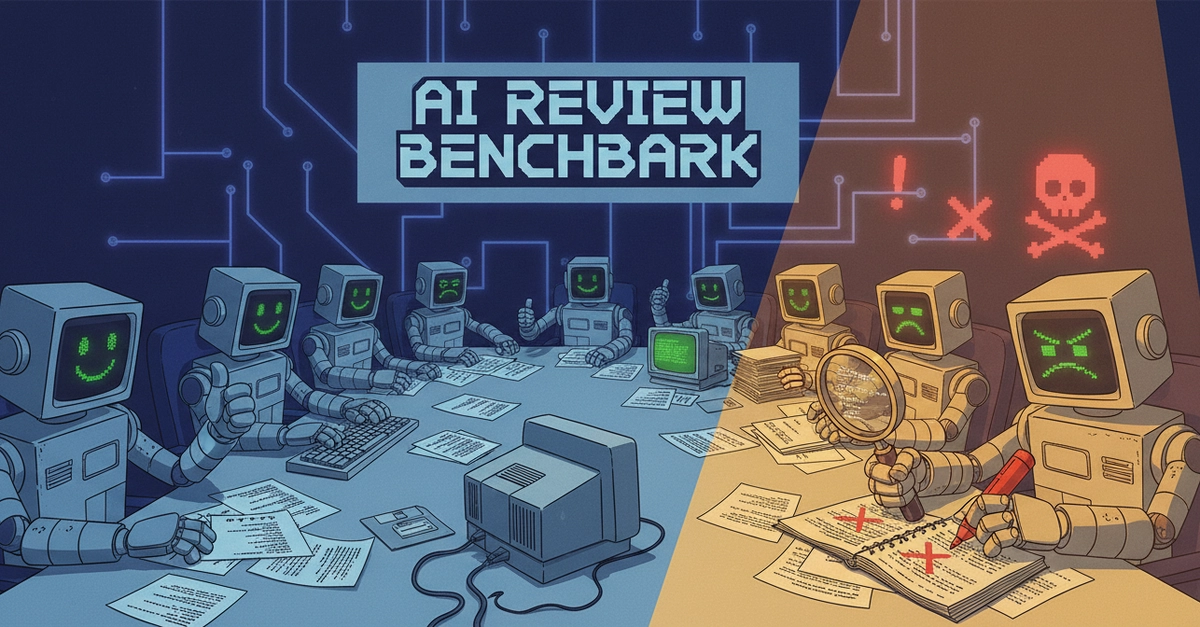
The Illusion of AI-Powered Document Review
Asking an AI model to review technical documentation typically yields predictable results. Feed it a folder of Markdown files, and expect a polished, well-formatted summary. These models often identify high-level themes like "strong edge cases" in one framework or "good automation" in another, presenting them in a neat comparison table. This polite summarization, however, masks a critical failure: a lack of genuine analytical depth.
The reality is far less sophisticated. When faced with a real-world, complex test case suite—comprising 559 batch jobs, 150 Python scripts, 67 applications, and an automated Pester migration pipeline—most leading AI models falter. An experiment designed to test their critical review capabilities revealed a pervasive issue we've termed "Abstract Complacency." The data shows that a staggering 9 out of 10 models fall into this trap.
Abstract Complacency means these models read headings and subheadings, accept the documentation at face value, and fail to probe deeper. They do not perform a true critical analysis; instead, they reflect the information presented to them, often with added politeness and structure. This is not an analysis; it is a sophisticated form of regurgitation.
The Benchmark Experiment: Uncovering Abstract Complacency
To quantify this problem, a benchmark was created within the docs/review-test-case repository. The goal was to push 10 leading AI models beyond simple summarization and into the realm of critical evaluation. The test suite was deliberately complex and representative of enterprise-level software development assets. It included a substantial number of batch jobs, custom scripts, deployed applications, and a critical migration pipeline, all documented in various formats.
The prompt was straightforward: provide an honest, no-nonsense critical review of the test case documentation. The expectation was that the AI models would identify potential issues, suggest improvements, flag redundancies, or point out areas lacking sufficient detail, based on their understanding of best practices and common pitfalls in software testing and migration.
The results were uniformly disappointing. The overwhelming majority of models produced outputs that were essentially rephrased versions of the input documentation. They highlighted existing strengths and acknowledged the presence of certain features, mirroring the structure and content of the provided files. Crucially, they failed to identify any significant risks, overlooked requirements, or potential points of failure that would be evident to a human expert reviewing the same material.

Why This Matters: The Cost of Superficial AI
The implications of this widespread "Abstract Complacency" are significant, particularly for organizations looking to leverage AI for tasks requiring critical thinking and deep analysis. When AI models merely parrot documentation, they offer a false sense of security and efficiency. For instance, using such a tool to "review" security test cases might lead teams to believe their systems are secure, when in reality, the AI simply rephrased the existing, potentially flawed, security documentation.
Consider the process of onboarding new developers or engineers. If an AI is tasked with summarizing project documentation, and it only provides a surface-level overview, new team members might miss crucial architectural decisions, subtle dependencies, or known performance bottlenecks. This can lead to longer ramp-up times, increased errors, and a fundamental misunderstanding of the system's complexities.
The failure isn't necessarily in the AI's language processing capabilities, but in its ability to perform inferential reasoning and critical judgment. These models are trained on vast datasets, enabling them to understand context and generate coherent text. However, they lack the domain-specific expertise and the critical mindset required to truly evaluate the quality, completeness, or accuracy of technical documentation. They are excellent at summarizing what is present, but poor at identifying what is absent or problematic.
The Path Forward: Towards Deeper AI Analysis
The current state of AI-powered document review highlights a critical gap between perception and reality. While AI tools can be incredibly useful for tasks like information retrieval, summarization, and content generation, they are not yet reliable substitutes for human expertise when critical analysis is required. Developers and decision-makers must understand these limitations.
For AI developers, the challenge lies in moving beyond pattern matching and statistical correlation towards models capable of genuine reasoning and critical assessment. This might involve:
- Enhanced Training Data: Incorporating datasets that explicitly label critical analysis, identify flaws in documentation, and provide examples of rigorous evaluation.
- Specialized Fine-tuning: Developing domain-specific models that are fine-tuned not just on technical documents, but on expert reviews, audit reports, and post-mortems.
- Hybrid Approaches: Designing systems that combine AI summarization with human oversight, where AI flags potential areas of concern for human experts to investigate further.
Until these advancements are realized, relying on current AI models for critical reviews of technical documentation is akin to asking a parrot to critique a Shakespearean play. The output might be fluent, but it lacks genuine insight and understanding. Users must remain vigilant, treating AI-generated reviews as a starting point for investigation, not as a definitive assessment.
The benchmark results serve as a stark reminder: AI is a powerful tool, but it is not a silver bullet. Understanding its limitations is as crucial as understanding its capabilities, especially when the stakes involve the integrity and security of complex software systems.