The AI Code Generation Hype Cycle
The narrative is familiar: a new AI model emerges, and with it, the predictable pronouncement that junior developers are obsolete. Tools like GitHub Copilot, Cursor, and Claude Code are frequently cited as evidence that AI can now write code, rendering entry-level human programmers redundant. The argument, often posed as a question – "Why hire a junior developer when AI can write code?" – sounds compelling at first glance. However, this perspective fundamentally misunderstands the role of junior developers and the nature of software engineering.
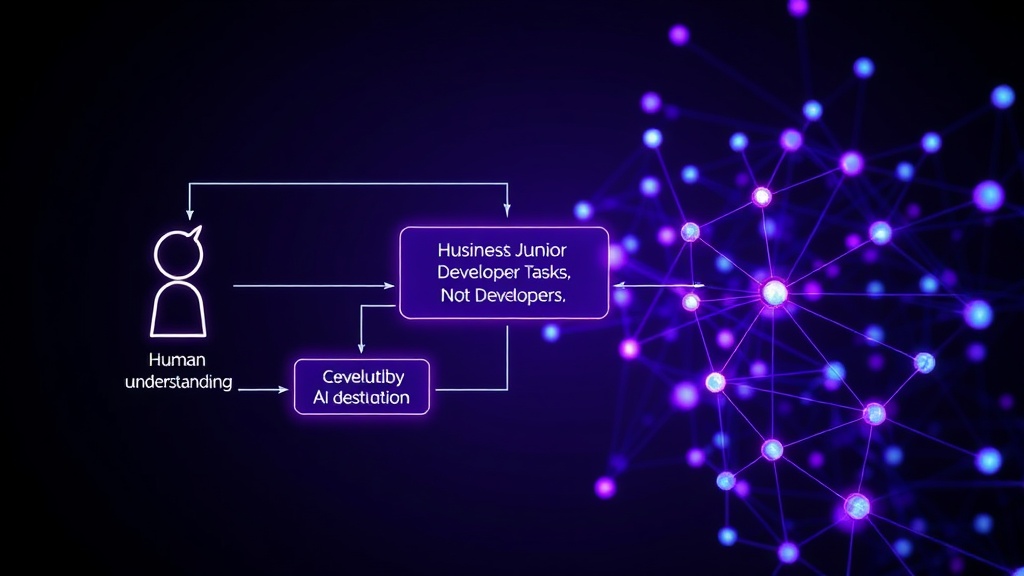
Spending time building software with AI daily reveals a different reality. AI isn't replacing junior developers; it's replacing junior tasks. These are distinct concepts. The core of software engineering extends far beyond mere code generation. It involves understanding business needs, debugging complex systems, collaborating with teams, and architecting solutions – skills that current AI models, while impressive, do not possess.
Writing Code Was Never the Entire Job
Many observers conflate writing code with the entire practice of software engineering. This is a critical error. For junior developers, the early stages of their careers are often about mastering foundational coding skills, understanding syntax, and implementing straightforward logic. These are precisely the types of tasks that AI excels at automating. AI can generate boilerplate code, suggest completions, and even write simple functions based on prompts. This automation frees up junior developers from tedious, repetitive work.
Consider the analogy of a skilled artisan. A master carpenter doesn't just wield a hammer; they understand wood types, structural integrity, design principles, and client needs. The hammer is a tool, essential for building, but it doesn't replace the carpenter's expertise. Similarly, AI code generators are powerful tools. They augment the capabilities of developers, allowing them to focus on higher-level cognitive tasks. For junior developers, this means transitioning from being code typists to becoming problem solvers and collaborators.
The Business Logic Gap
The true value junior developers bring, and will continue to bring, lies in their ability to understand and translate business requirements into functional software. This involves nuanced communication, asking clarifying questions, and grasping the implicit context of a project. AI agents, despite rapid advancements, struggle significantly with this. While frameworks like LangGraph, CrewAI, AutoGen, and OpenAI Agents promise automated workflows, their effectiveness hinges on a crucial prerequisite: a well-defined business language that the AI can understand.
Every enterprise has its own unique lexicon, its own way of defining processes, and its own set of priorities. Finance departments speak of invoices, receivables, and P&L statements. Marketing teams discuss campaigns, KPIs, and customer segmentation. These are not generic terms; they are the specific language of that business. AI agents can be programmed to execute tasks based on predefined instructions, but they lack the inherent understanding of business context that a human junior developer acquires through immersion and interaction.
The Evolving Role of the Junior Developer
The rise of AI coding assistants necessitates an evolution in the junior developer role, not its elimination. Instead of spending hours writing repetitive code, junior developers can now dedicate more time to:
- Understanding Business Requirements: Engaging with stakeholders, asking probing questions, and ensuring a deep comprehension of project goals.
- Debugging Complex Issues: AI can assist in identifying bugs, but tracing the root cause of subtle, system-wide defects often requires human intuition and systematic investigation.
- Architectural Design: Contributing to the design of software systems, considering scalability, maintainability, and security from the outset.
- Collaboration and Mentorship: Working effectively within a team, learning from senior developers, and eventually mentoring future junior engineers.
- Testing and Validation: Developing comprehensive test suites and validating that the software meets business needs beyond just functional correctness.
This shift moves the focus from manual code production to higher-order thinking, problem-solving, and strategic contribution. Junior developers become integral to bridging the gap between raw AI capabilities and tangible business value. They are the translators, the debuggers, and the early architects who ensure that AI-generated code serves a real purpose within the intricate ecosystem of an enterprise.
The Future is Augmented, Not Replaced
The fear that AI will replace junior developers is misplaced. Instead, AI is acting as a powerful co-pilot, automating the low-level, repetitive tasks that once consumed a significant portion of an entry-level developer's time. This allows junior engineers to accelerate their learning, tackle more challenging problems earlier in their careers, and contribute more meaningfully to their teams and organizations. The key for businesses and aspiring developers alike is to embrace this shift, focusing on developing the critical thinking, communication, and problem-solving skills that AI cannot replicate. The future of software development is augmented, with AI enhancing human capabilities rather than rendering them obsolete.