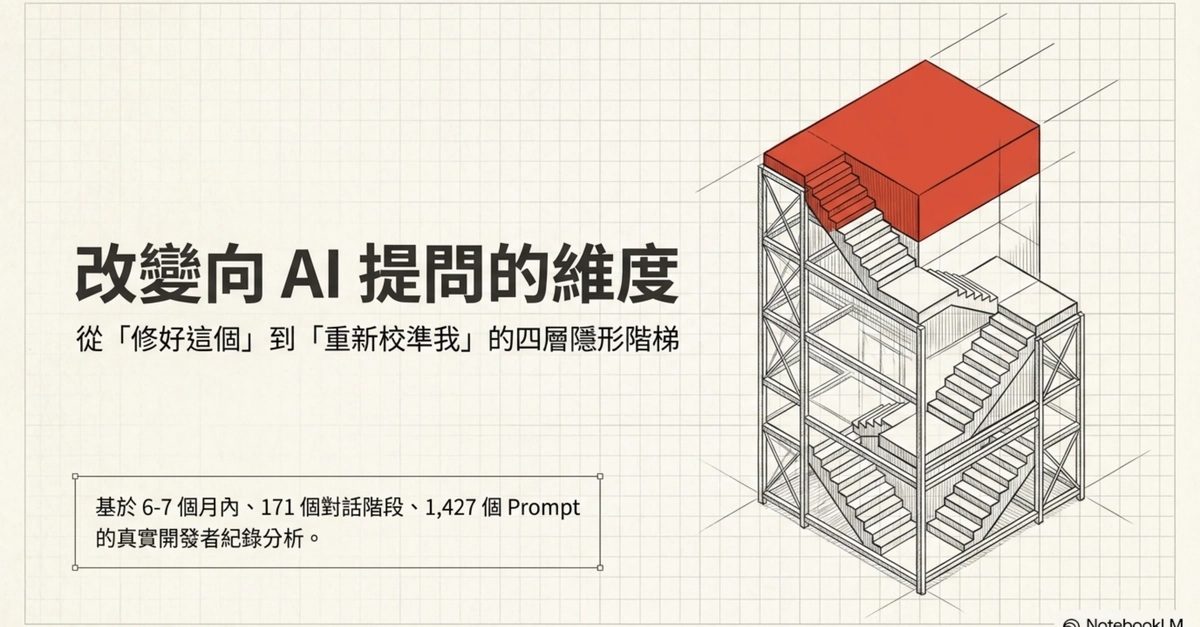
The Shifting Sands of AI Interaction
The way we prompt AI is not static. It evolves. What began as a tool for simple task execution, akin to a digital assistant fetching information or fixing code snippets, is rapidly maturing into something far more sophisticated. A recent analysis of personal AI prompts, spanning just six weeks, illustrates this dramatic transformation. The shift is from asking AI to execute commands like "Fix this bug" to seeking higher-order cognitive support, exemplified by requests such as "Recalibrate my thinking." This evolution signifies a deeper integration of AI into our problem-solving processes, moving beyond mere command-response to a collaborative partnership.
Consider the contrast in prompts. On June 24th, a developer asked an AI:
"That checkout button does nothing. No console error either. Help me find the cause."
This is a classic debugging scenario. The user identifies a specific problem – a non-functional checkout button with no apparent error messages – and delegates the task of root cause analysis to the AI. It’s a precise, problem-oriented request, seeking a technical solution within a defined scope.
Fast forward to July 23rd, and the same individual posed a fundamentally different question:
"I need you to correct my thinking. I'm not offering the kind of automation-plumbing service that everyone already does — what's the real value I provide? Please recalibrate me."
This second prompt represents a seismic shift. It’s not about fixing a broken component; it’s about fundamentally re-evaluating one’s own professional identity and value proposition. The user is not asking for a specific answer, but for a reframing of their perspective, a correction of their self-perception. This is asking AI to act as a cognitive sparring partner, a mentor, or even a therapist, helping to clarify complex, abstract concepts about personal value and market positioning.
From Floors to Stratospheres: The Prompting Spectrum
The analogy of "two completely different floors of a building" aptly captures the divergence. The first prompt operates on a lower floor – the ground level of immediate, tangible problems. It’s about diagnostics, execution, and direct intervention. The AI is a specialized tool for a specific technical task.
The second prompt, however, ascends to a much higher, more abstract floor. It’s about strategy, identity, and self-understanding. Here, the AI is not just a tool but a collaborator in a process of introspection and strategic realignment. It requires the AI to not just process information but to understand nuance, context, and subjective value, and then to offer constructive critique or guidance. This leap signifies a user who has moved beyond simply using AI to solve problems, to using AI to *understand* problems, and even to understand themselves better.
This evolution is not unique to this single developer. It reflects a broader trend observed across the AI user base. As users become more comfortable with AI capabilities, they naturally push the boundaries of what they expect from these tools. The initial fascination with AI's ability to perform tasks, often perceived as mundane or time-consuming, gives way to an exploration of its potential for more complex cognitive functions. This includes brainstorming, strategic planning, creative ideation, and, as seen in the example, self-reflection and personal recalibration.
The Implications for AI Development and Usage
The data, comprising 1,427 prompts, suggests that users are not just learning to prompt better; they are fundamentally changing *what* they are prompting for. The technical skills required for the first type of prompt involve precise language, clear problem definition, and knowledge of potential error states. The second type demands a different skillset: vulnerability, a willingness to explore ambiguity, and the ability to articulate abstract concepts and personal uncertainties.
This shift has profound implications for AI developers and the companies building these tools. It means that future AI models will need to be robust enough to handle not just factual queries and command executions, but also nuanced, subjective, and introspective dialogues. The training data and model architectures will need to accommodate these more complex, human-centric interactions. This could involve developing AI that can better understand intent, context, and emotional undertones, and that can provide empathetic, constructive, and insightful responses rather than just technically accurate ones.
For users, this evolution signals a move towards a more symbiotic relationship with AI. It’s no longer a master-apprentice dynamic, but a partnership where both parties contribute uniquely. The human brings the context, the lived experience, the subjective goals, and the willingness to be vulnerable. The AI brings computational power, vast knowledge recall, pattern recognition, and the ability to process information at scales far beyond human capacity. Together, they can tackle problems that neither could solve alone, especially those that require both technical execution and deep strategic or personal insight.
The ultimate question that remains is how these increasingly sophisticated AI interactions will be measured. When AI is used not just to debug code but to debug our professional identities, what metrics define success? Is it code quality, time saved, or a more profound shift in user confidence and strategic clarity? The long-term impact will depend on our ability to foster and measure these higher-order collaborative outcomes.