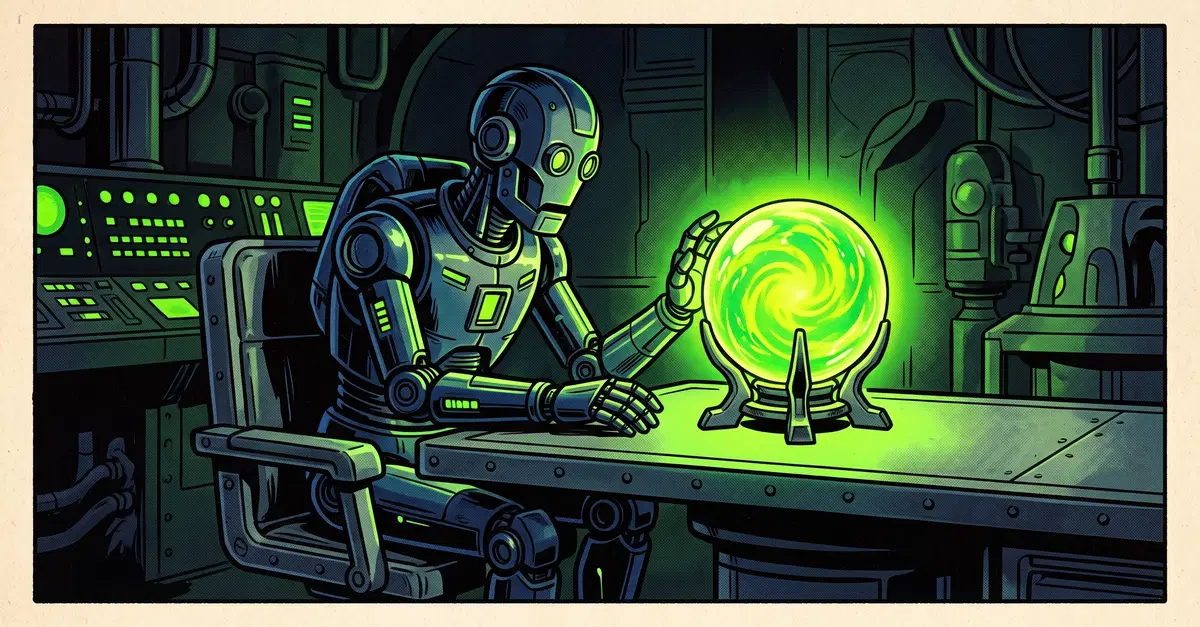
AI's Trajectory: A Look Ahead to August 2026
The rapid advancement of Artificial Intelligence is reshaping industries and daily life at an unprecedented pace. Based on extensive project work, client consultations, and hands-on development, a clear picture is emerging of AI's trajectory over the next two years. This outlook synthesizes 59 predictions across 17 distinct categories, offering a comprehensive view of what's to come for AI and its broader societal implications.
Core AI Development and Infrastructure
The foundational elements of AI are set for significant evolution. Expect a dramatic increase in the efficiency and accessibility of AI model training. This will be driven by advancements in specialized hardware, such as next-generation GPUs and TPUs, and more efficient distributed computing frameworks. The cost of training large models will decrease, democratizing access for smaller organizations and individual developers. Furthermore, the development of novel AI architectures, moving beyond current transformer models, will unlock new capabilities in areas like long-context understanding and multimodal reasoning. The focus will shift towards smaller, more specialized models that can be deployed edge-side, reducing latency and enhancing privacy. This trend is akin to the shift from monolithic desktop applications to the era of mobile apps and microservices – a move towards more distributed, efficient, and specialized deployment.
Data management and synthetic data generation will become critical bottlenecks and solutions. As models become more powerful, the demand for high-quality, diverse training data will skyrocket. Expect significant investment in tools and techniques for automated data labeling, cleaning, and augmentation. Synthetic data generation will move from a niche technique to a mainstream necessity, enabling the creation of vast, customized datasets without privacy concerns or real-world collection limitations. This will be crucial for training models in sensitive domains like healthcare and finance.
AI in Software Development and Operations
The software development lifecycle will be profoundly transformed. AI-powered coding assistants will evolve from basic code completion tools to sophisticated collaborators, capable of generating complex functions, debugging entire modules, and even proposing architectural improvements. This will significantly accelerate development cycles, allowing teams to focus more on design and problem-solving rather than boilerplate code. Think of these tools less as intelligent auto-complete and more as junior pair programmers who never sleep.
AI will also permeate software testing and quality assurance. Automated test case generation, intelligent bug detection, and predictive failure analysis will become standard. AI will analyze code changes and historical bug data to identify high-risk areas, allowing QA teams to focus their efforts more effectively. This proactive approach will lead to more robust and reliable software releases. In the realm of DevOps, AI will optimize CI/CD pipelines, predict infrastructure failures, and automate incident response, leading to more resilient and efficient operations. The concept of an AI-powered SRE (Site Reliability Engineer) will become a reality, capable of monitoring, diagnosing, and resolving issues autonomously.
AI's Impact on Content Creation and Media
The landscape of content creation will see widespread disruption. AI will become an indispensable tool for writers, artists, musicians, and video producers. Expect AI to generate drafts of articles, scripts, marketing copy, and even entire books. In visual media, AI will facilitate the creation of photorealistic images, sophisticated animations, and even short films from text prompts or simple storyboards. Personalization of content will reach new heights, with AI dynamically tailoring articles, videos, and music to individual user preferences in real-time.
The lines between human-created and AI-generated content will blur. Verification and authenticity will become paramount concerns. New tools and techniques will emerge to watermark AI-generated content and detect sophisticated deepfakes. This will lead to a greater emphasis on human curation and editorial oversight to maintain trust and credibility. The ethical implications of AI-generated art and media, including copyright and ownership, will be a major area of debate and regulatory development.
AI in Business Strategy and Operations
Businesses will leverage AI for hyper-personalized customer experiences. AI-powered recommendation engines will become more nuanced, anticipating customer needs before they are even expressed. Customer service will be augmented by AI chatbots capable of handling complex queries, providing personalized support, and escalating issues to human agents only when necessary. This will lead to significant improvements in customer satisfaction and operational efficiency.
Strategic decision-making will be heavily influenced by AI-driven analytics. AI will analyze vast datasets to identify market trends, predict competitor actions, and model the impact of various business strategies. This will enable faster, more data-informed decisions. The role of the business analyst will evolve, focusing more on interpreting AI insights and formulating strategic questions rather than manual data processing. AI will also optimize supply chains, predict demand fluctuations, and automate procurement processes, leading to more agile and cost-effective operations.
The Broader Societal and Ethical Landscape
The integration of AI into society will raise complex ethical and regulatory questions. Issues of bias in AI algorithms, job displacement, and data privacy will demand attention from policymakers and industry leaders. Expect to see the development of more robust AI ethics frameworks and potentially new regulatory bodies dedicated to overseeing AI development and deployment. The concept of AI alignment – ensuring AI systems act in accordance with human values – will move from academic discussion to practical implementation challenges.
The nature of work will continue to shift. While some jobs may be automated, new roles centered around AI development, management, and oversight will emerge. Lifelong learning and reskilling will become essential for individuals to adapt to the evolving job market. The digital divide may widen if access to AI tools and education is not equitable. Addressing these challenges proactively will be crucial for ensuring AI benefits society as a whole.