Revisiting the Crystal Ball: AI's Trajectory Two Years On
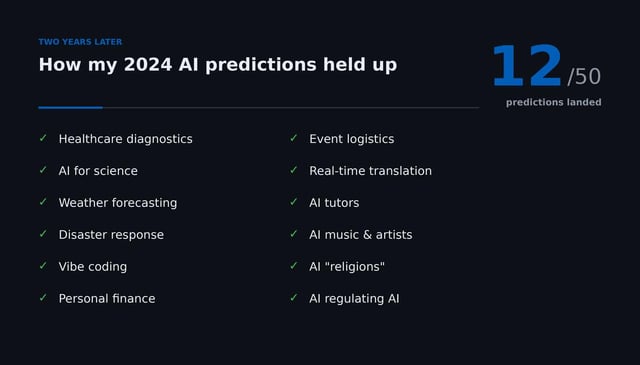
Two years ago, the landscape of Artificial Intelligence felt both rapidly evolving and brimming with potential. Predictions were rife, ranging from the cautiously optimistic to the wildly speculative. Now, with the benefit of hindsight, it’s time to revisit those forecasts and assess which ones landed with precision, which missed the mark entirely, and what those outcomes tell us about the true pace and direction of AI development.
The original set of predictions, published on LinuxBlog.io, covered a spectrum of AI applications, from enterprise adoption to creative tools and fundamental research advancements. The goal was not just to guess the future, but to identify key inflection points and technological shifts that would shape the AI ecosystem. Looking back, the most striking realization is how quickly some established trends accelerated, while others, once considered inevitable, proved more elusive or took a different path.
The Hits: Where AI Met Expectations
Several predictions from two years ago have materialized with remarkable accuracy. The widespread integration of AI into enterprise workflows, for instance, has been a dominant theme. Businesses have increasingly adopted AI for tasks ranging from customer service chatbots and personalized marketing to data analysis and predictive maintenance. This wasn't just about adopting new tools; it was about fundamentally rethinking operational efficiency and customer engagement through an AI lens.
The democratization of AI tools also stands out. What once required specialized expertise and significant computational resources is now accessible to a much broader audience. Generative AI models, in particular, have moved from research labs to mainstream applications, empowering individuals to create text, images, and even code with unprecedented ease. This accessibility has fueled innovation and experimentation, leading to novel use cases that were difficult to foresee.
Another area where predictions held firm is the continued advancement in large language models (LLMs). While the specific architectural breakthroughs might have been debated, the trajectory towards more capable, context-aware, and versatile LLMs was clear. Their ability to understand and generate human-like text has unlocked applications in summarization, translation, content creation, and sophisticated conversational agents.
The Misses: Unforeseen Hurdles and Detours
Not all predictions proved accurate. The expectation that AI would achieve true AGI (Artificial General Intelligence) within this timeframe, for example, has largely not materialized. While AI capabilities have expanded dramatically, the leap to human-level general intelligence remains a complex, long-term challenge. The nuances of consciousness, common sense reasoning, and true adaptability are proving more difficult to replicate than initially assumed.
Similarly, some predictions about specific industry disruptions were either premature or took unexpected forms. The wholesale replacement of human creative professionals by AI, for instance, has not happened. Instead, AI has largely become a powerful co-pilot or augmentation tool, changing workflows rather than eliminating roles entirely. The ethical and copyright considerations surrounding AI-generated content have also introduced significant friction and debate, slowing down certain adoption curves.
Another area of overestimation was the speed of regulatory frameworks catching up to AI advancements. The rapid pace of innovation outstripped the ability of governments and international bodies to establish comprehensive regulations. This lag has created uncertainty and has been a point of contention, impacting how certain AI technologies are developed and deployed.
The Underlying Trends: What We Learned
The successes and failures of these predictions offer critical insights into the nature of AI development. Firstly, the iterative nature of AI progress is more pronounced than a linear march towards a singular goal. Breakthroughs often build upon existing work in unexpected ways, and progress can be lopsided, with rapid advances in one area while others lag.
Secondly, the human element remains central. AI is not developing in a vacuum; it is shaped by human needs, ethical considerations, societal impacts, and regulatory pressures. The human response to AI – adoption, resistance, adaptation, and governance – is as crucial as the technological advancements themselves.
Finally, the distinction between narrow AI and general AI is more critical than ever. While narrow AI continues to excel in specific tasks and applications, the path to general intelligence is proving to be a marathon, not a sprint. The challenges are not just computational but also conceptual, touching upon fundamental questions of cognition and learning.
Looking Ahead: The Next Two Years
As we look to the next two years, the lessons learned from this retrospective are invaluable. We can expect continued, rapid progress in narrow AI applications, with more sophisticated tools for content generation, data analysis, and automation. The integration of AI into everyday devices and services will likely deepen.
However, the pursuit of AGI will remain a long-term endeavor, with incremental progress rather than a sudden leap. The focus will likely shift towards making AI systems more robust, explainable, and aligned with human values. Ethical considerations and regulatory frameworks will become increasingly important, shaping the direction of development and deployment.
The challenge for developers, founders, and researchers is to remain agile, to anticipate the real-world friction points, and to build AI systems that are not only powerful but also responsible and beneficial. The future of AI is not just about what technology can do, but how we choose to integrate it into our world.