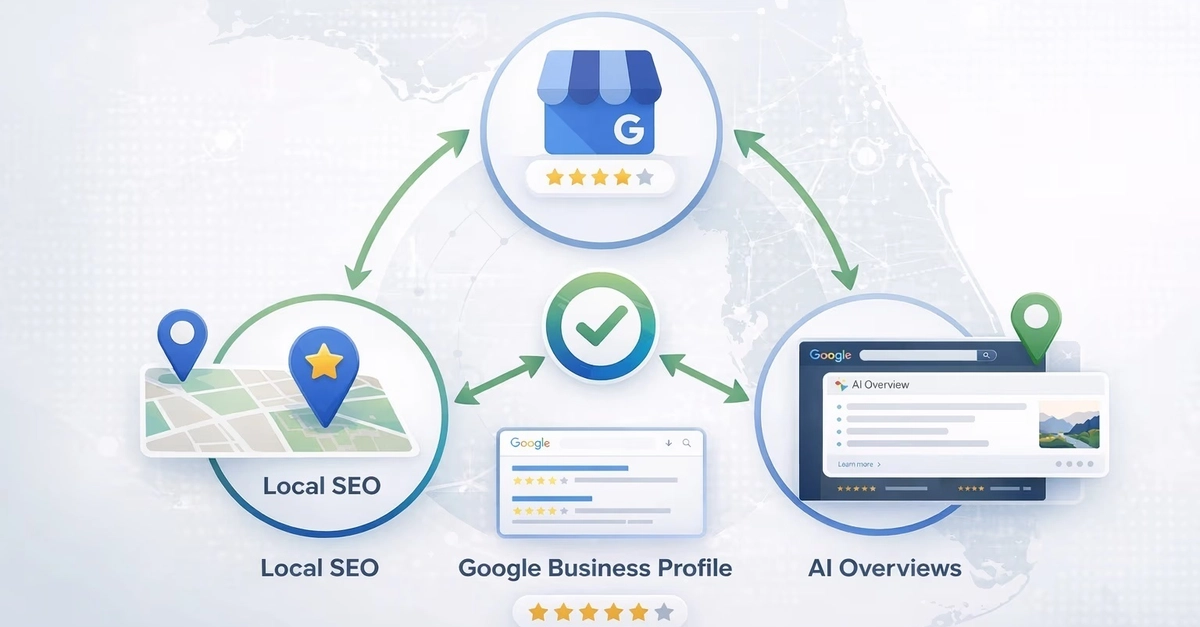
The Shifting Landscape of Local Search
If you build or maintain websites for local businesses, you've likely observed a concerning trend: organic click-through rates are declining, even when search engine rankings remain stable. The culprit is the rapid integration of AI Overviews into search results. These AI-generated summaries now appear in approximately 68% of local searches, significantly overshadowing the traditional three-pack local results which appear around 39% of the time. For specific queries like "near me" or those seeking pricing information, AI-powered answers are present in a staggering 80-97% of cases.
The implications for local businesses are profound. Simply ranking #1 in classic Search Engine Results Pages (SERPs) no longer guarantees a mention when a Large Language Model (LLM) synthesizes information for an AI Overview. This shift demands a fundamental re-evaluation of web optimization strategies. The job of web developers and SEO professionals has expanded beyond merely optimizing for crawlers that return links. The new objective is to optimize for models that can read, verify, and cite structured factual data, essentially competing for a spot within the AI's synthesized response.
ChatGPT, a prime example of an LLM driving this change, is already a significant player in local recommendations, reportedly ranking as the third most-used source, trailing only Google and Facebook. This underscores the growing reliance on AI-driven platforms for local discovery. The challenge for businesses is to ensure their critical information – services, hours, location, pricing – is not only accessible but also presented in a format that LLMs can easily ingest, trust, and incorporate into their generated answers.

Optimizing for AI: A New Technical Imperative
The core of this new optimization strategy lies in providing clear, structured, and verifiable data. This means moving beyond keyword stuffing and backlink building as the primary focus. Instead, developers must concentrate on creating rich, accurate, and easily parseable content that LLMs can confidently reference. This involves several key technical adjustments:
Structured Data Markup
Implementing schema.org markup is no longer a best practice; it's a necessity. Properly tagged data helps search engines and LLMs understand the context and attributes of your business information. This includes details like:
- Business Name and Address: Using `LocalBusiness` schema with specific types (e.g., `Restaurant`, `Plumber`).
- Opening Hours: Precisely tagging daily opening and closing times.
- Services Offered: Clearly defining and tagging each service with descriptions.
- Pricing Information: Specifying price ranges or specific service costs where applicable.
- Contact Information: Including phone numbers and website URLs in a structured format.
The goal is to provide a definitive source of truth for your business. When an LLM queries for information, it seeks reliable data points. Structured data acts as a direct signal, making your business's factual information readily available and less prone to misinterpretation.
Content Accuracy and Verifiability
LLMs are trained on vast datasets, but they also prioritize information that is consistent and verifiable across multiple reputable sources. For local businesses, this means ensuring that the information on their website is:
- Up-to-date: Regularly review and update hours, services, and pricing.
- Consistent: Ensure information matches across your website, Google Business Profile, and other online directories.
- Authoritative: Present information clearly and professionally, demonstrating expertise.
Think of your website not just as a brochure for human visitors, but as a highly reliable data feed for AI models. The more consistent and accurate your data, the more likely an LLM is to cite it.
Direct Answers and FAQs
Many AI Overviews directly answer user questions. Therefore, anticipating common questions and providing clear, concise answers on your website is crucial. A well-structured FAQ section, for example, can serve as a direct source for AI models to pull information from. Instead of just listing services, explain them. Answer common customer queries about availability, booking, or specific product features directly on the page.
Beyond SEO: New Tracking and Analytics
The shift to AI-driven search necessitates a rethink of how success is measured. Traditional SEO metrics like keyword rankings and organic traffic volume may become less indicative of true visibility. Developers need to instrument new forms of tracking to understand how their content is being consumed by AI models and whether it's being incorporated into AI Overviews.
This could involve monitoring:
- Mentions in AI Overviews: While direct tracking is challenging, analyzing competitor AI Overviews for common data sources can provide clues.
- Direct Traffic from AI Platforms: If platforms like ChatGPT provide attribution for recommendations, tracking this referral traffic becomes important.
- User Engagement with Answered Questions: Measuring how users interact with FAQ sections or content designed to answer specific queries.
The challenge is that the