
The Commoditization of AI Models
The artificial intelligence landscape is undergoing a fundamental shift. For years, the race was to build the most powerful, most capable foundational model. Companies poured billions into training ever-larger neural networks, aiming to achieve state-of-the-art performance on benchmarks. However, this era is rapidly drawing to a close. As similar capabilities emerge from a growing number of vendors, the AI model itself is becoming commoditized. This echoes patterns seen in previous technological waves, where the core innovation eventually becomes a widely available commodity, and value accrues elsewhere in the ecosystem.
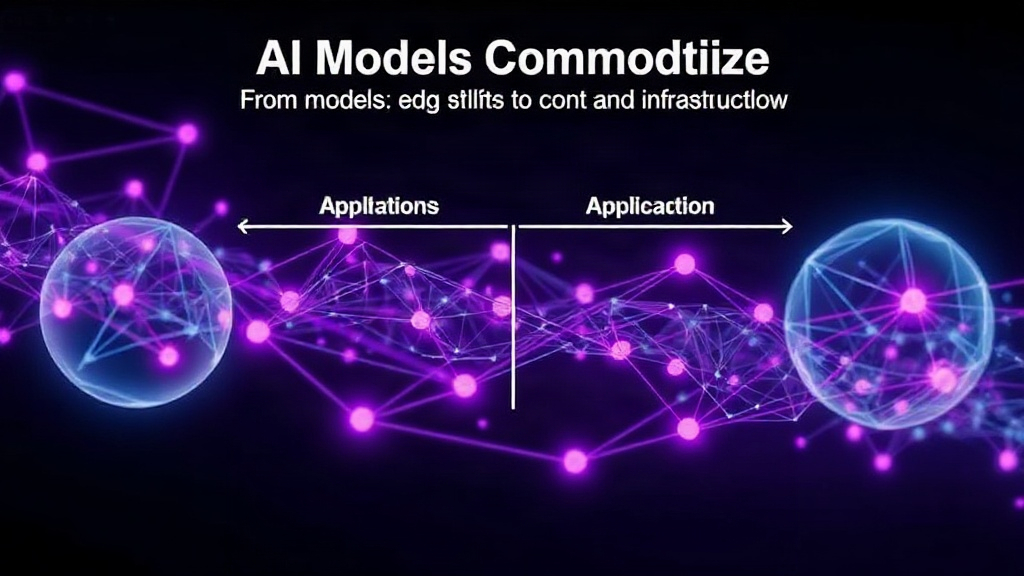
Trent Kannegieter's March 2025 essay, "Taking AI Commoditization Seriously," published on TechPolicy.press, articulates this transition effectively. The essay posits that when multiple vendors offer models with comparable performance and features, intense competition drives down prices. This price compression forces a re-evaluation of where value is created. Instead of residing within the proprietary AI model, the competitive edge is migrating both up the technology stack to the applications and user interfaces built upon these models, and down to the underlying hardware, tooling, and infrastructure required to deploy and manage them.
The implications are profound. Developers and businesses can no longer rely on having a unique, in-house model as their primary differentiator. The focus must pivot from developing the model itself to mastering its application. This means understanding how to integrate these increasingly standardized models into specific user workflows and enrich them with proprietary or highly relevant context. The model becomes a utility, akin to electricity or cloud computing, that powers a multitude of specialized applications.
The Rise of Context and Workflow
The shift away from model-centric differentiation places a premium on two key areas: context and workflow. The "context" refers to the specific data, knowledge, and situational awareness that an AI application can leverage. This could be a company's internal documentation, a user's personal preferences, real-time market data, or any other domain-specific information that imbues a generic model with specialized intelligence. A model that can access and reason over a user's private codebase, for instance, will be far more valuable to that user than a model with only general knowledge.
One compelling example of this trend is emerging from developer workspaces. A developer recently shared their frustration, not with the inherent weakness of AI models, but with the fragmentation of the knowledge required to perform useful work. Building a workspace tool became their solution. This tool aims to consolidate scattered information, integrate various AI capabilities, and present them in a cohesive, user-friendly interface that aligns with the developer's natural workflow. This isn't about a better language model; it's about a better way to use existing models by bringing relevant context and a streamlined process to the forefront.
Similarly, in customer service, the value is shifting from a chatbot's ability to understand natural language (a capability now widely available) to its capacity to access and synthesize a customer's history, product details, and support policies. The AI's effectiveness is dictated by the quality and accessibility of this contextual data, and how seamlessly it's integrated into the agent's or customer's problem-solving process. The workflow here involves not just generating a response, but guiding the user through troubleshooting steps, escalating issues appropriately, and logging interactions effectively.
Implications for the Ecosystem
This commoditization has far-reaching implications across the AI ecosystem. For model providers, the challenge is to find new avenues for differentiation. This might involve offering specialized fine-tuning services, providing superior data privacy and security guarantees, or developing unique deployment solutions. However, the core model's uniqueness will diminish. Instead, their success will depend on how easily their models can be integrated into various platforms and workflows.
For developers building AI-powered applications, this is an opportunity. The barrier to entry for creating sophisticated AI applications is lowering. Instead of needing to train massive models, developers can now focus on building intelligent features on top of existing APIs and open-source models. The real innovation will come from clever prompt engineering, effective data integration, and the design of intuitive user experiences that align with specific tasks and user needs. This is where the competitive advantage will be forged.
Hardware and infrastructure providers also stand to benefit. As models become more like utilities, the demand for efficient, scalable, and cost-effective ways to run them will increase. This includes specialized AI chips, optimized cloud infrastructure, and sophisticated MLOps tooling for deployment, monitoring, and management. The underlying plumbing that supports AI applications will become a critical area of innovation and investment.
The Future: Context-Rich, Workflow-Optimized AI
The future of AI is not about the single, monolithic model that can do everything. It is about a diverse ecosystem of specialized applications, each empowered by readily available, yet increasingly commoditized, AI models. The true edge will be defined by the depth and relevance of the context these applications can access and the fluidity with which they can integrate into human workflows. Companies that can master the art of combining generic AI capabilities with specific domain knowledge and user-centric processes will be the ones to capture the most value.
The question for many businesses is no longer "Which AI model should we build or buy?" but rather "How can we best leverage existing AI models by enriching them with our unique data and embedding them into our operational processes?" The answer to this question will dictate success in the next era of artificial intelligence.
What nobody has fully addressed yet is the potential for a fragmented user experience. If every application integrates AI differently, and requires its own specific contextual setup, users could face a steep learning curve and the overhead of managing multiple AI environments. This could inadvertently create a new form of friction that developers will need to overcome with intelligent abstraction layers and unified interfaces.