
The Hidden Cost of Waiting in AI Model Queues
Free capacity for AI models is only cheap when there are no users waiting. The moment a job enters a shared queue, the cost begins to accumulate, not in direct monetary spend, but in valuable wall-clock time. CI runners remain reserved, developers refresh status pages anticipating completion, and each retry consumes another slot in the same bottlenecked line. While the token meter might read zero, the actual pipeline cost escalates with every second of delay.
Consider a shared inference service. It offers free model access and a free server, but this capacity is absorbed by introducing wait times, not by dynamically scaling resources. This is akin to a 'courtesy checkout' at a grocery store – it's not a reserved lane. If twelve other carts are ahead of you, that unpaid register still represents a significant time investment for your afternoon. The same principle applies to AI model access. The perceived 'free' tier often masks a fundamental economic reality: user time is a resource, and waiting for it to be consumed is a direct cost.
Developers are accustomed to tracking token usage, a direct measure of computational work. However, the critical metric often overlooked is queue wait time. This is the interval between submitting a request and the worker process actually commencing execution. It's distinct from generation time, where the model is actively performing computations, and also from retry time, which represents the same job re-entering the queue after a failure or timeout.
When queue wait time becomes a dominant factor, it signals that the system is not performing as efficiently as advertised. The 'free' aspect of the service is being paid for by the user's patience and productivity. This is particularly relevant for services offering tiered access or 'free' inference tiers, which often rely on shared, limited resources that become bottlenecks under load.
Deconstructing AI Usage Time Metrics
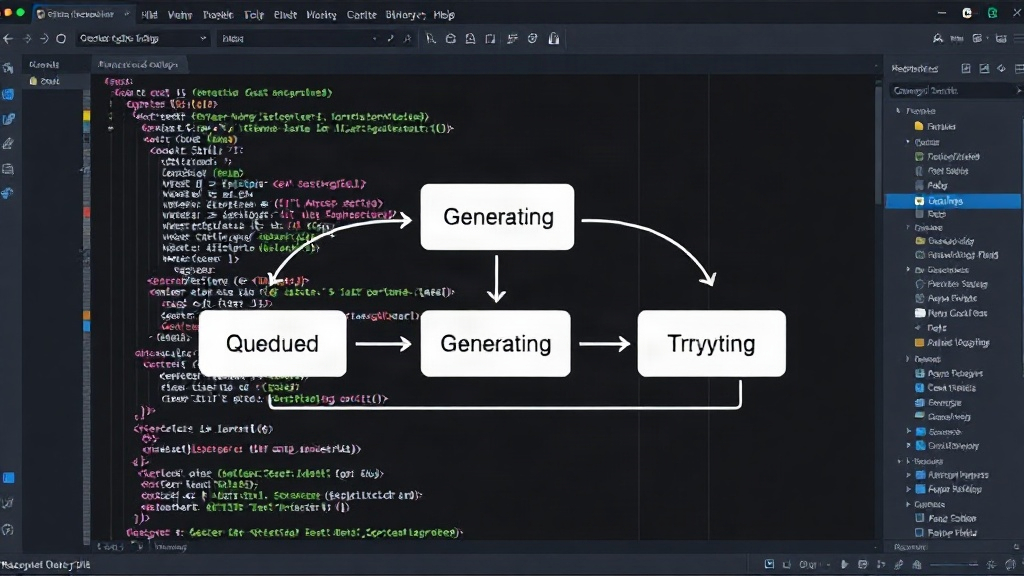
To truly understand the cost of using AI models, a more granular breakdown of time metrics is necessary. The traditional split between prompt tokens and completion tokens, while important for understanding model output size, fails to capture the full economic picture. A more useful segmentation for operational cost analysis includes:
- Queued Time: The duration from request submission to the commencement of processing by an AI worker. This represents idle time where resources may be reserved but are not actively computing.
- Generating Time: The actual time the AI model spends processing the request and producing an output. This is the core computational cost.
- Retry Time: The time spent on subsequent attempts for a request that previously failed or timed out. This is essentially a repeat of queued and generating time, adding to the overall expense.
If queued time constitutes a significant portion of the total time from submission to completion, the service is effectively costing users more in lost productivity and reserved resources than the direct monetary charges might suggest. This is especially true for microservices and applications that rely on rapid, low-latency AI responses. A system that frequently experiences long queues is not truly 'free' or even 'cheap' – it's simply deferring the cost to the user in the form of waiting.
The Impact on Development Workflows
The implications of significant queue time extend directly into developer workflows and productivity. When developers are forced to wait for AI model responses, several things happen:
- Reduced Iteration Speed: Rapid prototyping and experimentation, core to modern development, become sluggish. Developers cannot quickly test hypotheses or iterate on features if each test involves a lengthy wait.
- Context Switching Overhead: Developers waiting for a response are likely to switch to other tasks. This context switching incurs a cognitive cost, reducing overall efficiency and increasing the chance of errors when they eventually return to the original task.
- Increased Operational Costs: Even if the AI service itself is 'free' or low-cost per token, the reserved CI runners, the developer hours spent waiting, and the potential need for more robust retry mechanisms all contribute to higher overall operational expenses for the team or company.
- Frustration and Burnout: Persistent delays and a feeling of being blocked can lead to developer frustration and contribute to burnout, impacting morale and retention.
The perception of 'free' AI services can be misleading. These services often operate on a shared infrastructure model. When demand exceeds available capacity, users are placed in a queue. This queuing mechanism is a form of resource throttling, designed to manage load on a finite set of expensive hardware. The 'cost' is simply shifted from direct payment to indirect expenditure of time and developer efficiency.
Rethinking AI Service Cost Models
For providers of AI services, especially those offering free or low-cost tiers, transparency around queuing is paramount. Users need to understand that 'free' capacity is typically elastic only up to a point, and beyond that, wait times become the de facto cost. Developers and engineering managers must actively monitor not just token consumption but also the latency introduced by queues.
The useful split for cost analysis is not prompt vs. completion, but queued vs. generating vs. retrying. If a significant portion of the total time is spent in the 'queued' state, it indicates an under-provisioned or inefficiently managed service. This realization should prompt a re-evaluation of the AI service provider, a potential move to a dedicated instance, or a strategic decision to optimize workflows to minimize reliance on services prone to long queues.
Ultimately, time spent waiting in an AI model queue is a tangible cost. Recognizing and measuring this cost is the first step toward optimizing AI integrations and ensuring that the pursuit of cutting-edge AI capabilities does not come at the unbearable price of developer productivity.