The Promise and Peril of AI Memory for Teams
Artificial intelligence assistants are rapidly evolving beyond stateless interactions. A significant advancement is the integration of 'memory' – the ability for an AI to retain information across sessions. This feature addresses a fundamental limitation: every new conversation starting from a blank slate. For personal use, an AI remembering your coffee order or project preferences is convenient. It streamlines workflows and avoids repetitive questioning. However, when this memory function is applied to team knowledge, particularly in high-stakes environments like incident response, architectural decisions, or production deployments, the current implementation falls critically short of establishing a reliable trust model.
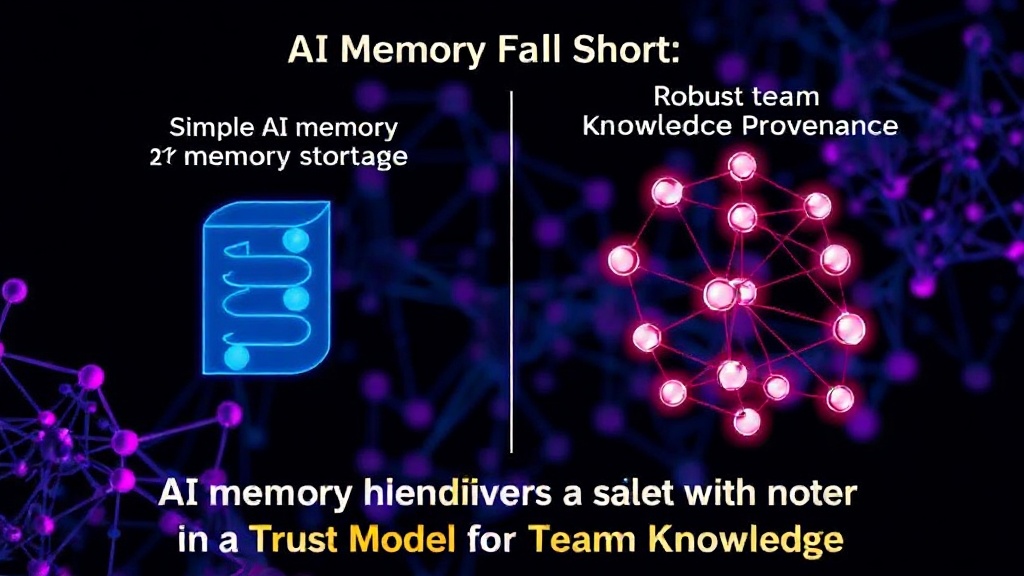
The core issue is that AI memory, as it stands, primarily offers persistence, not provenance. A simple memory database can store facts, but it doesn't inherently provide the crucial metadata teams need to trust that information. When an AI's remembered input influences decisions that impact live systems or critical projects, the team requires answers to a set of fundamental questions: What specific piece of information was saved? Who provided or verified it? Is this information still accurate and up-to-date? How can discrepancies be corrected, and who is responsible for approving those corrections? Without answers to these questions, AI memory risks becoming a repository for unchecked assumptions and outdated theories.
Consider a scenario where an engineer is troubleshooting a production incident. They might tell an AI assistant, "This is probably the connection pool again." At this stage, it's a working theory, a hypothesis that requires validation. If the AI's memory system simply stores this statement as a fact without any indication of its tentative nature or the context of its origin, it can lead to significant problems down the line. The AI might later recall this 'fact' with undue certainty, potentially misdirecting troubleshooting efforts or even influencing a premature, incorrect resolution. This is not a failure of the AI's intelligence, but a failure of the memory system to adequately represent the nature and confidence level of the information it stores.
Beyond Persistence: The Need for Provenance and Verification
The distinction between personal AI memory and team knowledge management is stark. Personal memory is about individual convenience and low-risk context. Team knowledge, especially in operational settings, carries significant weight. Decisions made based on this knowledge can have cascading effects on system stability, security, and business continuity. Therefore, a simple key-value store for AI recollections is insufficient. What teams need is a system that treats AI memory not just as a storage mechanism, but as a dynamic, auditable knowledge base.
This requires a shift in how AI memory is designed and implemented. Instead of just saving a statement, the system should capture:
- Source Attribution: Who entered the information? Was it a junior engineer, a senior architect, or an automated system alert?
- Timestamping: When was the information recorded? This is crucial for assessing currency.
- Confidence Levels: Was the information presented as a fact, a hypothesis, a best guess, or a confirmed finding?
- Verification Status: Has the information been reviewed, confirmed, or disputed by other team members?
- Correction Workflow: How can users flag incorrect information and propose amendments? What is the process for approving these changes?
- Version History: A clear log of all changes, who made them, and when.
Without these elements, AI memory risks becoming a black box. Imagine an AI suggesting a rollback for a production service based on a remembered piece of advice from months ago, advice that was never officially validated and is now irrelevant. The team would be left scrambling to understand why the AI made that recommendation, digging through logs, and trying to reconstruct the context, all while the system remains unstable. This is the antithesis of efficient incident response.
The Trust Gap in AI-Assisted Decision Making
The current approach to AI memory for teams creates a trust gap. Developers and operations staff are often hesitant to rely on AI suggestions when the source and validity of the information are opaque. This hesitancy is not a sign of technophobia, but of professional prudence. In critical situations, ambiguity is the enemy. Teams need to be able to interrogate the source of information, understand its context, and trust its accuracy before acting upon it.
This problem is analogous to relying on an unverified Wikipedia entry for life-or-death medical information versus consulting a peer-reviewed journal article with clear authorship, citation, and editorial oversight. Both contain information, but only one provides the necessary assurance for critical decision-making. AI memory, in its current form, leans heavily towards the unverified entry.
What remains unaddressed is the significant engineering effort required to build these provenance and verification layers into AI memory systems. It's not merely a matter of adding more storage; it's about architecting a system that supports collaboration, accountability, and continuous refinement of knowledge. This involves integrating with existing knowledge management tools, implementing robust user interfaces for feedback and correction, and potentially developing new paradigms for how AI interacts with and curates team knowledge.
Implications for the Future of Team Collaboration with AI
The vision of AI as an indispensable team member, capable of drawing upon and contributing to a shared knowledge base, is powerful. However, realizing this vision requires moving beyond simplistic memory functions. AI memory needs to evolve into a system that fosters trust through transparency, accountability, and verifiable accuracy. Until then, its application in high-stakes team decision-making will remain limited, viewed more as a helpful assistant for low-risk tasks rather than a reliable partner for critical operations.