Navigating the AI Integration Landscape
The question is no longer 'if' but 'how' AI tools will become integral to daily development work. Since the advent of AI in IT, developers have found themselves caught between polarized viewpoints. Some see LLMs, GenAI, and Agentic AI as a panacea, capable of enabling a single, unskilled individual to perform the work of an entire IT department. Conversely, others express fear or outright disdain for AI, citing concerns about job displacement and intellectual atrophy. A third group attempts to ignore AI, convinced of its irrelevance and their own superior ability to work without it. Navigating this cacophony of opinions and social media noise can be challenging.
The truth, as is often the case, likely lies between these extremes. Things are rarely as good as hoped or as bad as feared. This universal principle holds true for AI's impact on software development. As a senior developer, the prospect of AI replacement does not incite fear, nor do I mourn lost opportunities. The fear-mongering narratives often overlook the nuanced reality of AI as a tool, not a sentient replacement.
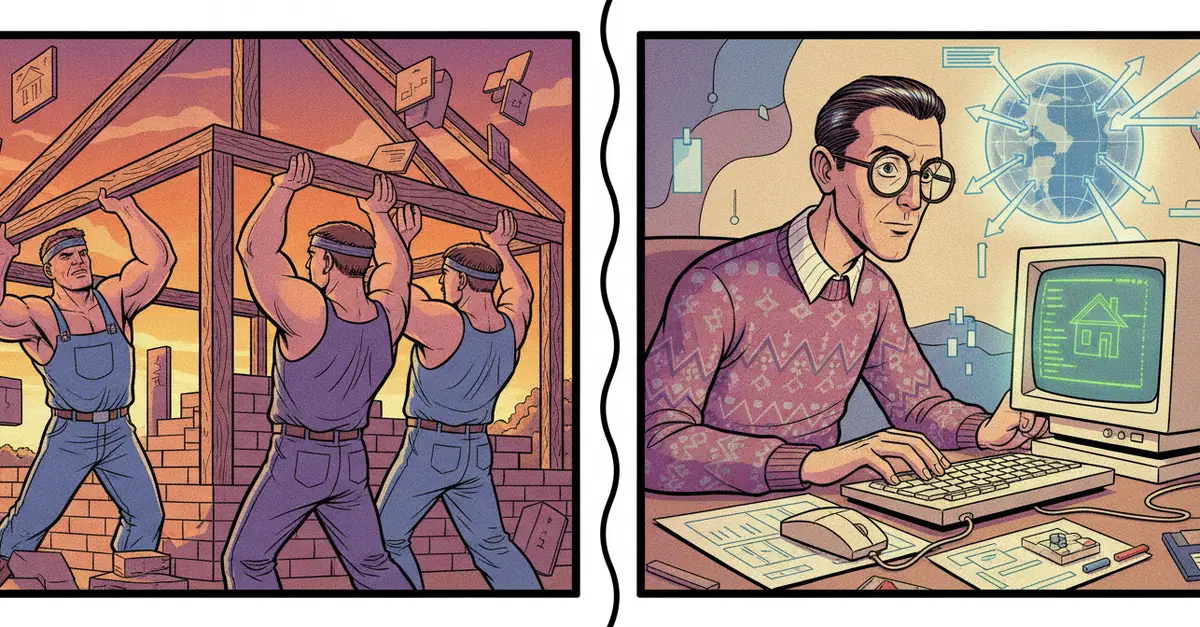
AI, in its current form, functions as a powerful set of 'muscles.' It can execute tasks, generate code, analyze data, and automate repetitive processes with remarkable speed and scale. However, these muscles lack a brain. They cannot strategize, understand complex human intent, innovate on abstract concepts, or exercise critical judgment. That vital cognitive function, the 'brain,' remains squarely with the human developer.
Consider AI code generation. Tools like GitHub Copilot or ChatGPT can produce functional code snippets, complete functions, or even draft entire classes based on prompts. This is akin to having an incredibly fast and knowledgeable junior developer at your beck and call. They can draft boilerplate, suggest implementations, or even translate code between languages. This dramatically accelerates the initial drafting phase. However, the code produced often requires refinement, debugging, and integration into a larger, complex system. It might lack context, fail to adhere to specific architectural patterns, or contain subtle logical errors. The developer's role is to provide the strategic direction, the architectural oversight, and the critical evaluation. They must understand the 'why' behind the code, not just the 'how.'

AI as a Force Multiplier, Not a Replacement
The fear that AI will make developers 'stupid' also warrants examination. This perspective often assumes a passive consumption of AI output. If a developer simply accepts AI-generated code without understanding it, then yes, their critical thinking skills could atrophy. However, this is not how effective developers work. Instead, they leverage AI as a sophisticated assistant. The process becomes one of prompt engineering, critical review, and iterative refinement. Crafting effective prompts requires a deep understanding of the problem domain and the desired outcome. Evaluating the AI's output necessitates a robust grasp of programming principles, algorithms, and best practices. This interaction, when done correctly, can actually enhance a developer's skills by exposing them to new approaches and forcing them to articulate complex requirements precisely.
Think of it this way: a carpenter doesn't fear a power saw because it's 'too good.' They embrace it because it allows them to cut wood faster and more precisely, enabling them to focus on the design, joinery, and finishing—the aspects that require their expertise and artistry. Similarly, AI tools amplify a developer's capabilities, freeing them to concentrate on higher-order tasks.
The 'useless' camp, those who dismiss AI entirely, risk obsolescence. The development landscape is shifting. Teams that effectively integrate AI will likely outpace those that do not in terms of productivity, innovation speed, and cost-efficiency. Ignoring these tools is akin to a programmer in the 1980s refusing to use a compiler in favor of manual assembly. While technically possible, it is an inefficient and ultimately self-defeating approach.
The Evolving Role of the Developer
The skills required for successful software development are evolving. While deep technical proficiency remains crucial, there is a growing emphasis on:
- Strategic Thinking: Understanding business objectives, user needs, and long-term system architecture.
- Problem Decomposition: Breaking down complex problems into manageable components that can be tackled by humans and AI.
- Prompt Engineering: The art and science of crafting effective prompts to elicit desired outputs from AI models.
- Critical Evaluation: Rigorously assessing the accuracy, efficiency, security, and ethical implications of AI-generated outputs.
- System Integration: Seamlessly incorporating AI components and AI-generated code into existing or new systems.
- Ethical Awareness: Understanding the biases in AI models and ensuring responsible AI deployment.
AI can handle the 'heavy lifting' of code generation, debugging common errors, and performing extensive data analysis. This allows developers to dedicate more time to designing elegant solutions, architecting resilient systems, and ensuring the ethical and secure deployment of technology. The developer's role shifts from being a pure code-writer to a conductor of an increasingly sophisticated orchestra of tools, with AI as a prominent instrument.
The potential for AI to democratize certain aspects of software development is real. Individuals with strong domain knowledge but limited traditional coding skills might find AI tools enable them to build applications or automate tasks previously out of reach. This could lead to a surge in citizen developers and a broader base of technical problem-solvers. However, building robust, scalable, and secure software systems will still require the deep expertise and critical judgment of seasoned developers. These new entrants will likely rely on AI to bridge skill gaps, but complex projects will still demand the architectural vision and problem-solving prowess of experienced professionals.
Ultimately, AI is a tool. Like any tool, its effectiveness depends entirely on the skill, intent, and intelligence of the user. It provides the processing power, the speed, the sheer volume of output – the muscles. But it is the human developer who provides the direction, the understanding, the creativity, and the judgment – the brain. The future of software development lies not in humans versus AI, but in humans augmented by AI.