The Unseen Constraints of Fiscal Records
Building AI features for a business application is one thing. Building them for an application that generates legally mandated fiscal records is another. Slate, an invoicing and bookkeeping SaaS for Israeli businesses, operates under precisely these constraints. Its documents are real fiscal records, subject to Israeli law requiring them to be kept for seven years, numbered without gaps, and crucially, never edited after issuance. This strict regulatory environment profoundly shaped every AI feature developed for the platform. The result is a suite of AI tools that enhance user experience and efficiency without compromising the integrity of financial data.
Receipt Scanning: From Photo to Form
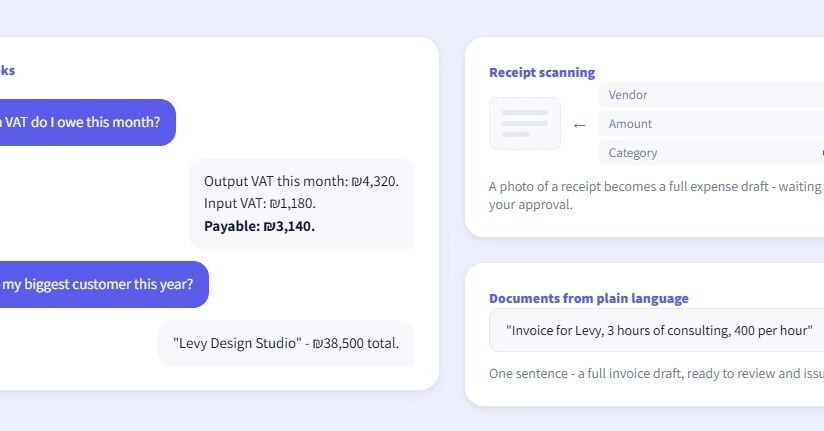
One of the most immediate pain points in bookkeeping is manually entering expense data from physical receipts. Slate’s AI tackles this with its receipt scanning feature. Users can simply upload a photo of a receipt, and the AI processes the image to extract key information. This includes vendor name, date, amount, and potentially tax details. The AI then populates an expense form automatically. The critical rule here is that the AI does not modify existing fiscal records. Instead, it generates new data entries based on the scanned receipt, which are then reviewed and approved by the user before becoming part of the official bookkeeping. This separation ensures that the AI’s output is always a new addition, never an alteration of a finalized record.
Chat Assistant for Bookkeeping Insights
Many small business owners and freelancers struggle to interpret their financial data. Slate’s chat assistant acts as a knowledgeable guide, answering questions about the user's own books. A user might ask, "How much did I spend on office supplies last quarter?" or "What was my total revenue in May?" The AI queries the user's verified financial data and provides a direct answer. The safeguarding mechanism is twofold: first, the AI only has read-access to the approved fiscal records. It cannot initiate any changes. Second, its responses are framed as informational queries, not as directives or suggestions that would imply modifying data. This keeps the AI firmly in an analytical and reporting role, respecting the immutability of the fiscal records.
Support Reply Drafter for Admin Efficiency
Customer support is a vital function for any SaaS product. For Slate, drafting replies to customer inquiries about invoicing or bookkeeping can be time-consuming. The AI-powered support reply drafter assists the administrative team. It analyzes incoming support tickets and suggests draft responses. This feature operates on a separate data domain – it does not interact with the user's financial records at all. Its training data and operational scope are confined to common support queries, product knowledge bases, and communication best practices. The AI generates suggestions, but all replies are reviewed and edited by human support staff before being sent. This ensures that while AI speeds up the drafting process, human oversight maintains accuracy and appropriate tone, and crucially, keeps the AI’s function entirely external to the fiscal record-keeping system.
Natural Language Document Creation
Creating invoices, quotes, or other fiscal documents often involves repetitive data entry. Slate’s natural language document creation feature simplifies this. A user can input a request like, "Quote for Dani, 3 consulting hours at 500." The AI parses this request and generates a draft quote document. The core principle here is that the AI generates a *new* document, which is then presented to the user for review and explicit confirmation. Only upon user approval is the document finalized, assigned a sequential fiscal number, and added to the ledger. It cannot alter existing documents. This adheres strictly to the rule that fiscal records are never edited post-issuance. The AI acts as a sophisticated form-filler, translating natural language into structured fiscal documents, with the user always in the final control loop.

Column Mapping for Excel Imports
Accountants and businesses often import data from spreadsheets, typically in Excel format. A common challenge is that different users or systems use different column headers for the same data (e.g., "Invoice Date," "Date Issued," "Bill Date"). Slate’s AI feature for Excel imports automates column mapping. It analyzes the headers in an uploaded spreadsheet and intelligently matches them to Slate’s required fiscal data fields. This significantly reduces manual effort and potential errors. The AI’s role is purely one of translation and data alignment. It maps incoming data to the correct fields within the import process. The data itself is then subject to the same validation and immutability rules as if it were entered manually. The AI doesn't alter the source spreadsheet or the final fiscal record; it facilitates a more accurate ingestion of data into the system.
The Overarching Principle: AI as Augmentation, Not Alteration
The common thread across all five AI features in Slate is their design philosophy: augmentation, not alteration. The stringent requirements of Israeli fiscal law—seven-year retention, sequential numbering, and absolute immutability after issuance—dictate that AI must serve as a tool to streamline data entry, enhance analysis, and improve user interaction, without ever touching the core financial records. For developers building similar applications, especially in regulated industries, this means a clear separation of concerns. AI models should operate on input data to generate new entries or provide insights, but never on finalized, auditable fiscal data. This approach ensures compliance, maintains data integrity, and builds trust with users who rely on their financial records being accurate and unalterable.