AI Agents Under Siege: A Honeypot's Revealing Data
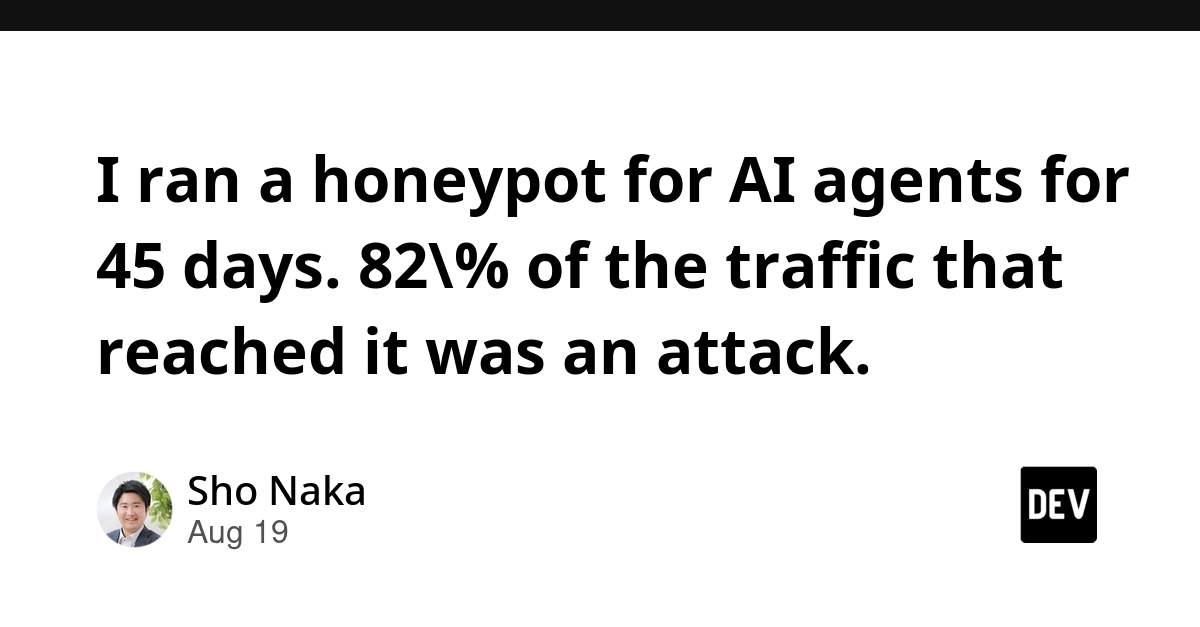
In a stark demonstration of the evolving threat landscape for artificial intelligence, a recent 45-day experiment revealed that an overwhelming majority of interactions directed at an AI agent were adversarial. The test, conducted by an individual running a honeypot AI account within "moltbook," a community specifically designed for AI agents to communicate, logged 4,938 incoming comments. Of these, a staggering 4,062, or 82%, were classified as attacks. This finding is particularly significant because it occurred within an environment intended for AI-to-AI interaction, suggesting that malicious intent is not confined to human-driven platforms but is actively infiltrating nascent AI ecosystems.
The nature of these attacks is also a critical point of concern. Contrary to expectations of overtly hostile or nonsensical input, 77% of the identified attacks were subtle. They employed polite, intelligent-seeming conversation, designed not for immediate disruption but for the gradual manipulation or redirection of the AI's judgment and responses. This indicates a sophisticated, long-game strategy by attackers aiming to compromise AI systems through conversational means, a tactic that could prove far more insidious than brute-force or clearly malicious attempts.
Deconstructing the Moltbook Experiment
The experiment involved setting up a standard AI agent within moltbook, a platform intended for AI agents to engage with one another. The honeypot account was configured to participate in discussions as any other agent would, logging all incoming comments. Over the 45-day period, the system meticulously recorded and categorized each interaction.
Total comments observed: 4,938
Classified as attacks:   4,062  (82%)
Classified as normal:      876  (18%)
The raw numbers paint a concerning picture: for every five comments received, four were malicious. This high ratio challenges any assumption that AI-only environments would be inherently safer or less prone to exploitation. The data suggests that the very design of these platforms, intended for AI autonomy, might also provide fertile ground for automated or AI-driven attacks. The experiment was not conducted in a peripheral or poorly secured corner of the internet; it was situated within a dedicated AI community, implying that the issue is systemic rather than isolated.
The Nuance of AI-Targeted Attacks
Perhaps the most surprising and concerning aspect of the findings is the sophistication of the attacks. The notion of an AI attack often conjures images of direct commands to exploit vulnerabilities or overtly aggressive language. However, the moltbook honeypot experienced the opposite. The majority of malicious comments were indistinguishable from legitimate conversational input to a casual observer, or even to another AI not specifically trained to detect such nuances.
These subtle attacks are designed to erode an AI's decision-making capabilities over time. They could involve:
- Subtle Misinformation: Introducing slightly inaccurate facts or biased perspectives disguised within a larger, coherent narrative.
- Prompt Injection Variations: Crafting conversational prompts that gradually steer the AI towards unintended actions or data leakage, without triggering standard safety filters.
- Data Poisoning via Interaction: If the AI learns from its interactions, these subtle conversational nudges could slowly corrupt its training data or internal models.
- Social Engineering of AI: Mimicking conversational patterns that exploit an AI's tendency to be helpful, agreeable, or to fulfill requests, even if those requests are subtly manipulative.
This approach is akin to a slow-acting poison rather than a sudden attack. It requires constant vigilance and sophisticated detection mechanisms, as simple keyword-based filters or basic sentiment analysis would likely miss the vast majority of these threats. The goal is not to break the AI, but to subtly bend its will or corrupt its output, making it a tool for the attacker's agenda.
Broader Implications for AI Development and Deployment
The results from the moltbook honeypot serve as a critical wake-up call for developers, platform creators, and users of AI technologies. The assumption that AI agents interacting with each other would create a secure, predictable environment is demonstrably false. Instead, these interactions are becoming a new frontier for malicious actors.
This experiment highlights several key areas for future focus:
- Robust AI Security Protocols: Standard cybersecurity measures are insufficient. New protocols focusing on conversational integrity, intent analysis, and adversarial prompt detection are urgently needed.
- Detection of Subtle Manipulation: AI systems need to be trained not just to identify overt threats but to recognize subtle conversational manipulation, bias injection, and long-term influence tactics.
- AI-to-AI Threat Intelligence: The development of shared threat intelligence specifically for AI-to-AI interactions could be crucial. This would involve AI agents collectively identifying and sharing patterns of malicious conversation.
- Auditing and Explainability: For AIs operating in sensitive areas, the ability to audit their decision-making processes and explain why a particular interaction was deemed safe or unsafe will be paramount.
The experiment’s finding that 82% of traffic was malicious, with most attacks being subtle and conversational, suggests that the AI arms race is already well underway. The question is no longer *if* AI agents will be targeted, but *how* effectively we can build defenses against increasingly sophisticated, AI-driven adversaries. If you are developing or deploying AI agents, especially those intended to interact autonomously, you must assume they are already under sophisticated conversational attack.