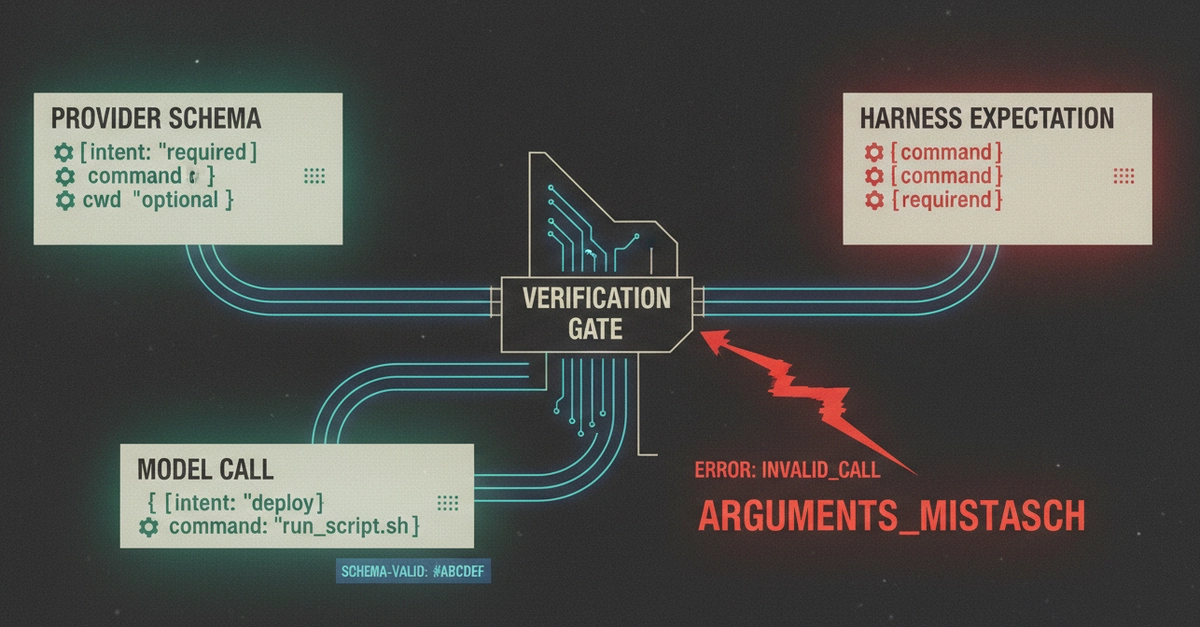
The Problem: Mismatched Expectations in AI Execution
When integrating AI models, particularly those that interact with external tools or APIs, a critical step is ensuring the model adheres to the expected input and output schemas. A common approach involves a 'harness' that pre-defines the structure of an `exec` call. This harness freezes the expected parameters, instructs the AI model to send precisely that structure, and then compares the model's actual output against the frozen expectation. If a mismatch occurs, the system fails, preventing potentially erroneous actions.
However, a recent observation highlighted a flaw in this seemingly robust control mechanism. The harness flagged a model for sending incorrect arguments, but the conclusion drawn from this flag was fundamentally wrong. The comparator could not have identified this error because the problem wasn't with the model deviating from the *expected* schema, but rather with the expectation itself being misaligned with what the model *actually shipped*.
The Setup: A Control Mechanism That Went Astray
The specific setup involved a self-correcting integration maintainer. The harness meticulously prepared an `exec` call, effectively creating a blueprint of the intended interaction. This blueprint was then 'frozen' – locked in time – before being presented to the AI model. The model's task was to generate tool arguments that perfectly matched this frozen blueprint. The subsequent comparison acted as the gatekeeper: any deviation meant failure.
The expectation, at the time of its creation, was meticulously constructed. A look at the commit history for this specific check reveals the initial setup: scripts/ju. This commit, 5bf10ac, laid the groundwork for the expected schema. The intention was clear: enforce a strict contract between the AI's reasoning and the tools it could invoke.
The Flaw: Comparing Against the Wrong Target
The critical error occurred not in the execution of the comparison, but in the definition of what was being compared against. The harness was comparing the model's output against a schema that was established *before* the model's final execution plan was solidified. In essence, the system was checking if the model met a standard that was already outdated by the time the model attempted to meet it.
This is akin to a chef preparing a recipe with a specific list of ingredients, then asking a sous chef to gather those ingredients, and finally checking if the sous chef gathered exactly what was on the original list, without accounting for any last-minute substitutions or additions the chef themselves might have decided upon after the list was finalized. The comparison is technically correct – the sous chef didn't bring what was *on the paper* – but it misses the larger point: the chef's own evolving requirements.
The model was supposed to adhere to a pre-determined schema. However, during the execution phase, the model might have dynamically adjusted its tool calls based on new information or a refined understanding of the task. The harness, still holding the original, static schema, would then flag this as an error. The model wasn't necessarily 'wrong' in its execution; the validation was.
The Fix: Shifting the Comparison Point
The proposed solution is not to 'loosen' the comparison in a way that allows for arbitrary deviations. Instead, the core fix involves changing the reference point for the comparison. The harness must compare the model's actual tool arguments against the schema that was *committed to or finalized just before the model's final execution*, not against an earlier, potentially superseded, expectation.
This means the process needs to be: prepare potential `exec` calls, allow the model to finalize its choice of `exec` call and arguments, *then* freeze that final choice, and *then* compare the model's actual execution against this newly frozen, finalized target. The system should validate against the schema the model *effectively shipped*, not a theoretical one it was initially presented with.
The Part That Will Rot: The Dynamic Nature of Expectations
Even with this improved comparison strategy, a fundamental challenge remains: the inherent dynamism of AI model execution. AI models, by their nature, can adapt and evolve their understanding and approach mid-execution. Any validation system, no matter how well-defined at a given point in time, risks becoming outdated if the underlying AI's decision-making process is not fully captured or accounted for.
The part of this system that is most susceptible to 'rot' is the static snapshot of the 'committed' schema. If the model's internal state or reasoning process changes in a way that invalidates the *reason* for the finalized schema, a simple comparison will still miss the deeper issue. Future iterations will likely need mechanisms to understand not just *what* the model executed, but *why*, and to validate that the reasoning aligns with the executed action, even if the schema itself had to adapt.
This problem underscores a broader challenge in AI integration: bridging the gap between deterministic validation systems and the probabilistic, adaptive nature of AI. As AI models become more sophisticated, simply comparing against a pre-defined schema, even the 'shipped' one, may prove insufficient. The true test will be in ensuring the AI's actions are not just schema-compliant, but also logically sound and aligned with the overall objective, a far more complex validation problem.