The Deceptive Simplicity of 'Ten Is Not a Hundred'
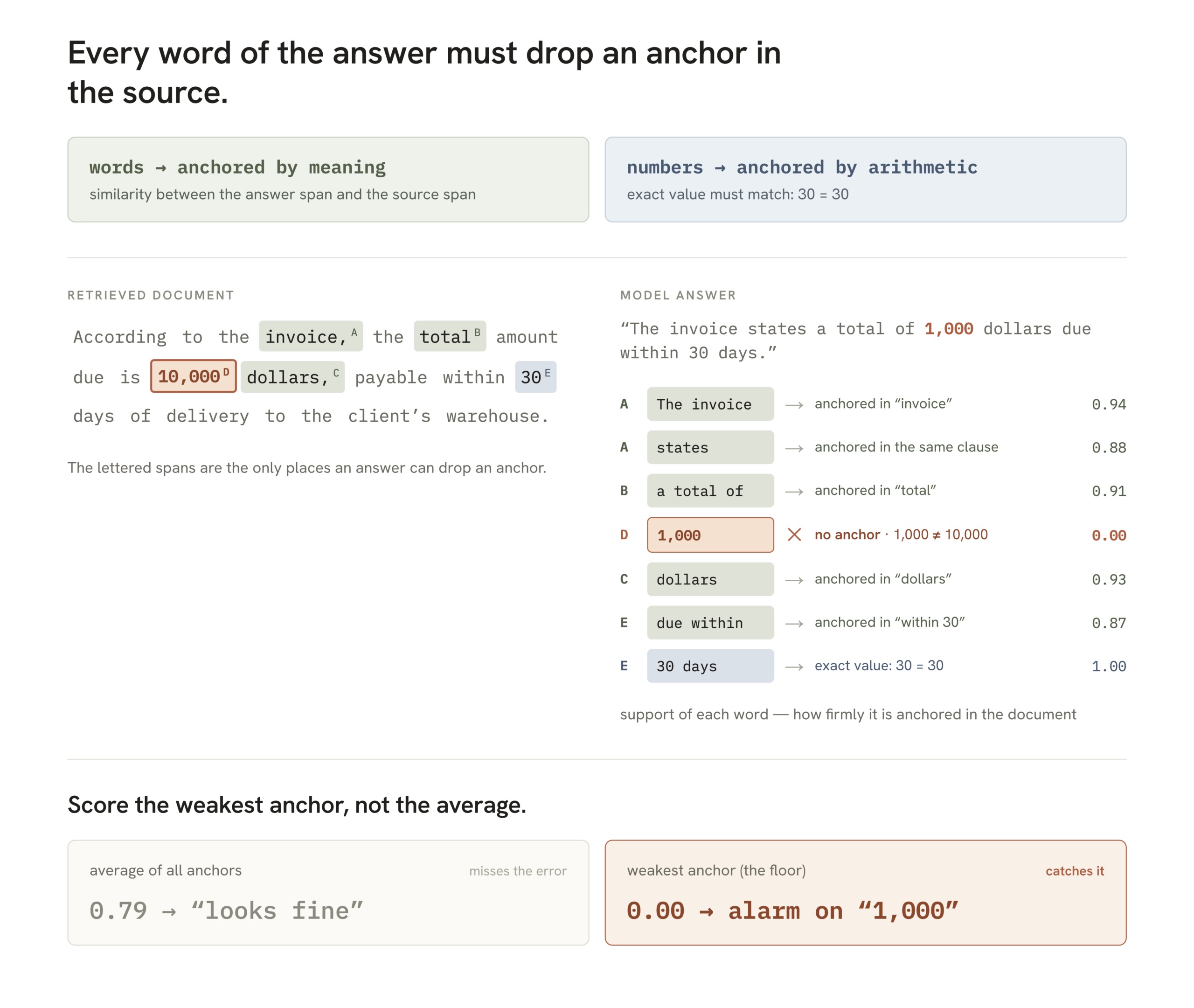
In the rapidly evolving landscape of artificial intelligence, particularly with the rise of large language models (LLMs), ensuring factual accuracy and preventing 'hallucinations'—where models generate plausible but false information—is a paramount concern. Researchers and developers are constantly seeking robust methods to detect and mitigate these errors. However, a recent, stark demonstration has revealed a significant blind spot: a common AI hallucination detector was demonstrably fooled by a simple, almost trivial, numerical statement. The phrase 'Ten Is Not a Hundred' became the unexpected Achilles' heel for a system designed to catch AI fabrications, highlighting the subtle yet critical challenges in AI evaluation.
The core of the issue lies in the nature of how these detectors often operate. Many rely on pattern matching, semantic similarity, or the LLM's own confidence scores to flag potential inaccuracies. While effective for many common hallucination types, these methods can be blindsided by statements that are logically sound but contextually nonsensical or factually incorrect in a way that circumvents superficial checks. The statement 'Ten Is Not a Hundred' is, on its face, mathematically and linguistically true. Ten is indeed not a hundred. However, within the context of typical AI outputs, especially those aiming to generate factual or comparative information, such a statement might appear out of place or deliberately obtuse, yet it passes simple logical and semantic filters.
This incident is not just an anecdote; it's a critical data point for anyone building, deploying, or evaluating LLMs. It suggests that current detection mechanisms might be more brittle than assumed, potentially failing to flag subtle but important errors, or conversely, flagging correct statements as erroneous if they deviate from expected patterns. The implications extend to applications where factual accuracy is non-negotiable, such as legal, medical, or financial advice generation.
The Mechanics of the Failure
The exact architecture of the hallucination detector in question was not detailed, but the failure points to common approaches. One prevalent method involves comparing the generated text against a knowledge base or using a secondary LLM to verify facts. Another approach leverages the probability distributions of the primary LLM itself, looking for low-confidence predictions or unusual token sequences. However, the statement 'Ten Is Not a Hundred' presents a unique challenge. It is factually correct (10 \u2260 100), yet it is often used in contexts where a comparison is expected, or a more nuanced quantitative relationship is sought. For instance, if an LLM were asked to compare the scale of two phenomena, and it responded with 'Ten is not a hundred,' it would be factually correct but unhelpfully vague, potentially indicating a failure to grasp the user's intent or a basic inability to perform comparative analysis.
Hallucination detectors that rely solely on surface-level truthfulness or semantic coherence would likely rate this statement as 'correct' or 'low risk.' The detector fails because it doesn't adequately account for the pragmatics of language—how meaning is conveyed through context and implied intent. A human would immediately recognize the statement as odd in most comparative contexts, inferring that the AI might be malfunctioning or misunderstanding the query. The AI detector, lacking this inferential capability, is left to judge the literal truth of the proposition.
Broader Implications for AI Evaluation
This single phrase, 'Ten Is Not a Hundred,' serves as a potent metaphor for the broader challenges in evaluating AI systems. It underscores that simply checking for factual correctness is insufficient. We must also consider:
- Contextual Appropriateness: Does the statement make sense given the preceding conversation or prompt?
- Completeness: Does the statement fully answer the user's implicit or explicit question, or is it unhelpfully vague?
- Intent Alignment: Does the AI understand what the user is *trying* to achieve, not just what they are literally asking?
The failure of the hallucination detector suggests that many current evaluation benchmarks might be susceptible to similar 'trick' questions. This could lead to a false sense of security, where models are deemed reliable when they are, in fact, prone to subtle but critical errors. For developers, this means a renewed focus on developing more sophisticated evaluation metrics that go beyond simple factual recall. It might involve adversarial testing, human-in-the-loop feedback mechanisms, or more advanced techniques for measuring semantic understanding and contextual awareness.
This is not an isolated incident of a poorly designed detector. Instead, it points to a fundamental gap in our understanding of how to reliably assess AI's grasp of nuanced information. The problem is akin to a student who can perfectly recite definitions from a dictionary but struggles to construct a coherent essay. The knowledge is present, but the application and synthesis are flawed. The challenge for the AI community is to build detectors and evaluation frameworks that can distinguish between genuine understanding and mere pattern replication, especially when the 'errors' are presented in a logically sound, yet pragmatically flawed, manner.
The Unanswered Question: What Constitutes 'Understanding'?
What remains unaddressed is how to quantitatively measure an AI's grasp of 'understanding' versus mere pattern matching, especially in cases where the output is technically correct but pragmatically useless or misleading. If an AI can generate 'Ten is not a hundred' and pass a factual check, but fail a contextual relevance check, what does that say about its 'intelligence'? The current divide between systems that excel at generating fluent, factually verifiable text and those that can truly reason or comprehend context remains vast. This seemingly trivial numerical statement cracks open the door to that chasm, posing a significant hurdle for deploying AI in high-stakes environments where nuanced comprehension, not just factual recall, is essential.