The Illusion of Guardrail Efficacy
You've built an AI agent. You've implemented guardrails to ensure it behaves within defined ethical and safety boundaries. You run tests, and they pass. Great. But what if those tests are fundamentally flawed? What if your guardrail tests are still showing success even after the guardrail itself has been deleted? This is not a hypothetical scenario; it's a critical blind spot in current AI testing methodologies.
Consider a typical setup: an AI agent, a policy gate (the guardrail), and a labelled corpus of inputs designed to trigger rejection. You run this corpus against the system. If the pipeline outputs DENY, the build is green, and you assume your guardrail is working. The problem arises when you remove the guardrail—the policy gate—and rerun the same tests. If the tests still pass, indicating rejection, it's tempting to assume another part of the system is handling it. However, this doesn't prove the guardrail's effectiveness; it merely shows that other components in the pipeline might be catching the problematic inputs. These other stages could be anything from input sanitization to output filtering, and their presence can mask the true performance of your intended guardrail.
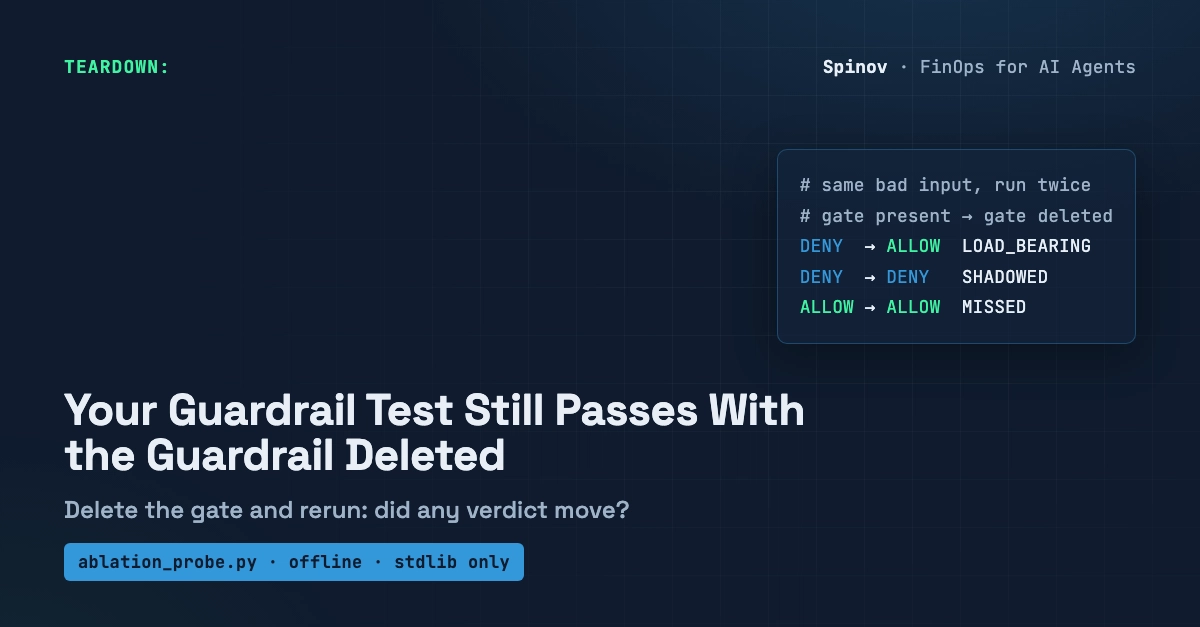
Alex Spinov, in a recent Dev.to post, highlighted this exact issue. By using a script called ablation_probe.py, he tested a corpus of 26 'bad' inputs. When the guardrail was active, 9 of these inputs were rejected. When the guardrail was removed, and replaced with a simple pass-through, the same 9 inputs were *still* rejected. This is akin to having a security guard at a door, and then removing the guard and finding that people are still not entering—perhaps because the door is locked, or there's a fence. The guard's specific function wasn't tested; only the outcome of preventing entry was observed.
The implication is stark: your confidence in your AI's safety might be misplaced. The tests you're running might be passing not because your guardrails are robust, but because other, incidental mechanisms are preventing undesirable outputs. These incidental rejections are 'decoration' – they indicate that something rejected the input, but not necessarily the specific gate you intended to test. This means that when you truly need your guardrail to function, it might fail silently, and your testing regime would never have caught it.

The Double Document Problem: A Crawler's Persistence
This concept of a system behaving unexpectedly after a perceived change echoes a similar issue encountered in web development, particularly with Single Page Applications (SPAs). Imagine running a directory website. Your core promise is to list reliable entities. You discover two listings that violate this promise and immediately remove them. You flip the flag in the database, check the live site, and see them gone from the main directory and specific city pages. Removal confirmed, right? Not quite.
A day later, those same listings reappear on the live site. This isn't due to caching or CDN issues; they are present in the freshly deployed HTML, visible in the exact lists from which they were supposed to be gone. The root cause? The website is an SPA. The initial HTML download serves a JavaScript bundle. This bundle then fetches data and renders the page client-side. Crawlers, however, are notoriously poor at executing JavaScript and waiting for dynamic content assembly. To cater to crawlers, many SPA operators implement a server-side rendering (SSR) or pre-rendering strategy. This means the server or a pre-rendering service generates a static HTML version of the page specifically for crawlers.
In this scenario, the deletion was only performed in the data source that the client-side JavaScript reads from for the *interactive* user experience. The pre-rendering service, which generates the HTML for crawlers, was not correctly updated or did not reflect the deletion in its own rendering process. Thus, the interactive view showed the deletions, but the crawler view—the 'second document'—still contained the removed listings. This is a critical distinction: a single logical change can manifest as two different realities within the same web application architecture, depending on how the content is consumed.
Bridging the Gap: From Web Crawlers to AI Guardrails
The parallels between these two scenarios are striking. In both cases, a change made with the intention of altering system behavior is not fully reflected in the observed outcome, leading to a false sense of security or correctness. For AI guardrails, the