The Illusion of Speed
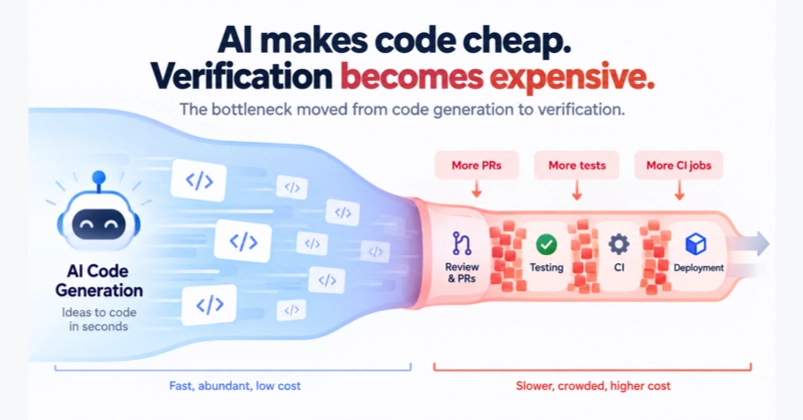
AI code generation tools like GitHub Copilot and Claude are rapidly changing how developers work. The headline number often cited is the sheer volume of code these tools can produce, leading to an assumption that the entire software development lifecycle will accelerate proportionally. However, Anthropic's internal experience with Claude paints a more nuanced picture. While Claude generates a significant portion of their code, the company observed a dramatic increase in their testing infrastructure demands. Over a six-month period, their test suite grew tenfold, and CI jobs surged by a factor of 25. This isn't merely an infrastructure scaling challenge; it signals a fundamental shift in the development bottleneck.
For years, the industry focused on optimizing developer productivity in code creation. AI has now effectively removed that constraint, allowing code to be generated at an unprecedented pace. When code writing ceases to be the primary bottleneck, attention inevitably shifts to the subsequent stages of the development pipeline. Anthropic's data strongly suggests that verification—testing, debugging, and ensuring code correctness—is rapidly becoming the new, more expensive bottleneck.
More Code, More Testing
The core assumption that faster code generation equates to faster overall development is flawed. When developers could only produce a limited amount of code manually, the amount of code that needed testing was inherently capped. For instance, a developer might ship five meaningful changes a week. This translated to a manageable number of tests required to validate those changes.
Now, with AI assistants generating dozens, even hundreds, of potential code snippets or entire functions in a short period, the volume of code to be vetted explodes. Each AI-generated line, function, or module requires rigorous verification. This includes unit tests, integration tests, end-to-end tests, and potentially more sophisticated static analysis and formal verification methods. The complexity doesn't just scale linearly; it can grow exponentially as AI-generated code interacts with existing systems or introduces subtle, hard-to-detect bugs.
Consider a scenario where a developer previously wrote 100 lines of code a day, all of which needed manual review and testing. With an AI assistant, they might generate 1,000 lines of code in the same timeframe. While the AI-generated code might be syntactically correct, its logical correctness, adherence to requirements, and security implications still demand thorough scrutiny. This means the testing effort doesn't scale down with faster generation; it scales up to cover the increased volume and complexity. The tooling and processes built around manual coding speed are simply not equipped to handle the velocity of AI-assisted code production.
The Verification Gauntlet
The increased verification burden manifests in several critical areas. Firstly, the sheer volume of tests required to cover AI-generated code grows. Developers must not only write tests for new features but also ensure that AI-generated code doesn't break existing functionality. This necessitates a robust regression testing strategy, which itself becomes more computationally expensive and time-consuming.
Secondly, the nature of bugs introduced by AI can be more insidious. While AI can reduce common syntax errors and boilerplate, it can also introduce subtle logical flaws, race conditions, or security vulnerabilities that are harder for human developers to spot. These bugs often require more sophisticated debugging techniques and specialized testing tools to uncover. The assumption that AI-generated code is inherently more reliable is a dangerous oversimplification.
Thirdly, the CI/CD pipeline, the backbone of modern software deployment, faces immense pressure. With test suites expanding dramatically and CI jobs multiplying, the time it takes for a code change to be integrated and deployed can actually increase if the verification infrastructure cannot keep pace. This negates the speed advantage gained from AI code generation. Companies must invest heavily in scaling their CI infrastructure, optimizing test execution, and potentially exploring new paradigms for automated verification.
Shifting Investment and Mindset
Anthropic's experience is a wake-up call. Companies that heavily adopt AI coding tools cannot simply assume a linear speed-up. They must proactively invest in their verification capabilities. This includes:
- Scaling Test Infrastructure: Significant investment in compute resources for running tests, parallelizing test execution, and optimizing CI/CD pipelines.
- Advanced Testing Tools: Adoption of more sophisticated static analysis, dynamic analysis, fuzz testing, and potentially formal verification tools to catch complex bugs.
- Developer Training: Educating developers on how to effectively prompt AI for code, critically evaluate AI-generated output, and write comprehensive tests for it.
- Rethinking Quality Assurance: Moving beyond traditional QA roles to embrace a culture where quality is a shared responsibility throughout the development lifecycle, with a strong emphasis on automated verification.
The cost of verification is not just monetary; it's also temporal and intellectual. The time spent debugging AI-generated code, the cognitive load on developers to ensure its correctness, and the engineering effort to build and maintain robust verification systems all contribute to this rising cost. What this means is that while AI makes the *act* of writing code cheaper, the *assurance* that the code is correct, secure, and performs as intended is becoming the premium service. For organizations relying on AI for code generation, the strategic imperative is clear: double down on verification, or risk being bogged down by it.