
The Unanswered Question: Why This Model?
In regulated industries like finance and healthcare, the question "Why did this request go to that model?" is not merely a technical curiosity. It's a compliance imperative that can arise under oath-adjacent conditions. Most organizations struggle to provide a satisfactory answer because their AI integrations are a free-for-all. Teams pick their preferred LLM provider, data handling practices diverge wildly, regional compliance rules are applied inconsistently, and there's no auditable trail explaining the decision-making process behind model selection.
This lack of centralized control and auditable decision-making creates significant risk. It means sensitive data could be routed to models or regions that violate privacy regulations, compliance policies can be bypassed unintentionally, and in the event of a breach or audit, pinpointing responsibility or understanding the data flow becomes a near-impossible task. This isn't just a development problem; it's a business and legal liability.
To address this, the concept of an "AI Gateway" emerges as a critical architectural component. It acts as a single, authoritative front door for all AI requests originating within an enterprise. This gateway’s primary responsibility is to intercept, inspect, and route AI requests to the most appropriate model, based on a defined set of policies. Crucially, it must also log and be able to report on precisely why a given request was directed to a specific model, and why other potential models were bypassed.
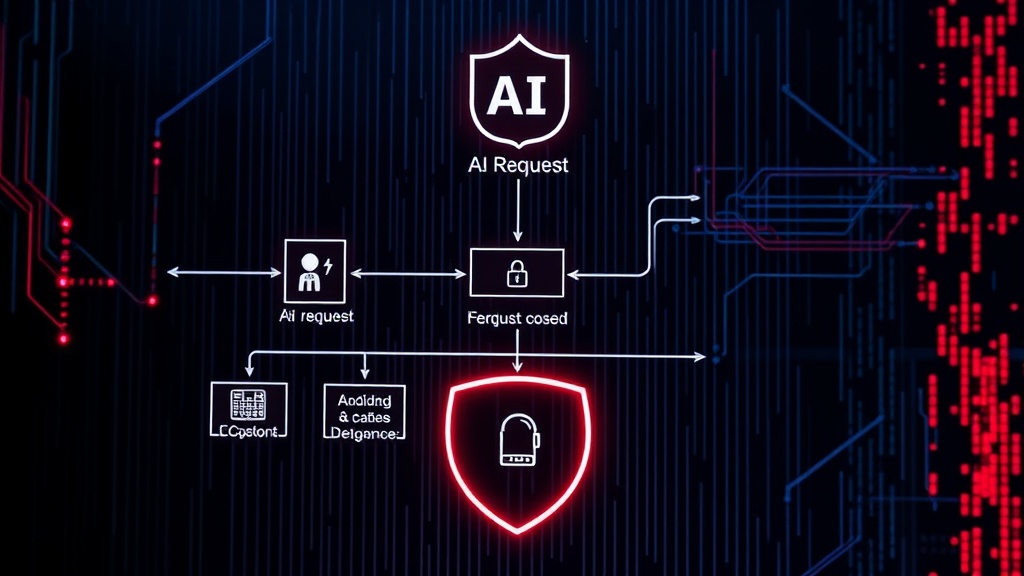
The Three Pillars of a Robust AI Gateway
Building an effective AI gateway for regulated environments requires careful consideration of several design principles. Based on the development of projects like Aegis Gateway, three core decisions stand out as paramount:
1. Policy Enforcement as the Primary Function
The gateway must not be a passive proxy; it must actively enforce policies. These policies are the bedrock of compliance and secure AI usage within a regulated enterprise. They dictate granular controls over:
- Data Sensitivity: Identifying and classifying sensitive data within a prompt or payload. This classification then determines which models are permitted to process the data. For example, personally identifiable information (PII) or protected health information (PHI) might be restricted to models hosted within specific geographic boundaries or those with stringent data processing agreements.
- Model Capabilities and Cost: Different models have varying strengths, weaknesses, and costs. A policy might direct complex reasoning tasks to a more powerful, expensive model, while simple summarization tasks go to a faster, cheaper one. It can also enforce usage limits or flag requests that exceed certain cost thresholds.
- Regional Restrictions: Certain regulations mandate that data remain within specific jurisdictions. The gateway must enforce these regional data residency requirements, routing requests only to models deployed in compliant locations.
- Access Control: Ensuring that only authorized users or applications can access specific models or functionalities. This prevents unauthorized use and maintains an auditable log of who requested what.
Think of the policy engine not as a simple firewall, but as a sophisticated air traffic controller for your AI requests. It understands the payload, the destination's requirements (the model), and the origin's constraints (the user/application and regulatory environment), and makes the optimal, compliant routing decision. Without this active enforcement, the gateway is merely a convenience, not a control mechanism.
2. Auditable Decision Logging
The ability to answer "Why this model?" under scrutiny is non-negotiable. This requires comprehensive, immutable logging at the gateway level. Every request intercepted by the gateway should be logged with:
- The original request details (anonymized or redacted as appropriate for sensitive data).
- The identified data sensitivity classifications.
- The enforced policies that were applied to the request.
- The specific model selected as the destination.
- The reasons for selecting that model (e.g., "Policy: PII detected, routed to compliant model X").
- The models that were considered but rejected, along with the reason for rejection (e.g., "Rejected: Model Y does not meet regional data residency requirements").
- Timestamps for all stages of the process.
This detailed audit trail is your proof of compliance. It demonstrates due diligence, provides a clear history of data flow, and is essential for post-incident analysis or regulatory audits. The logs must be tamper-evident, typically achieved through cryptographic hashing or integration with secure, append-only logging systems.
3. Extensibility and Future-Proofing
The AI landscape is evolving at an unprecedented pace. New models are released constantly, and regulatory frameworks are likely to adapt. An AI gateway must be designed with extensibility in mind to avoid becoming obsolete quickly.
- Model Agnosticism: The gateway should not be tightly coupled to specific model providers (e.g., OpenAI, Anthropic, Google). It should abstract the interaction layer, allowing new providers or custom-hosted models to be plugged in with minimal effort. This is often achieved through a standardized API interface that the gateway exposes to internal applications and a corresponding adapter layer for each supported model endpoint.
- Policy Definition Language: Policies should be defined using a flexible, declarative language that can be easily updated and extended. This might involve a domain-specific language (DSL) or a configuration-driven approach that allows non-developers to manage certain policy aspects.
- Integration with Security and Observability Tools: The gateway should seamlessly integrate with existing enterprise security information and event management (SIEM) systems, logging platforms, and monitoring tools. This ensures that AI request traffic is visible within the broader security and operational monitoring framework.
This extensibility ensures that the gateway remains a relevant and effective control point as the AI ecosystem matures and enterprise needs evolve.
The Critical Failure Mode: Fail Open
The most dangerous design choice for an AI gateway in a regulated enterprise is to fail open. This means that if the gateway encounters an error, cannot determine the correct policy, or its policy engine is unavailable, it defaults to allowing the request to proceed without restriction, or at least without the intended restrictions.
Consider the implications: A temporary outage of the policy service could lead to sensitive PII being sent to an unapproved model in a non-compliant region. A misconfiguration in the policy engine could inadvertently grant broad access to powerful models for all users, regardless of their role or the data's sensitivity. In a regulated environment, such an event is not just a technical glitch; it's a potential breach of compliance, leading to significant fines, reputational damage, and loss of customer trust.
Therefore, the gateway must be designed to fail closed. If any part of the decision-making or enforcement process fails, the gateway must default to blocking the request. This ensures that in the absence of certainty and explicit permission, no action is taken. While this might lead to temporary service unavailability for some requests during an outage, it prioritizes security and compliance above all else. This is the fundamental principle: when in doubt, deny access.
Conclusion: A Necessity, Not a Luxury
For enterprises operating under strict regulatory frameworks, an AI gateway is not an optional add-on; it's a fundamental requirement. It provides the necessary control, visibility, and auditable proof that AI is being used responsibly and in compliance with legal and ethical standards. By prioritizing policy enforcement, comprehensive logging, extensibility, and a "fail closed" security posture, organizations can build a robust and trustworthy foundation for their AI initiatives.