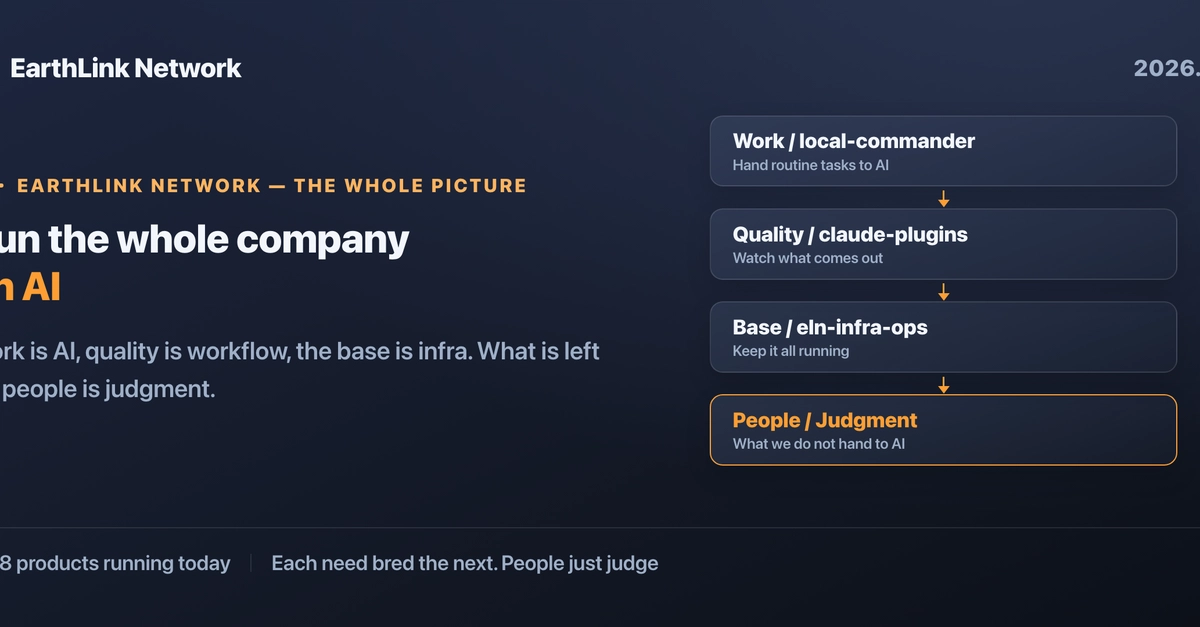
The AI-First Imperative: Rethinking Operational Structure
EarthLink Network’s journey to integrating AI across its operations began not with a gradual adoption, but with a foundational commitment: to run the entire company on AI. This was the starting line, a deliberate choice to position AI at the core of their strategy before considering how human judgment would fit in. The company's CEO, Uehara, emphasizes that this order is critical. Getting it wrong, he states, blurs the entire picture.
The initial mandate was clear: 'do everything with AI.' This aggressive stance meant that AI wasn't just a tool for specific tasks; it was envisioned as the primary engine for all company functions. This AI-first philosophy contrasts with approaches where AI is layered onto existing human-centric processes. For EarthLink, the decision to become an AI company was the genesis of their operational model.
The derivative outcome of this approach, Uehara explains, is that 'people make the judgment.' This statement, while seemingly straightforward, represents a significant shift in operational hierarchy. Routine tasks, data processing, and initial decision-making frameworks are handled by AI. Human intervention is reserved for higher-level judgment, strategic oversight, and areas where AI's current capabilities are insufficient. This structure ensures that AI handles the volume and speed required for modern operations, while humans provide the nuanced, complex reasoning that remains their unique strength.
From AI-First to Human Judgment: The Evolved Structure
The sequence of implementation is paramount. First, the company focused on running all work on AI. This generated a significant amount of AI-driven output and automation. As a direct result, routine work naturally migrated to AI systems. This liberation of human capital from repetitive tasks allowed for a strategic reallocation of resources. The AI systems, unburdened by the need for human oversight on every micro-decision, could operate at peak efficiency, processing vast datasets and executing predefined workflows without fatigue or error.
Only after establishing this robust AI infrastructure did the role of human judgment become clearly defined. It was not the starting point, but a subsequent derivation. This means that AI handles the 'what' and 'how' of many operational processes, while humans are empowered to focus on the 'why' and 'what next.' This division of labor is not about AI replacing humans, but about AI augmenting human capabilities. The AI handles the heavy lifting of data analysis, pattern recognition, and predictive modeling, presenting insights and options to human decision-makers. This allows individuals to operate at a higher strategic level, making more informed and impactful decisions.
This structured approach has led to the development of a comprehensive suite of products. In a related article, the company detailed 18 in-house products. The sheer number of these products isn't arbitrary; it’s a direct consequence of this AI-first strategy. Each product is designed to leverage AI for specific functions, contributing to the overall automation and efficiency of the company. The AI-first mindset compelled the creation of specialized tools and platforms, each tackling a distinct operational challenge or opportunity. Without this foundational commitment to AI, the necessity and design of such a diverse product portfolio might not have emerged.
The Broader Implications of an AI-Centric Enterprise
EarthLink Network’s model offers a compelling case study for other organizations contemplating deep AI integration. The 'AI first, judgment later' paradigm can be viewed as a strategic framework for digital transformation. It demands a fundamental re-evaluation of existing workflows and a willingness to cede control of certain processes to autonomous systems. This is not a trivial undertaking. It requires significant investment in AI talent, infrastructure, and data governance. Furthermore, it necessitates a cultural shift within the organization, fostering trust in AI capabilities while clearly delineating the indispensable role of human oversight.
The benefits, however, can be substantial. Companies that successfully implement such a strategy can expect increased operational speed, reduced error rates, and enhanced efficiency. By automating routine tasks, employees are freed to focus on innovation, complex problem-solving, and strategic initiatives. This can lead to a more dynamic and competitive business environment. The company’s extensive product suite, born from this philosophy, serves as tangible evidence of the innovative potential unlocked by prioritizing AI.
The challenge for many companies lies in overcoming the inertia of established processes and the inherent resistance to change. Traditional hierarchical structures, where human decision-making is the default, can be difficult to upend. EarthLink’s success suggests that a bold, top-down commitment to an AI-first approach, coupled with a clear strategy for integrating human judgment, is key. It’s about building a symbiotic relationship between human intellect and artificial intelligence, where each plays to its strengths, creating an enterprise that is more agile, intelligent, and ultimately, more effective.
What remains to be seen is how this model scales as AI capabilities continue to evolve. As AI becomes more sophisticated, the line between AI-driven output and human judgment may blur further, potentially shifting the balance of decision-making even more towards autonomous systems. The long-term sustainability and adaptability of this AI-first framework will depend on its ability to remain agile in the face of rapid technological advancement.