The Illusion of Progress: AI and Design Regression
The narrative around AI in design and development often centers on acceleration and efficiency. Yet, for many in the trenches, the reality is more complex. Olena Ivlieva, a UI Engineer at Kavita Systems, found herself questioning the direction of AI's integration, observing a peculiar trend: AI seemed to be making her see more bad design, not less. This sentiment, captured in her own words, feels like "inventing a time machine and starting to move backwards." The ease with which AI tools can generate interfaces can mask underlying design and implementation flaws, especially for founders with limited technical backgrounds who might incorrectly assume AI can autonomously bridge the gap between concept and functional product.
Ivlieva's professional journey, from UX/UI Designer to UI Engineer to Front-End Developer, provides a unique vantage point. She remembers a time before ubiquitous tools like Figma, where the design-to-code handoff was a more human-centric process, relying on direct communication and agreement between designers and developers. Today, with AI tools capable of generating code from design mockups, there's a risk of automating away the critical thinking and nuanced collaboration that lead to truly effective user experiences.

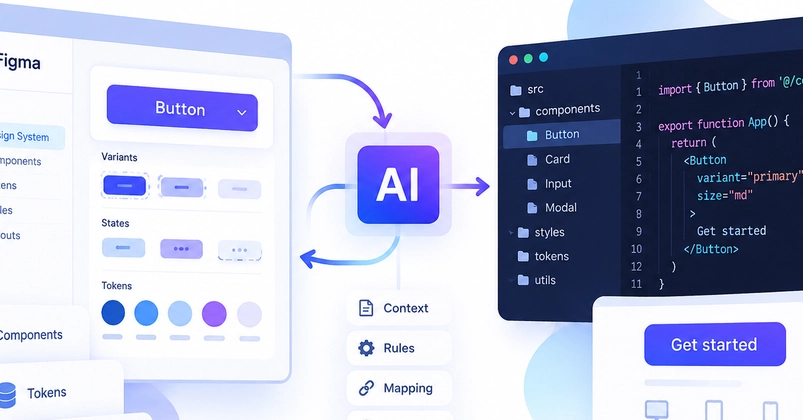
The Figma ↔ Code Experiment
To investigate this phenomenon, Ivlieva embarked on a practical experiment: translating designs between Figma and code, leveraging AI tools. The goal was to understand where the AI excelled, where it faltered, and what this revealed about the current state of automated design implementation. The experiment wasn't about proving AI's inadequacy, but about understanding its limitations and the potential pitfalls it introduces into the design and development lifecycle.
The process involved taking a design, often created in a tool like Figma, and using AI to generate the corresponding code. Conversely, she also explored generating designs from code components. The core tension arose when the AI-generated output, while syntactically correct, lacked the polish, accessibility, or semantic correctness expected in professional development. It highlighted a critical disconnect: AI could replicate visual appearance but struggled with the underlying principles of good design and robust engineering.
What AI Misses: The Nuances of Good Design
The experiment revealed several key areas where AI-generated designs and code fell short. Firstly, accessibility is often an afterthought. While an AI might generate a visually appealing button, it may not correctly implement ARIA attributes, ensure sufficient color contrast, or consider keyboard navigation. This oversight is particularly concerning, as accessibility is not merely a compliance issue but a fundamental aspect of good design that ensures products are usable by everyone.
Secondly, semantic correctness in HTML and CSS is frequently compromised. AI tools may opt for generic `div` elements where more specific semantic tags like `
The Developer's Role in an AI-Assisted Future
The implication for developers is clear: AI tools are not replacements for skilled professionals, but rather augmentations that require careful oversight. The ability to generate code quickly is valuable, but it places a greater emphasis on the developer's critical evaluation skills. Developers must become adept at reviewing AI-generated output, identifying flaws, and refactoring code to meet quality, accessibility, and performance standards. This means understanding the AI's outputs not as final products, but as starting points that need expert refinement.
Furthermore, the experiment underscores the importance of a strong design system. A well-defined design system provides a set of reusable components and guidelines that AI can more reliably translate into code. Without such a system, AI is left to guess, often leading to inconsistent and suboptimal results. The human element remains crucial in defining these systems, ensuring consistency, and making the high-level strategic decisions that AI cannot replicate.
Beyond the Hype: A Call for Mindful Integration
Ivlieva's experiment serves as a valuable reality check in a landscape often dominated by hype. The promise of AI to democratize design and development is real, but it comes with caveats. Founders and product managers must temper expectations, understanding that AI-generated solutions often require significant human intervention to achieve professional quality. The true value of AI lies not in replacing human expertise, but in amplifying it, freeing up designers and developers to focus on more complex, creative, and strategic tasks.
The