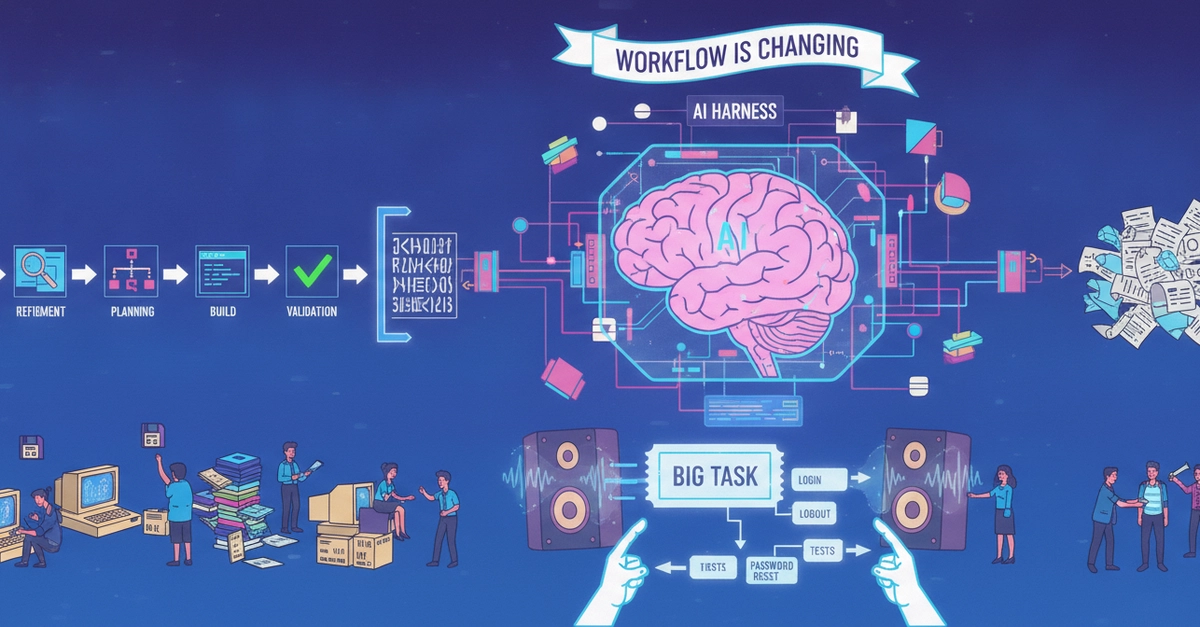
The Shifting Landscape of AI in Development
The term "AI engineering" might sound like a futuristic buzzword, conjuring images of complex algorithms and advanced robotics. However, beneath the surface of terms like "agentic development," "AI-native engineering," and "spec-driven development," a practical revolution is underway. AI is no longer just a research topic; it's becoming an active participant in the software development lifecycle. From assisting with initial requirements gathering and challenging Product Requirement Documents (PRDs) to exploring user experience (UX) ideas, reasoning about system architecture, generating implementation plans, and even writing and validating code, AI's capabilities are expanding rapidly.
The immediate question many developers and product managers face is, "What can AI *do*?" But a more profound and impactful question looms: "Is our current software development methodology ready to effectively leverage these AI capabilities?" The challenge isn't the AI itself, but the integration of AI into established human-centric workflows. This gap represents the true hurdle in realizing the full potential of AI in engineering.
Reimagining the Development Workflow with AI
A promising approach to integrating AI involves breaking down the traditional development process into five distinct stages: requirements, refinement, planning, build, and validation. While these stages are not new concepts, AI's ability to actively participate in each one fundamentally alters their execution and outcomes.
In the requirements phase, AI can process existing product inputs, help clarify ambiguous problem statements, and identify potential gaps or inconsistencies in PRDs. It can act as a rigorous reviewer, questioning assumptions and ensuring that the problem being solved is well-defined and understood.
Following requirements, the refinement stage involves fleshing out the details. AI can assist in translating high-level requirements into more granular user stories or feature specifications. It can explore edge cases, identify potential user pain points, and suggest alternative approaches, enriching the initial problem definition before any code is written.
The planning phase benefits significantly from AI's analytical power. Once requirements are refined, AI can help generate detailed implementation plans, break down complex tasks into manageable sub-tasks, estimate effort, and even suggest optimal technology stacks or architectural patterns based on the project's needs. This is akin to having an experienced technical lead who can rapidly draft a project roadmap.
During the build phase, AI's code generation capabilities come to the forefront. It can write boilerplate code, implement specific functions, generate unit tests, and even assist in refactoring existing codebases. This doesn't eliminate the need for human developers but allows them to focus on more complex logic, system integration, and higher-level problem-solving.
Finally, in the validation phase, AI can automate much of the testing process. It can generate test cases, execute them, analyze results, and identify bugs or regressions. AI can also perform code reviews, checking for style adherence, potential security vulnerabilities, and adherence to architectural guidelines. This rigorous, automated validation loop can significantly improve code quality and reduce the time spent on manual testing and debugging.
The Human Element: Bridging the Gap
The true difficulty lies not in deploying AI models or using AI-powered coding assistants, but in fundamentally changing how development teams operate. AI engineering, in its current state, excels at augmenting human capabilities and automating specific tasks. However, it doesn't inherently solve the organizational and cultural challenges associated with adopting new technologies.
Consider the analogy of a highly skilled artisan who has always used hand tools. Introducing a sophisticated power tool doesn't immediately make them a master of a new craft. They need to learn how to operate the tool safely, understand its limitations, integrate it into their existing process, and perhaps even adapt their entire workflow to take full advantage of its capabilities. Similarly, AI tools require developers and teams to adapt their practices.
This adaptation involves several key shifts:
- Trust and Verification: Developers must learn to trust AI-generated code and plans, but also to critically verify them. Over-reliance without scrutiny can lead to subtle bugs or security flaws.
- Prompt Engineering and Collaboration: Effective use of AI tools often requires skillful prompt engineering. Developers need to learn how to communicate their needs clearly and iteratively to the AI, treating it as a collaborator rather than just a code generator.
- Workflow Redesign: Existing development pipelines, CI/CD processes, and team communication strategies may need to be re-architected to accommodate AI's role. This could involve new review processes, automated validation gates, and different team roles.
- Skill Development: While AI can handle repetitive tasks, developers will need to hone skills in areas like AI oversight, complex problem-solving, system design, and understanding the nuances of AI model behavior.
The challenge is organizational. It requires buy-in from leadership, training for development teams, and a willingness to experiment and iterate on new ways of working. Companies that successfully integrate AI engineering will not just adopt new tools; they will fundamentally transform their development culture and processes.
The Unanswered Question: Scalability of Human Adaptation
What remains to be seen is how effectively and how quickly organizations can achieve this human-AI workflow integration at scale. We have seen AI tools mature rapidly, capable of generating sophisticated code and designs. Yet, the human side of the equation—the adaptation of processes, the retraining of teams, and the cultural shift required for true AI-native development—is inherently slower and more complex. Will companies that are slow to adapt be left behind, or will the inherent complexity of workflow transformation create a new kind of moat for established players?
The ease of AI engineering, in terms of its technical capabilities, is undeniable. The hard part is the human engineering required to make it a seamless, productive, and impactful part of how we build software. This organizational and cultural inertia is the true frontier for AI in the software development world.