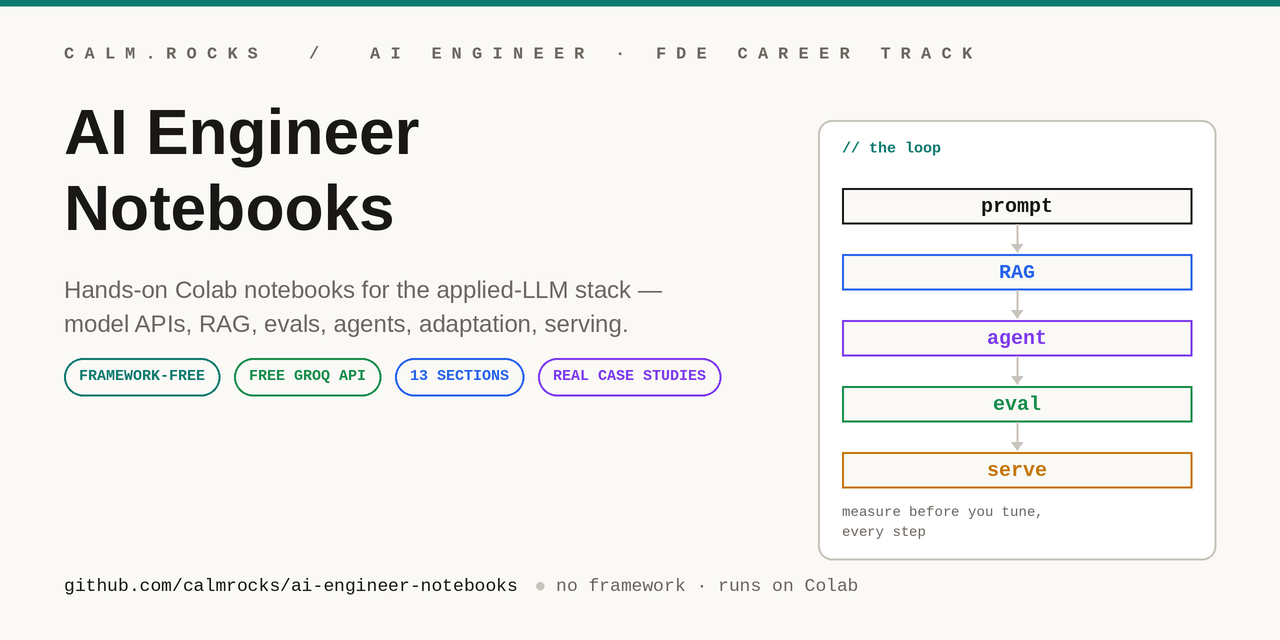
Framework-Free AI Development on Google Colab
A new open-source initiative, dubbed "AI Engineer Notebooks," aims to democratize the development and evaluation of advanced AI applications. The project provides a suite of pre-built Google Colaboratory (Colab) notebooks designed for Retrieval-Augmented Generation (RAG), agent-based systems, and rigorous evaluation of AI models. Crucially, these notebooks are framework-free, meaning they do not tie users to specific AI libraries or platforms like LangChain, LlamaIndex, or proprietary cloud services. This approach grants developers maximum flexibility and control over their AI stacks.
The core philosophy behind AI Engineer Notebooks is to offer a practical, hands-on environment for AI engineers to experiment, build, and benchmark without the overhead of setting up complex local environments or committing to specific commercial tools. By leveraging Google Colab, the project ensures accessibility, allowing anyone with a Google account to run sophisticated AI experiments for free, with access to GPUs and TPUs. This lowers the barrier to entry for individuals and small teams looking to explore cutting-edge AI capabilities.
The project's emphasis on being "framework-free" is a significant differentiator. Many existing solutions for RAG, agents, and evaluation often come bundled with specific libraries that dictate how data is processed, how models are orchestrated, and how results are measured. This can lead to vendor lock-in, making it difficult to switch components or integrate with other systems. AI Engineer Notebooks sidesteps this by providing foundational code and best practices that can be adapted to any preferred framework or custom implementation. Developers can slot in their chosen vector databases, LLMs, or evaluation metrics with minimal friction.
The notebooks are structured to cover three key areas of modern AI application development:
Retrieval-Augmented Generation (RAG)
The RAG notebooks focus on enabling LLMs to access and synthesize information from external data sources. This is critical for building AI applications that can provide accurate, up-to-date, and contextually relevant answers beyond their training data. The framework-free approach here means users can experiment with various embedding models, vector stores (e.g., FAISS, Chroma, Pinecone), and retrieval strategies. The notebooks likely guide users through the process of chunking documents, creating embeddings, storing them, and then performing semantic searches to retrieve relevant context before prompting the LLM. This modularity allows engineers to swap out components to find the optimal configuration for their specific use case, whether it’s for customer support bots, internal knowledge bases, or research assistants.
Agent-Based Systems
Building intelligent agents that can perform complex tasks autonomously is another key focus. These notebooks likely provide templates for creating agents that can reason, plan, and execute actions. This typically involves orchestrating LLMs with tools, memory modules, and planning algorithms. The framework-agnostic nature allows developers to integrate different LLM providers (OpenAI, Anthropic, open-source models), various toolkits (e.g., custom APIs, web search), and different memory mechanisms. The goal is to provide a blueprint for constructing agents that can tackle multi-step problems, offering a foundation for more sophisticated AI assistants and automation tools.
Evaluation of AI Models
Perhaps one of the most critical and often overlooked aspects of AI development is robust evaluation. The "evals" notebooks are designed to equip engineers with the tools to objectively measure the performance of their RAG systems, agents, and LLMs. This includes frameworks for generating test datasets, defining evaluation metrics (e.g., accuracy, relevance, latency, hallucination rates), and conducting systematic testing. Without proper evaluation, it's impossible to know if an AI system is truly effective or reliable. By providing a flexible evaluation framework, AI Engineer Notebooks empowers developers to benchmark different configurations, track improvements, and ensure their AI applications meet desired quality standards. This is essential for production-ready AI systems.
Accessibility and Community Contribution
The project's decision to host its resources on GitHub and utilize Google Colab signifies a commitment to open-source principles and community involvement. This allows developers worldwide to access, use, and contribute to the notebooks. The framework-free design encourages contributions from developers familiar with various AI ecosystems, fostering a rich and diverse set of adaptable examples. As the AI landscape evolves rapidly, a modular and adaptable set of tools like AI Engineer Notebooks becomes increasingly valuable. It provides a stable foundation upon which new techniques and frameworks can be built or integrated, rather than requiring a complete overhaul of existing projects.
The Unanswered Question: Scalability Beyond Colab
While the accessibility and free nature of AI Engineer Notebooks on Colab are undeniable advantages for learning and prototyping, the question remains: what is the clear path to productionizing applications built with these framework-agnostic components? Scaling these solutions beyond the resource limitations and usage policies of Google Colab, and integrating them into robust, enterprise-grade MLOps pipelines, will require careful architectural decisions and potentially significant refactoring. The framework-free design, while flexible, also means developers must explicitly architect for scalability and deployment themselves, a challenge that integrated platforms often abstract away.
Referenced Sources
- verified