The Problem with Blanket AI-Generated Content Flags
Current practices for marking AI-generated content often fall short by treating entire documents as either human-owned or machine-generated. This approach, typically applied at the Markdown file level, fails to account for the nuanced nature of documentation. A single page can intermingle sections that are factually verifiable through repository artifacts, such as CLI tables or code snippets, with paragraphs that require human interpretation, policy language, or strategic product intent. When an AI model is given such a mixed-ownership page, it can generate plausible-sounding text for the human-owned sections, but this text often lacks any grounding in verifiable facts. The failure here isn't a lack of fluency; it's the introduction of unverifiable claims that undermine the integrity of the documentation.
This indiscriminate flagging creates a false sense of security. Developers or product managers reviewing the document might assume all content is either demonstrably true or carefully crafted human insight. However, the AI's output, while grammatically correct, can introduce subtle inaccuracies or misinterpretations that are difficult to trace back to their origin. This is particularly problematic for technical documentation where precision is paramount. A CLI table might accurately reflect a command's output, but a subsequent paragraph explaining its implications could be based on flawed reasoning or outdated product goals that the AI cannot possibly grasp.
The core issue is that recoverability—the ability to prove a statement true or false using existing artifacts—is not a property of an entire document but of individual sections within it. A model trained to generate content for a whole file might prioritize linguistic coherence over factual accuracy when it encounters sections that require domain expertise or policy knowledge it doesn't possess. This leads to documentation that looks good on the surface but crumbles under scrutiny, eroding trust in the system and the information it provides.
Introducing Section-Level Scoring for Recoverability and Judgment
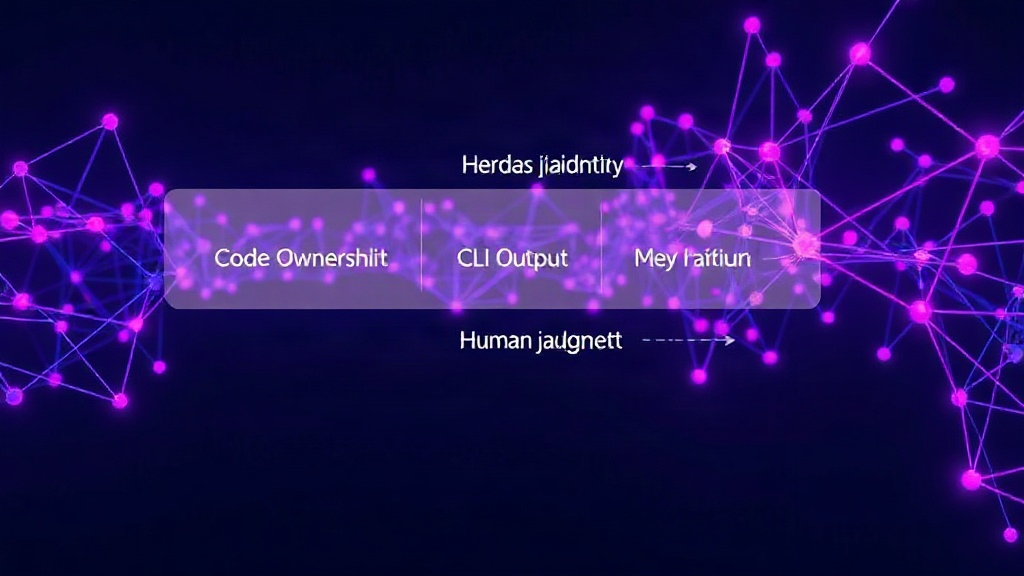
To address these shortcomings, a new approach proposes a gate model that evaluates AI-generated content at the section level. This model would assign two key scores to each section: recoverability and judgment density. Recoverability measures the extent to which the claims made in a section can be empirically verified against repository artifacts like code, test results, or configuration files. Judgment density, on the other hand, quantifies the degree to which a section relies on human interpretation, policy decisions, product intent, or conversational context—elements that are inherently difficult for an AI to reliably generate or verify.
The proposed gate model would establish a fixed threshold for both scores. AI generation would be permitted only for sections that meet or exceed these predefined thresholds. This ensures that models are confined to drafting material that is demonstrably source-backed and factually verifiable. Human contributors would retain ownership of sections that are rich in judgment, policy language, or conversational nuances, preserving the essential human elements that define product intent and strategic direction.
By breaking down documentation into granular sections, teams can maintain precise control over content ownership and verification. A section detailing a specific API endpoint's behavior, accompanied by a verifiable code example, would score high on recoverability. Conversely, a section discussing the strategic rationale behind a feature, or a user-support anecdote, would score high on judgment density but low on recoverability. The gate model acts as a sophisticated filter, allowing AI to assist with the former while safeguarding the latter for human expertise.
Implications for AI-Assisted Documentation Workflows
This section-level gate model has significant implications for how AI is integrated into documentation workflows. It shifts the focus from broad content generation to targeted, verifiable assistance. Instead of asking an AI to write an entire README, developers might use it to draft specific code examples, generate initial descriptions for API parameters based on their definitions, or summarize test results. The AI's output for these sections would be automatically scored for recoverability, and if it falls below the threshold, the generation would be flagged or rejected.
This granular control also implies a redefinition of roles within documentation teams. AI becomes a powerful tool for drafting factual, source-backed content, freeing up human writers and subject matter experts to focus on higher-level tasks. These include defining product intent, crafting persuasive narratives, ensuring policy compliance, and handling nuanced user communication. The AI assists in the 'what' and 'how' of technical implementation, while humans remain responsible for the 'why' and the 'for whom'.
The success of this model hinges on robust tooling that can accurately parse documents, identify section boundaries, and execute verification checks against repository artifacts. This might involve integrating with CI/CD pipelines to automatically score generated content during the build process or developing specialized editors that provide real-time feedback on recoverability and judgment scores as content is drafted. The surprising detail here is not the complexity of the AI model itself, but the organizational and tooling shifts required to implement such a granular control system effectively.
Refining Judgment and Recoverability Thresholds
Determining the appropriate thresholds for recoverability and judgment density is crucial for the effective implementation of this gate model. These thresholds will likely vary depending on the type of documentation, the criticality of the information, and the specific AI model being used. For instance, core API reference documentation might require extremely high recoverability scores, while introductory guides or conceptual overviews might allow for a higher degree of human judgment.
The process of setting these thresholds will itself involve a degree of human judgment and iterative refinement. It requires close collaboration between AI engineers, technical writers, product managers, and legal counsel. What constitutes 'sufficient' recoverability for a security-sensitive document versus a marketing page? How much 'judgment density' is acceptable before the risk of unverifiable claims becomes too high? These are questions that need to be answered through careful consideration and empirical testing.
Ultimately, this section-level gate model represents a more mature and responsible approach to AI-generated content. It acknowledges the strengths and limitations of current AI capabilities, ensuring that AI assists rather than supplants human expertise in critical areas of documentation. By focusing on verifiable facts and clearly demarcating areas of human judgment, this model promises to improve the accuracy, reliability, and trustworthiness of AI-assisted documentation.
What remains to be seen is how quickly development teams will adopt such granular control mechanisms. The ease with which existing documentation platforms can be adapted, or the development of new tools to support this model, will be a key factor in its widespread adoption. The transition from blanket content flags to section-level scrutiny requires a fundamental shift in how we think about and manage AI-generated text.