The Genesis of Almide: Designing for AI
Four months ago, a bold claim emerged: the ease with which an AI can correctly write code for a language hinges on the language's design, not the AI model. The initial evidence was a toy language, Almide, that tackled eight test problems, albeit taking three times longer than Ruby. The prevailing hypothesis was that this performance gap was merely a training data issue. The expectation was that with more Almide code publicly available, AI models would eventually improve their proficiency.
This hypothesis proved incorrect. Despite minimal growth in public Almide code, current AI models like Claude now solve all twenty test problems with remarkable speed and conciseness, often outperforming mature languages with a decade of training data. This suggests a fundamental shift in how AI interacts with programming languages, driven by intentional design rather than sheer data volume.
The core of this transformation lies in Almide's unique architecture, meticulously crafted to be comprehensible and manageable for AI agents. This design philosophy extends beyond simple syntax; it incorporates intrinsic properties that facilitate formal verification, a critical component in ensuring correctness. The challenge was not just to create a language AI could write, but a language AI could write correctly, with a high degree of assurance.
Almide's success indicates that the path to AI-generated code is not solely paved with more data, but with smarter language design. It suggests that by embedding principles of formal logic and verifiable structures directly into a language's DNA, we can unlock new levels of AI programming capability.
Mathematical Proofs as the Ultimate Arbiter
The true innovation in Almide's development isn't just its AI-friendliness, but the integration of mathematical proofs for compiler correctness. This approach moves beyond traditional testing methodologies, which often struggle to capture all edge cases. Instead, Almide's compiler is subjected to rigorous formal verification, ensuring that its output adheres to a set of provable mathematical invariants.
This means that on every build, the compiler's logic is not just tested, but mathematically proven to be sound. This is akin to a bridge engineer not just testing the bridge with trucks, but proving its structural integrity through complex physics calculations before it's ever opened to traffic. The implications for software reliability are profound. For Almide, this verification layer acts as an indispensable safeguard, guaranteeing that the code generated by AI, and subsequently compiled, meets a predefined standard of correctness.
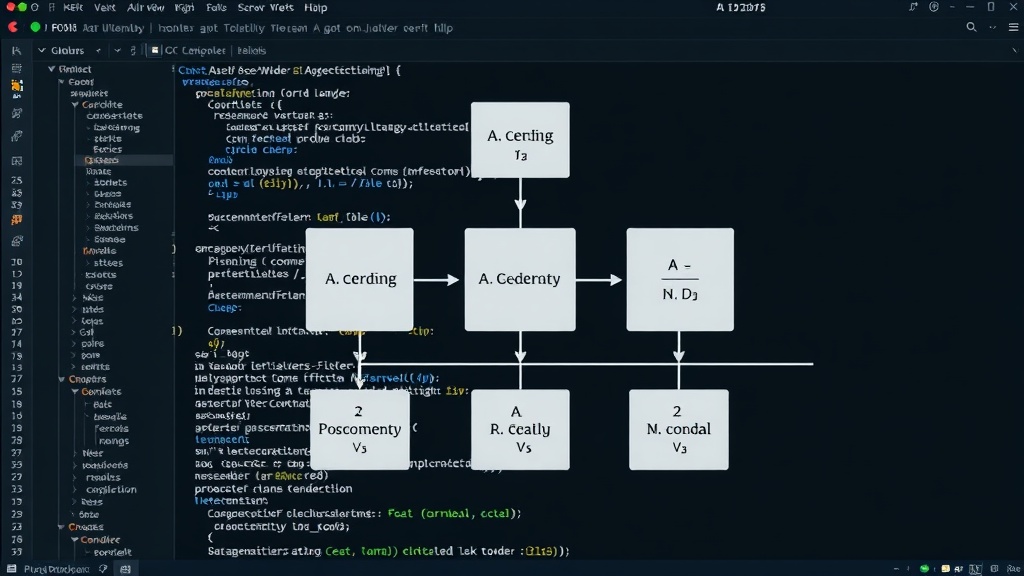
The process involves translating the compiler's operational semantics into a formal mathematical model. Tools like Coq or Isabelle/HOL might be employed to construct proofs that demonstrate the compiler's behavior aligns with its specification across all possible inputs. This is a significant departure from conventional development, where compiler bugs are often discovered through extensive test suites and user reports, sometimes leading to subtle, hard-to-diagnose issues.
For Almide, this rigorous verification ensures that the AI's translation of intent into executable code is not only syntactically correct but semantically sound. It provides a level of confidence that traditional testing alone cannot offer. This mathematical rigor is a key differentiator, enabling AI models to produce code that is not just functional, but demonstrably correct.
Performance Benchmarks: AI vs. The Established
The performance data emerging from Almide is striking. While initial development focused on correctness, the language and its compiler have demonstrated unexpected speed and efficiency. Claude, a leading AI model, now solves Almide's test problems faster and with fewer lines of code than many established languages with years of optimization and vast training datasets.
This suggests that Almide's AI-centric design principles, combined with its mathematically verified compiler, create an environment where AI can operate with exceptional efficiency. The language's structure appears to minimize the cognitive load on the AI, allowing it to focus on generating optimal solutions rather than navigating linguistic complexities or dealing with ambiguity.
Consider the analogy of learning a new skill. If you're given a complex, multi-step manual with ambiguous instructions, you'll struggle. But if you're given a clear, concise guide with logical steps, you'll master it faster. Almide is that clear guide for AI. Its design prioritizes clarity and verifiability, directly translating into faster, more efficient code generation.
The implications extend beyond mere speed. This efficiency could translate to reduced computational costs for AI-driven software development and potentially faster development cycles for complex applications. It challenges the long-held belief that language maturity and extensive training data are the sole drivers of AI programming performance. Almide demonstrates that intelligent language design can be a powerful catalyst for AI capabilities.
The Unanswered Question: Scalability and Generalization
While Almide's success with its specific set of test problems is impressive, a critical question remains: how well will this approach scale to more complex, real-world programming tasks? The current tests, while comprehensive for a toy language, are still a limited domain. What happens when Almide is tasked with generating code for large-scale distributed systems, intricate machine learning pipelines, or performance-critical embedded systems?
The integration of mathematical proofs for compiler correctness is a powerful tool for ensuring reliability. However, the process of formally verifying compilers for increasingly complex languages is itself a significant undertaking. Will the overhead of formal verification become a bottleneck as language complexity grows? Furthermore, can the AI models trained on Almide's design principles generalize effectively to other languages or paradigms that do not share these specific AI-centric attributes?
The current evidence suggests that AI's ability to write code is deeply intertwined with the structure and verifiability of the language itself. Almide's success highlights the potential for designing languages that are inherently better suited for AI comprehension and generation. But the path from a successful toy language with a verified compiler to a widely adopted, AI-producible, and verifiable general-purpose language is long and filled with engineering challenges. The next step will be observing Almide's evolution and its ability to tackle broader programming domains while maintaining its rigorous verification standards.