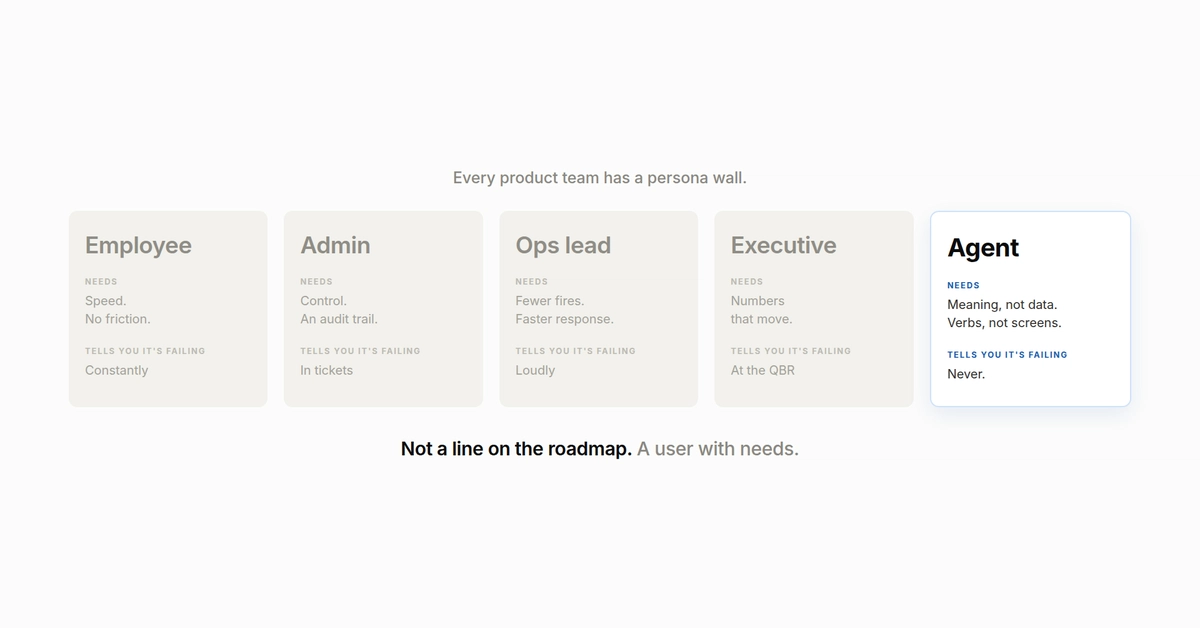
The AI Persona: A Strategic Blind Spot
Product teams meticulously craft personas for their human users. We map out the needs of the "Stressed Admin," the "Power User," and the "Busy Executive." But when artificial intelligence arrived, it didn't earn a persona card. Instead, it was often relegated to a superficial line item on the product roadmap, treated as a mere feature rather than a distinct user with unique requirements. This is a profound strategic error. Treating AI as just an add-on results in the shallow implementations we see today: a chat bubble in the corner, briefly demoed, and abandoned by users within months. To navigate the next era of software, companies must shift their perspective. AI must be designed for as the most demanding, alien user on your platform, a user with zero common sense.
Human users, with their inherent intuition and ability to cover for design flaws, have masked these shortcomings for years. They can infer intent, correct misunderstandings, and bridge gaps in logic. AI, however, cannot. It operates on patterns and data, lacking the contextual understanding and common sense that humans take for granted. This fundamental difference means that a product designed solely for human intuition will inevitably fail when subjected to the literal, unyielding logic of an AI. The contrast between how humans interact with software and how AI will interact is stark, and ignoring it is a critical design flaw.
Why AI is Not Just Another User
The core of the problem lies in treating AI as an extension of existing user paradigms. AI doesn't browse, click, or type in the same way a human does. Its interaction is often programmatic, driven by APIs, data streams, and complex algorithms. It requires explicit instructions, clear data formats, and predictable outputs. Unlike a human who can adapt to ambiguity, AI thrives on precision. A product that relies on implicit understanding or user guesswork will be brittle when faced with AI integration. This isn't about adding a new button; it's about rethinking the underlying architecture and interaction models.
Consider the difference between a user filling out a form and an AI processing that same data. A human can mentally parse a poorly formatted date or infer a missing zip code based on context. An AI will either error out or produce nonsensical results if the input doesn't conform to its expected structure. This is why designing for AI requires a level of rigor and explicitness that often feels like over-engineering when applied to human users. But for AI, this explicitness is the bedrock of functionality. It’s less like building a user-friendly interface and more like constructing a robust API contract that the AI can reliably consume.

The Strategic Implications of Ignoring AI's Needs
The current approach to AI integration is akin to building a house with only human inhabitants in mind and then trying to force a new, highly specific type of resident to live there without any modifications. This resident doesn't sleep, doesn't eat, and doesn't understand social cues. They need power, data, and direct access to information, but they also need clear, unambiguous instructions. When product teams fail to account for this, the result is a product that technically *has* AI but doesn't truly *leverage* it effectively.
This failure manifests in several ways. First, user adoption plummets because the AI feature is clunky, unreliable, or doesn't deliver on its promise. Second, development costs skyrocket as teams struggle to retroactively patch in AI capabilities that weren't part of the original design. Third, and most critically, companies miss out on the transformative potential of AI. They end up with AI features that are little more than a veneer, failing to unlock the deeper efficiencies, insights, and capabilities that AI can offer when properly integrated. The contrast between a well-integrated AI and a bolted-on one is not subtle; it's the difference between a product that feels intelligent and one that feels like a gimmick.
Designing for the Alien User
To move beyond superficial implementations, product development must embrace AI as a distinct user. This means:
- Explicit Data Contracts: Define precise schemas and formats for data exchange. Don't rely on AI to parse unstructured or ambiguous inputs.
- Clear Instruction Sets: Design interaction models that provide AI with unambiguous commands and parameters. Think APIs, not just conversational prompts.
- Robust Error Handling: Anticipate and design for AI-specific failure modes. How does the system respond when AI provides unexpected output or fails to process data?
- Contextual Awareness: While AI lacks common sense, products can provide it with structured contextual information to improve decision-making.
- Iterative Design with AI Feedback: Treat AI interactions as data points. Use logs and output to refine prompts, data structures, and system logic.
This is not a minor adjustment. It requires a fundamental rethinking of product design principles. It means developers and product managers must collaborate more closely with AI engineers and data scientists from the outset. It also means acknowledging that the skills required for building AI-native products are different from those needed for traditional software. The persona wall needs an AI-shaped expansion, not just a sticky note.
The Unanswered Question: What Happens to Legacy Workflows?
What nobody has adequately addressed yet is the transition for existing human users and workflows. If we design products to be AI-native, how do we ensure backward compatibility or provide a smooth migration path for teams accustomed to older, more human-centric interaction patterns? The risk is creating a divide where some users are left behind, unable to leverage the new AI-driven capabilities, or worse, unable to use the product at all. This isn't just a technical challenge; it's a significant organizational and user experience hurdle that demands careful consideration beyond the initial AI integration.
Companies that successfully navigate this shift will be those that recognize AI not as a feature to be bolted on, but as a fundamental new type of user. They will design their products from the ground up with AI's unique characteristics in mind, treating its needs with the same seriousness—if not more—than their human counterparts. The alternative is to continue shipping products that offer a fleeting AI experience, destined for the digital graveyard of abandoned features.