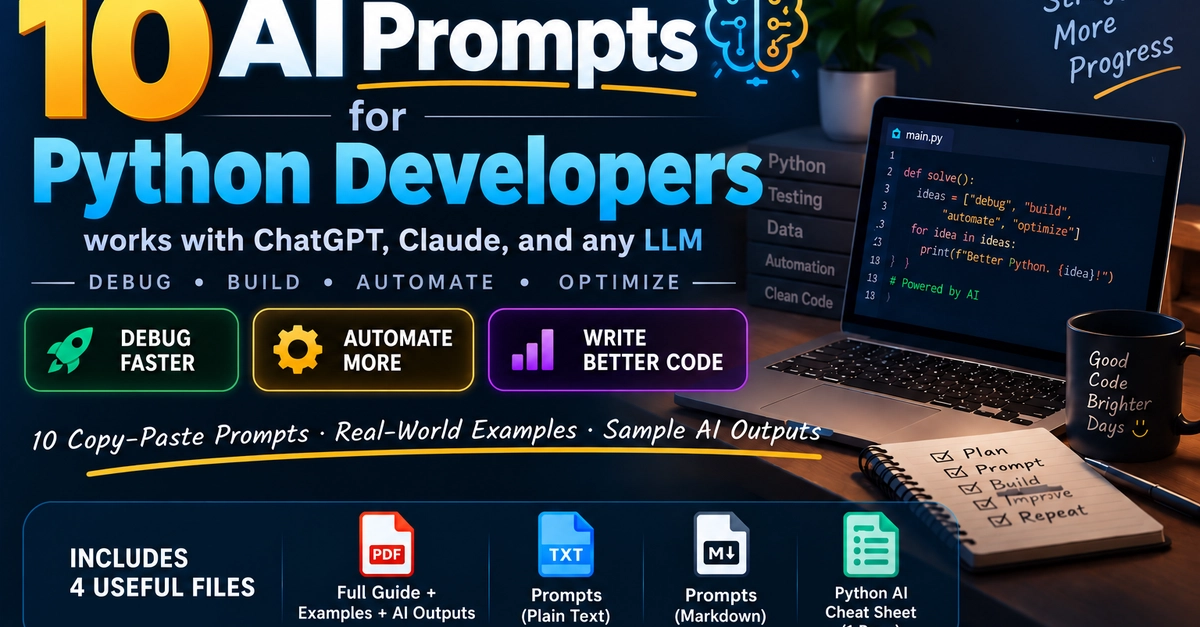
The Debugging Dilemma: When AI Offers Little Help
Developers often turn to AI assistants for help with complex coding problems, especially during debugging. However, a common frustration arises when the AI provides generic, unhelpful advice. Consider a scenario familiar to many Python developers: a Celery task functions flawlessly in local development and staging environments but fails intermittently in production. The error message, a `DetachedInstanceError: Instance
The problem stems from how AI models process information. They are trained on vast datasets of code and text, but without specific context, they default to common patterns and solutions. When debugging, the environment, specific code snippets, dependencies, and the exact sequence of events leading to an error are crucial. Without this detailed context, the AI cannot differentiate between a common error pattern and the specific manifestation of that error in your unique setup. It's like asking a seasoned mechanic to fix a car problem without telling them the make, model, year, or any symptoms beyond "it's making a weird noise." They might guess a common issue, but a precise diagnosis requires more information.
Crafting Effective Prompts for Actionable Debugging
To overcome this limitation, developers must shift their approach to prompting. Instead of a broad question like "Why am I getting this error?", the prompt needs to be structured to provide the AI with the necessary context. Think of it as guiding the AI to act like a senior engineer who has all the relevant information at their fingertips. This involves including:
- The full error message and traceback: This is non-negotiable. The traceback provides the exact line of code where the error occurred and the sequence of function calls that led to it.
- Relevant code snippets: Include the function or method where the error originates, and any surrounding code that might be interacting with it. This helps the AI understand the logic flow.
- Environment details: Specify the programming language, framework (e.g., Django, Flask, FastAPI), database (e.g., PostgreSQL, MySQL), and relevant library versions (e.g., Celery version, SQLAlchemy version).
- Reproduction steps: Clearly outline how to reproduce the error. If it's intermittent, describe the conditions under which it's more likely to occur (e.g., "occurs during high load," "happens after a specific user action").
- What has already been tried: Mentioning attempted solutions prevents the AI from suggesting things you've already ruled out and shows the AI the direction of your investigation.
By providing this comprehensive information, you enable the AI to analyze the specific context of your problem rather than offering generalized advice. This structured approach helps the AI identify potential causes that are relevant to your situation, such as session management issues in ORMs like SQLAlchemy, which are notorious for `DetachedInstanceError` when not handled correctly across asynchronous tasks or different request contexts.
Beyond Debugging: The Broader Implications for AI Accuracy
The challenge of vague AI responses extends beyond code debugging. A recent Financial Times report highlighted that AI chatbots often provide incorrect answers to financial queries. This underscores a fundamental limitation: AI models are powerful pattern-matching engines, but they lack true understanding and domain-specific reasoning unless explicitly guided. For financial advice, accuracy is paramount, and a wrong answer can have severe consequences. Similarly, in debugging, a misplaced suggestion can waste significant developer time or even introduce new bugs.
The lesson learned from both coding and financial queries is that the quality of the AI's output is directly proportional to the quality of the input. Users must become adept at providing precise, contextual information. This requires a deeper understanding of how these models work and what kind of data they need to perform specific tasks effectively. For developers, this means treating AI assistants not as magic problem-solvers, but as highly capable junior developers who need clear instructions and all necessary background information to assist effectively.
The future of AI assistance in complex domains like software development and finance hinges on our ability to communicate our needs effectively. As AI models become more sophisticated, the responsibility will increasingly fall on the user to frame questions in a way that leverages the AI's strengths while mitigating its weaknesses. This involves a continuous learning process for both humans and AI, refining the art of the prompt to unlock more accurate and actionable insights.