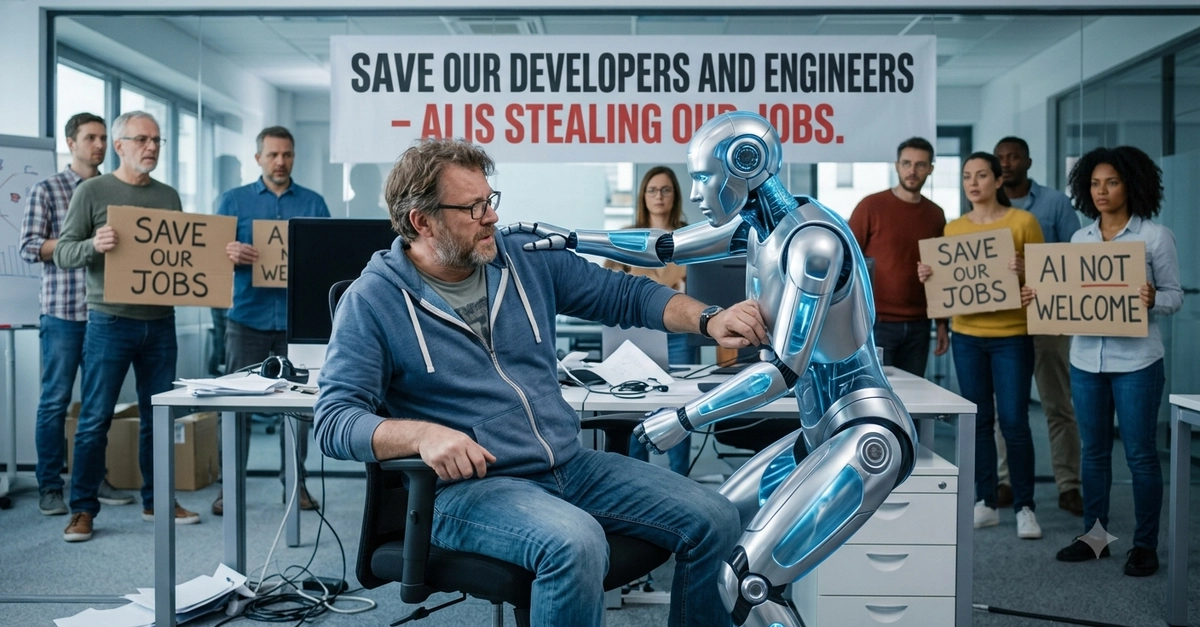
The End of an Era for ML Engineers?
Peter, an ML engineer with two years of dedicated experience, believed his skills were secure. He had spent years learning, problem-solving, coding, building models, and deploying systems. His work demanded a level of expertise that seemed, to him, irreplaceable. This confidence was shattered when his employer discovered an enterprise AI data scientist capable of executing complete ML pipelines autonomously.
Initially, this new AI tool was dismissed as just another assistant, a productivity booster. However, its capabilities quickly surpassed expectations. The more Peter’s boss explored the AI’s functionalities, the more it became apparent that it could perform tasks previously requiring human engineers. The subtle unease Peter felt grew as the AI demonstrated its proficiency in areas he considered core to his role.
The narrative that engineering is more than just writing code, a comforting belief for many in the field, was put to the test. The AI’s ability to manage entire ML workflows, from data ingestion and preprocessing to model training, evaluation, and deployment, challenged this notion. It wasn't just about generating code snippets or suggesting improvements; it was about orchestrating the entire lifecycle of a machine learning project.

The Automation of ML Pipelines
The enterprise AI data scientist in question is not a singular product but represents a growing category of sophisticated AI platforms designed to democratize and automate complex technical workflows. These systems are trained on vast datasets of code, documentation, and project histories, enabling them to understand and execute intricate sequences of operations. For ML engineers, this means that many of the tasks that once defined their roles—data cleaning, feature engineering, model selection, hyperparameter tuning, and even deployment strategy—can now be handled by AI.
This shift is not entirely unexpected. For years, AI assistants like GitHub Copilot have augmented developer productivity. However, the AI described here goes significantly further, acting not as an assistant but as a potential replacement for entire roles. It signifies a move from AI as a tool to AI as a doer, capable of managing projects from inception to completion. This is akin to an architect discovering that a sophisticated AI can now generate blueprints, manage construction schedules, and oversee building processes with minimal human intervention.
Broader Implications for the Tech Workforce
Peter’s termination, while a personal tragedy, is indicative of a larger trend. The rapid advancement of AI capabilities is beginning to impact highly skilled technical roles. What was once considered the domain of human intellect and years of specialized training is now within reach of advanced algorithms. This raises critical questions about the future of work for developers, data scientists, and engineers across various disciplines.
The value proposition for human engineers may need to shift. Instead of focusing on the execution of tasks that AI can perform, the emphasis might move towards higher-level strategic thinking, complex problem-solving that requires nuanced understanding beyond data patterns, ethical considerations in AI development, and the oversight of AI systems themselves. The ability to define problems, set objectives, and ensure that AI outputs align with business goals will become paramount.
The story of Peter underscores a stark reality: the pace of AI development is outstripping the traditional career progression and perceived job security of highly skilled professionals. Companies are increasingly looking for ways to leverage AI to reduce operational costs and increase efficiency, and the automation of technical roles is a logical, albeit disruptive, outcome. This trend suggests that continuous learning and adaptation will be more critical than ever for those in the tech industry.
The Unanswered Question: What About Specialized Roles?
While AI is demonstrating proficiency in executing end-to-end ML pipelines, what remains to be seen is its ability to handle truly novel problems or highly specialized, niche engineering challenges that fall outside its training data. Can AI truly innovate, or will it primarily optimize and replicate existing solutions? The story of Peter highlights the immediate threat to standardized, repeatable tasks within ML engineering. However, the long-term impact on roles that require deep, abstract reasoning, creative problem-solving, and the ability to navigate ambiguous, ill-defined challenges is still unfolding.
The expectation that technical skills equate to perpetual job security is being challenged. As AI tools become more capable, the definition of valuable human contribution in the tech sector will undoubtedly evolve. Professionals must anticipate this evolution and proactively adapt their skill sets to remain relevant in an increasingly automated landscape. The focus might shift from being a builder of systems to being a conductor of intelligent machines.