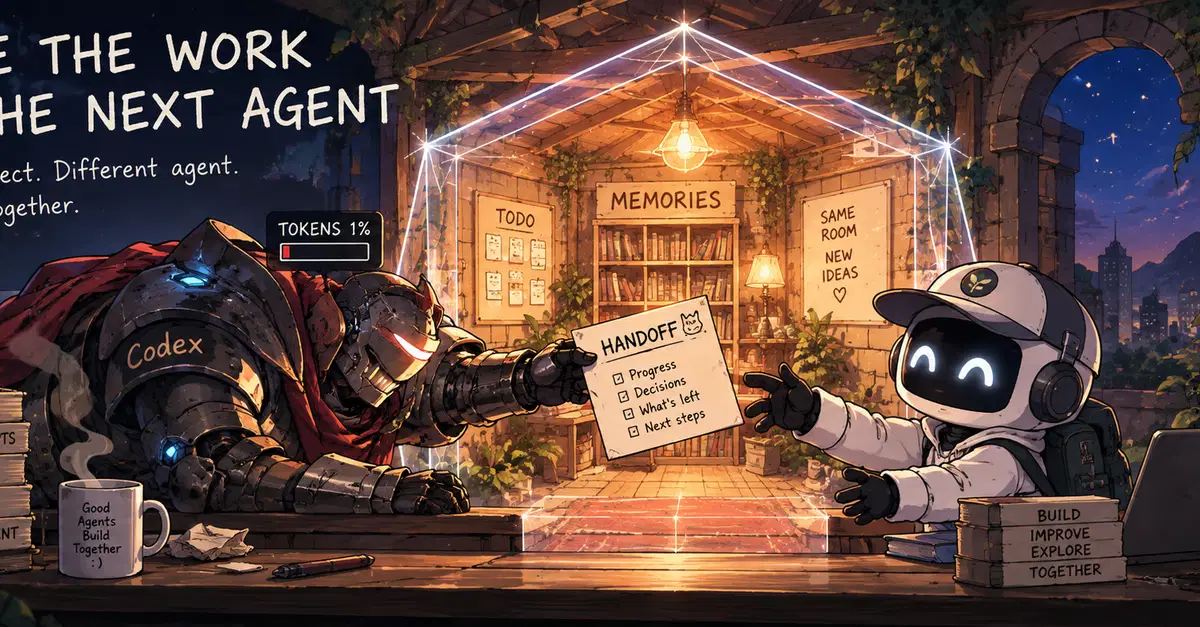
The Problem: Code Without Context
You've invested hours, perhaps days, with an AI coding agent. It understands the project's intricacies: the failed experiments, the intentional workarounds, the next steps. Then, usage limits hit, or you simply decide to switch models. The challenge isn't finding a new AI; it's bridging the knowledge gap. Your code repository is a snapshot, but it lacks the narrative – the 'why' behind every line. A new agent arrives with a clean slate, unaware of the project's history. To ensure continuity, this context must be explicitly transferred.
This article outlines a practical, four-step workflow designed to move an unfinished coding project from one AI agent to another, preserving the critical context that allows development to continue efficiently.
Step 1: Consolidate and Document Project State
Before switching agents, the first crucial step is to meticulously document the current state of the project. This isn't just about committing code; it's about capturing the ephemeral knowledge residing in the AI's memory and your own recent interactions. Begin by ensuring all current code is committed to your version control system. This provides a stable baseline. Then, create a dedicated document – a README, a project journal, or a specific markdown file within the repository – that serves as the project's 'story'.
This document should detail:
- Current Functionality: What parts of the project are working as intended? What are the immediate goals for the next phase?
- Known Issues and Bugs: List any outstanding bugs, their severity, and any attempted (or failed) solutions.
- Intentional Workarounds: Explain any 'ugly' code or unconventional solutions. Document why they exist and what problem they solve. This prevents the new AI from trying to 'fix' something that is deliberately implemented.
- Future Plans: Outline the immediate next steps, planned features, or refactoring tasks. This provides a clear roadmap for the incoming agent.
- AI Interaction Summary: Briefly summarize key decisions made during the previous AI's sessions, especially those that influenced the current codebase.
Think of this document as a detailed handover note for a human colleague, but tailored for an AI. It's the knowledge transfer package that prevents the new agent from re-learning everything you've already discovered.
Step 2: Extract and Structure AI Knowledge
The AI agent itself holds valuable information that isn't directly in the code. This includes its internal reasoning, its understanding of your prompts, and the conversational context. The goal here is to extract this information in a structured format that the new AI can easily parse and understand.
There are several ways to approach this:
- Conversation Log Export: Many AI coding interfaces allow you to export the chat history. This raw log is invaluable. You may need to manually curate it, removing irrelevant chatter, but the core interactions, prompts, and AI responses should be preserved.
- Contextual Summaries: Based on the conversation log and your project state document, create concise summaries of key architectural decisions, algorithm choices, or complex logic. For example, if the AI helped design a specific data structure, summarize its purpose and constraints.
- Prompt Engineering for New Agent: When you initiate interaction with the new AI, you'll need to construct a comprehensive initial prompt. This prompt should include:
- A clear statement of the project's objective.
- A summary of the current state (referencing your documented state).
- Key snippets of the exported conversation log, or summaries derived from it, to highlight critical past decisions or problem-solving steps.
- Specific instructions on what needs to be done next.
The more structured and relevant the information you feed the new AI, the faster it can orient itself and begin contributing effectively. Imagine giving a new team member not just the project files, but also the key meeting minutes and design documents from the last six months.
Step 3: Inject Context into the New Agent
With your documentation and extracted AI knowledge ready, the next step is to systematically introduce this context to the new AI agent. This is more than just pasting code into a new chat window. It requires a deliberate injection of the project's narrative.
Here’s how to do it:
- Initial Prompt Engineering: As mentioned in Step 2, craft a detailed initial prompt. This prompt should be a combination of your project state summary, key insights from the AI's past reasoning, and the immediate task you want the new agent to tackle. Start with high-level context and progressively drill down.
- Codebase Upload: Provide the new agent with access to the current codebase. This might involve uploading files directly, sharing a link to a repository (if the agent supports it), or pasting significant code blocks. Ensure the agent can reference and understand the existing code structure.
- Iterative Refinement: Once the new agent has processed the initial context, engage in a dialogue. Ask it questions about its understanding of the project. Correct any misunderstandings immediately. If the AI seems to be heading in the wrong direction, refer it back to specific parts of your documentation or conversation logs. This iterative process helps the new agent build its internal model of the project.
The key is to treat the new agent like a new developer joining the team. You wouldn't just hand them the code; you'd walk them through the project history, explain critical decisions, and answer their questions. This deliberate injection of context prevents the AI from making costly assumptions or re-treading old ground.
Step 4: Verify and Validate
The final step is rigorous verification. The new AI agent must demonstrate a clear understanding of the project and its goals. This involves not just checking if it can generate syntactically correct code, but if it can reason about the project's logic and constraints.
Perform these checks:
- Task Execution: Assign a small, well-defined task that builds upon the existing codebase. Observe how the AI approaches it. Does it correctly leverage existing functions? Does it understand dependencies?
- Conceptual Questions: Ask the AI questions that require it to recall or infer information from the context you provided. For example: "Why was the `process_data` function implemented this way?" or "What are the potential side effects of modifying the `user_auth` module?"
- Code Review: Have the AI generate new code or modify existing code. Critically review its output. Does it align with the project's established patterns and best practices? Does it introduce regressions?
- Performance Monitoring: If the previous AI had performance characteristics (e.g., speed, specific output quality), try to benchmark the new agent against similar tasks.
This validation phase is critical. It ensures that the knowledge transfer was successful and that the new agent is ready to contribute meaningfully. If the AI struggles with these checks, it indicates that more context needs to be provided or that the initial prompt requires further refinement. It’s a feedback loop that guarantees the project stays on track.
Beyond the Code: The Human Element
While this workflow focuses on transferring context to AI agents, it highlights a broader challenge in human-AI collaboration. As AI tools become more integrated into development workflows, the ability to seamlessly transition between tools, models, or even human team members becomes paramount. The efficiency gained from AI can be lost if context transfer is a bottleneck.
The temptation to simply discard previous work and start anew with a new tool, or worse, to view AI-driven efficiency as a signal to reduce human headcount, overlooks the complexity of software development. As Source 2 points out, when AI accelerates a team's capabilities, the logical next step isn't headcount reduction but leveraging that enhanced capacity to tackle more ambitious projects or address long-standing bottlenecks. The ability to effectively manage and transition AI-assisted projects, as outlined in this workflow, is a key skill for teams looking to maximize their AI investments without sacrificing momentum or valuable human expertise.