The New Frontier: AI as a Partner, Not a Crutch
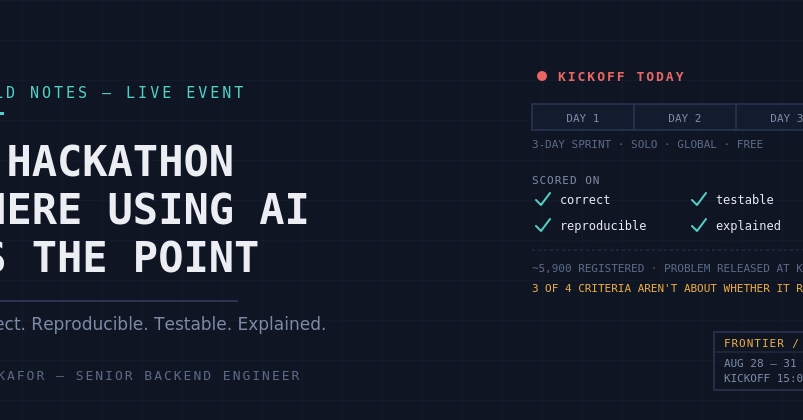
The landscape of software development is rapidly shifting, and with it, the nature of coding competitions. Traditional hackathons often view AI coding assistants as a potential shortcut, bordering on cheating. However, micro1's Frontier Engineering Challenge, kicking off today, fundamentally redefines this paradigm. This global, online competition, running as a three-day sprint from August 28–31, 2026, explicitly mandates the use of AI coding agents. The challenge isn't about whether participants can generate code using AI; it's about their ability to produce code that withstands rigorous scrutiny.
This inversion creates a fundamentally different competitive arena. Instead of optimizing for raw code output, participants must optimize for code quality, security, and maintainability when augmented by AI. This approach mirrors the evolving reality of professional software engineering, where AI is increasingly integrated into workflows, not as a replacement for human developers, but as a powerful collaborator. The success of AI in this context hinges on its ability to produce code that is not just functional but also robust, efficient, and secure – qualities that are notoriously difficult to assess and guarantee.
The competition statement, released at the kickoff on August 28 at 15:00 UTC, will outline a real-world software engineering problem. Participants, competing individually, will leverage AI coding agents to tackle this challenge. The sheer volume of registrations—5,900 engineers—underscores the significant interest in this novel approach to AI-augmented development and the pressing need to understand how to effectively evaluate and integrate AI-generated code within professional environments.
Judging Criteria: Beyond the Surface
The core differentiator of the Frontier Engineering Challenge lies in its judging methodology. Unlike hackathons that might penalize AI use, micro1 embraces it, but with a critical eye. The judging criteria will focus on aspects that move beyond simple code generation. This includes:
- Code Quality and Readability: How well-structured, commented, and maintainable is the generated code? Can another human developer easily understand and modify it? This moves beyond mere functionality to assess the long-term viability of the codebase.
- Robustness and Error Handling: Does the code gracefully handle edge cases and potential errors? The AI might generate functional code, but robust applications require meticulous error management, a task that AI assistance must prove capable of supporting effectively.
- Security Vulnerabilities: A significant focus will be placed on identifying and mitigating security flaws. AI-generated code can inadvertently introduce vulnerabilities if not carefully reviewed and secured. This aspect challenges developers to use AI not just for speed, but for secure coding practices.
- Performance and Efficiency: Is the generated code performant? Does it utilize resources efficiently? AI might produce a working solution, but often at the cost of performance, an area where human oversight and optimization are crucial.
- Testability and Test Coverage: How effectively is the code tested? Does the solution include comprehensive unit and integration tests? The ability to generate testable code and accompanying tests is a key indicator of a well-engineered solution.
- AI Integration Effectiveness: The challenge will also assess how effectively participants leveraged their AI coding agents. This could involve prompt engineering, iterative refinement, and strategic use of AI tools to overcome complex problems, rather than simply accepting the first output.
This multi-faceted judging approach is designed to identify developers who can truly partner with AI, guiding it to produce high-quality, production-ready software. It shifts the focus from the mechanics of code generation to the sophisticated engineering required to build reliable systems in an AI-assisted era.
The Broader Implications for Software Engineering
The success of this hackathon and its unique judging criteria could set a new precedent for how AI is integrated into software development workflows. For too long, the conversation around AI in coding has been polarized: either it's a magic bullet that writes all code, or it's a dangerous shortcut that undermines skill. The Frontier Engineering Challenge suggests a more nuanced path forward.
This competition forces participants to confront the limitations of current AI coding tools. While AI can accelerate the generation of boilerplate code or suggest solutions, it often struggles with complex logic, nuanced requirements, and the subtle art of writing code that is both efficient and maintainable. Developers who excel in this challenge will be those who can effectively prompt, guide, and critically review AI outputs, essentially acting as AI orchestrators. This is a skill set that is becoming increasingly valuable in the professional world.
The 5,900 registrations are a clear signal: developers are eager to explore and master AI-assisted development, but they need clear frameworks for doing so effectively. The challenge addresses a critical gap in the industry's understanding of how to evaluate and implement AI-generated code. What remains to be seen is how the winning solutions will influence best practices and tooling for AI-augmented software development in the coming years. Will this competition foster new standards for AI code auditing, or will it highlight the persistent need for human expertise in the loop?
Preparing for the Challenge
For participants, preparation involves more than just brushing up on algorithms. It requires a deep understanding of AI prompting techniques, familiarity with various AI coding agents, and a robust approach to testing and code review. The ability to iterate rapidly, incorporating AI suggestions while maintaining control over the project's direction and quality, will be paramount. This hackathon isn't just about coding; it's about mastering a new form of collaboration and critical evaluation in the age of artificial intelligence.
The shift in focus from mere code generation to code quality and robustness is more than a novelty; it's a reflection of the maturation of AI in the development lifecycle. As AI coding tools become more sophisticated, the true value will lie not in their ability to write code, but in their capacity to assist developers in writing better, more secure, and more maintainable software. This hackathon is a crucial testbed for this evolving relationship.